Deadline for solar panel requirement for large businesses postponed to 1 April 2026
Text Wouter PolspoelImage Pixabay
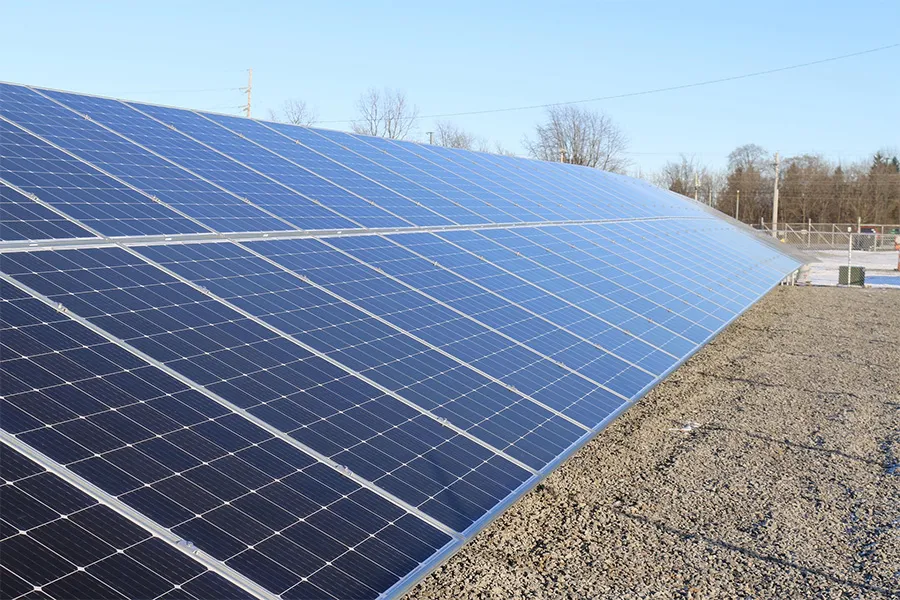
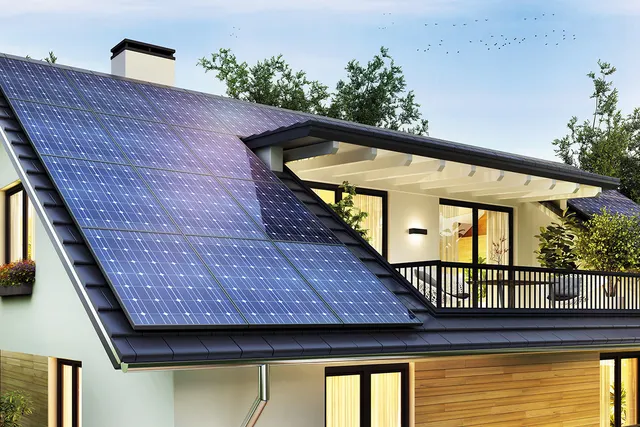
The Flemish requirement for businesses, defined in the legislation as non-residential buildings, with annual electricity consumption of more than 1,000 MWh to generate some of their electricity locally using rooftop solar panels, with the threshold set at 250 MWh a year for public-sector businesses, was due to take effect on 30 June this year, but following a critical opinion from the Council of State, the start date was moved to 1 April 2026. The deadline has been postponed, but the requirement is certainly not being dropped. Flanders is serious about making the use of sustainable energy, that is, electricity from renewable sources, compulsory across its territory. The Flemish Government has already introduced several other rules to encourage both businesses and individuals to integrate renewable energy into their buildings.
Everyone agrees that the shift to sustainable energy is a necessary structural transformation of our energy supply. Fossil fuels, once the engine of industrial growth, are not only a finite resource, they also impose an environmental cost that is becoming increasingly difficult to ignore. By using sustainable energy from renewable sources such as the sun, wind, water and biomass, we can avoid increasing pressure on scarce resources and drastically reduce CO2 emissions. These renewable sources are also available locally, reducing dependence on imports.
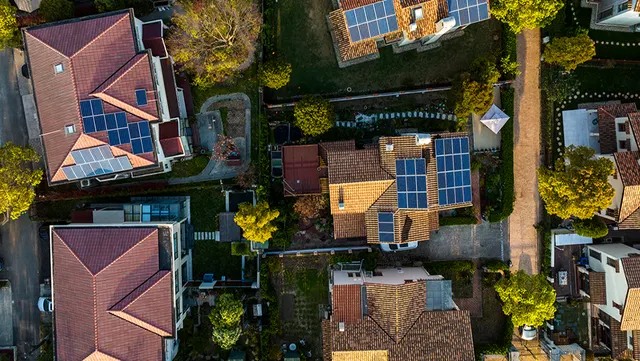
The Flemish Government recognised this several years ago. A range of rules are now in force in Flanders to encourage both businesses and individuals to integrate renewable energy into their buildings. For example, since 2014, Flemish Energy Performance regulations have required new-build projects and major energy renovations to meet a minimum share of renewable energy. This share has gradually increased over the years. From this year, a new-build home must generate at least
15 kWh/m² of renewable energy per year to obtain planning permission, while a non-residential building must generate at least 20 kWh/m². In practice, this is usually solar energy, whose technology has become significantly cheaper in recent years while continuing to improve in efficiency.
From 2025, permits for new-build projects in Flanders will also be refused if they include a gas connection. Buildings may be heated only via a heat network, a biomass boiler, a heat pump or direct electric heating. In the latter two cases, the electricity required may of course still come from fossil fuels, but these systems are in any case ready to run on renewable electricity.

Businesses account for half of electricity consumption
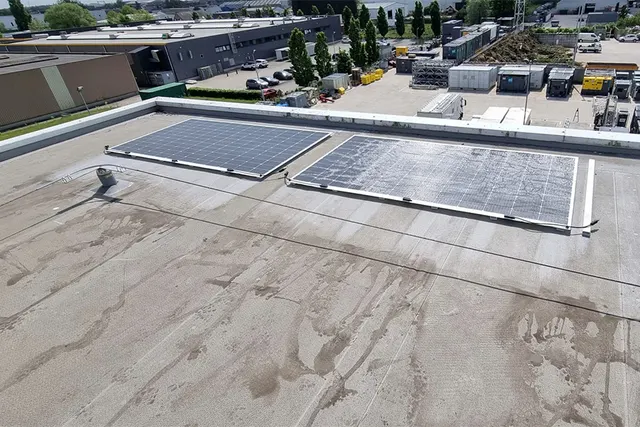
From 1 April 2026, businesses in Flanders with annual electricity consumption of more than 1,000 MWh, classed as large consumers, will also be required to generate some of their electricity using rooftop solar panels. The threshold for public-sector businesses is 250 MWh a year. This is a logical next step: although businesses account for more than half of electricity consumption in Flanders, their share of solar energy production is far lower than that of households. Yet large business sites often have extensive roofs that are technically suitable for solar panel installations. Businesses covered by the requirement can invest in the panels themselves, or involve a third party through, for example, an energy performance contract or an operating or finance lease. In all cases, the solar panels must be installed on the business’s own roof.
For context, 1,000 MWh, equivalent to a capacity of around 115 kW, is a relatively high threshold for a typical SME. In practice, the requirement will therefore mainly apply to logistics centres, industrial sites, large retail chains and public institutions with high energy consumption.
The requirement, set out in the Flemish Energy Decree, was originally due to take effect on 30 June 2025. However, on 2 May this year, the Flemish Government decided to move the start date to 1 April 2026. This followed a critical opinion from the Council of State. No specific complaint had been lodged: as is customary with draft decrees, the Flemish Government had requested an opinion. The Council found that the proposed deferral arrangements in the requirement, which would in certain cases have given businesses until 1 July 2026 to comply, lacked a sufficient legal basis. The Flemish Government therefore decided to postpone the entire requirement for all large electricity consumers until 1 April 2026, to avoid administrative complexity.
But what share of solar energy must businesses generate? This is determined by the available roof area, as the requirement explicitly concerns installing solar panels on the roofs of business premises. The roof area must be at least 500 m², although this additional condition will naturally be met by most large businesses. The roof must also be technically suitable for solar panels, with sufficient load-bearing capacity, suitable solar exposure and no excessive shading. Otherwise, the requirement does not apply.
The installed solar panel system must have a minimum capacity of 12.5 Wp, or watt-peak, per m² of horizontal roof area. The requirement stipulates that this figure must rise to 18.75 Wp/m² by 1 January 2030 and reach 25 Wp/m² from 1 January 2035.
Subject to certain conditions and approval, businesses covered by the requirement may also invest in other forms of renewable energy, such as new or refurbished wind turbines, combined heat and power (CHP), heat pumps or a stake in new green energy projects. Businesses that fail to comply on time risk a fine. The fine has provisionally been set at 400 euros for every kilowatt-peak (kWp) of capacity missing. Businesses that act quickly may also benefit from grants, although it remains to be seen how long the funding pots will remain open.
The Flemish Government has also indicated that a similar requirement may follow for businesses with medium-level energy consumption.

A new field of work for installers
The solar panel requirement opens up a new field of work for installers, as well as designers and other construction professionals. Solar panels, once merely an option, are now becoming an integral part of energy planning for large businesses.
To conclude, although the forthcoming solar panel requirement may feel like a tight constraint for some businesses, in practice it will undoubtedly act as a catalyst for greater sustainability. This applies both environmentally and, certainly, economically: by generating their own renewable energy, businesses become less dependent on the public electricity grid and can reduce their energy costs over time. The solar panel requirement therefore marks not only a policy shift, but also an opportunity for businesses to help build a more resilient and climate-friendly Flanders.
Question about this story? Ask your question
Keep following this
Get an email when a new story is published. No account needed.
- ThemeEnergy generation and smart use
- SubjectSolar