Silent climate control at NAVIGO Visserijmuseum thanks to bespoke textile ducts
Text Wouter PolspoelImage Atelier Debeaussaert/ Filip Dujardin
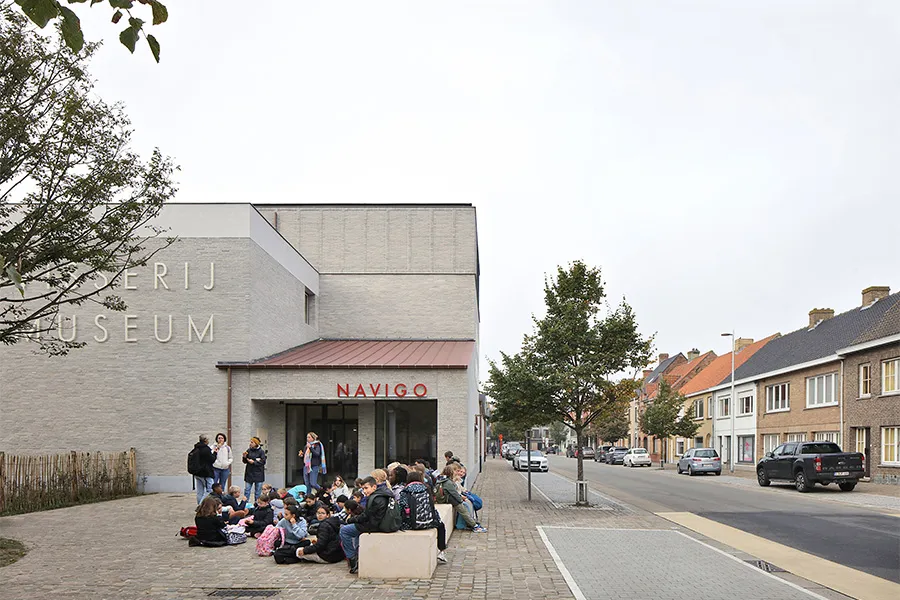
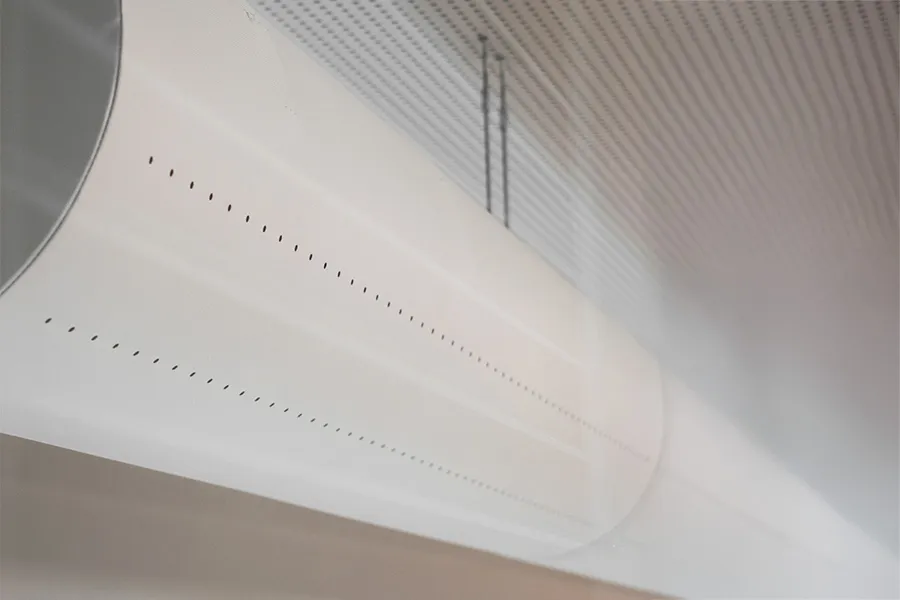
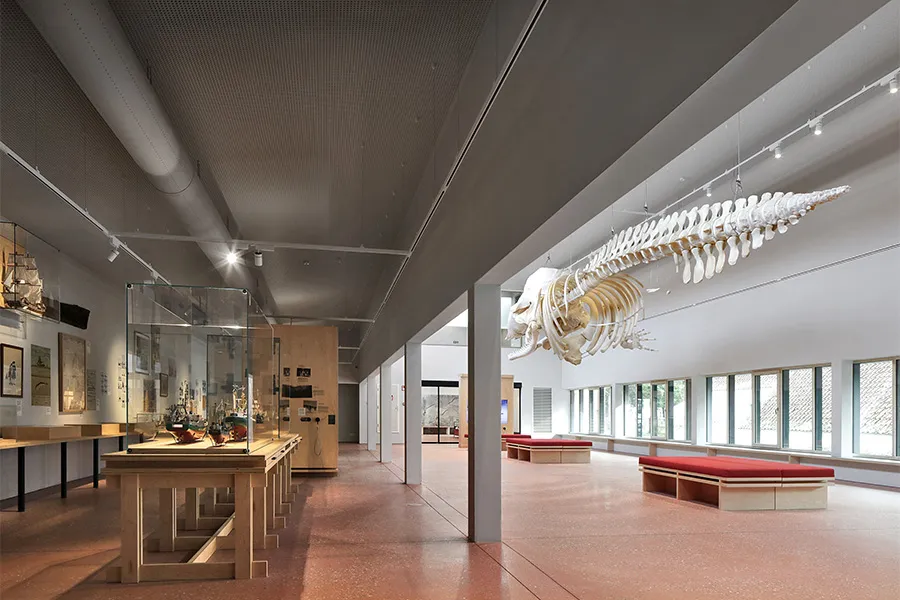
NAVIGO Visserijmuseum in Koksijde reopened in September 2024 following an extensive renovation and extension. Prihoda supplied textile ducts for ventilation, cooling and heating in two areas as part of the redevelopment, including the new wing built to display the impressive skeleton of a sperm whale. “The brief was to distribute 9,000 cubic metres of air per hour as evenly and quietly as possible. Polyester air socks with a combination of micro-perforations and larger perforations enabled us to provide a bespoke solution,” says Gaëton Vanpoucke, account manager at Prihoda.
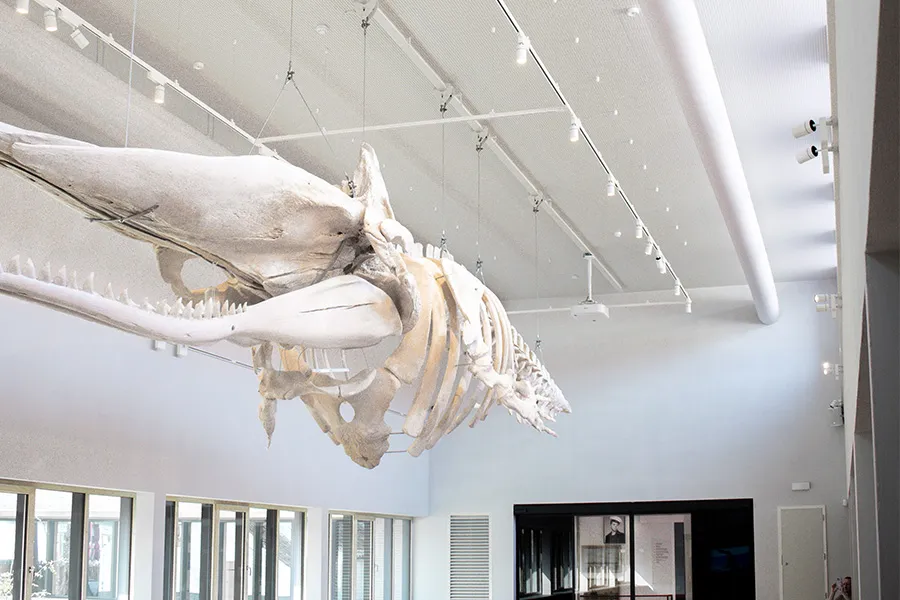
Schoonackers engineering consultancy in Ursel acted as the link between NAVIGO Visserijmuseum and Prihoda. “We are regularly contacted by engineering consultancies specialising in building services, and that was the case here too,” says Gaëton Vanpoucke. “Schoonackers, which already knew us from an earlier project, brought us in to supply textile socks for heating, cooling and ventilation in two areas of the renovated NAVIGO Visserijmuseum, including the sperm whale hall, the new wing where the 13-metre-long, one-tonne skeleton of the famous sperm whale Valentijn was to be displayed.”
The sperm whale washed ashore 35 years ago in Oostduinkerke, a district of Koksijde. The municipal council decided to bury the animal so that its skeleton could be put on display later. In 2019, after the carcass had been in the ground for 30 years, the skeleton of Valentijn the sperm whale was excavated. Until it was suspended in NAVIGO Visserijmuseum in autumn 2024, the skeleton was in the good hands of Professor Pieter Cornillie and his team at Ghent University. They took it apart, cleaned and bleached it, studied it and finally reconstructed it.
No chance of condensation
“The brief was to distribute 9,000 cubic metres of air per hour as evenly and quietly as possible,” Gaëton Vanpoucke continues. “At Schoonackers’ request, we helped calculate the duct layouts for air diffusion in the two areas and carried out the necessary simulations, covering airflow, noise, pressure and more. In the end, polyester textile socks, our standard premium fabric, with a combination of micro-perforations and some larger perforations of at least 4 mm, proved the most suitable solution for the project requirements. Polyester provides excellent sound attenuation. This sets us apart from other ducting options, which are often made from materials that conduct sound. The micro-perforations also help the textile socks operate quietly. Another key difference is that, in projects where the textile socks are also used for cooling, as in this one, we always use moisture-permeable fabrics. This prevents condensation, so there is no need to insulate the socks.”
Easy to install
According to Gaëton Vanpoucke, installing the textile ducts was no great effort for installer Peter Gits. “And not just because he is familiar with our solutions,” the account manager explains. “All our textile socks are easy to install. They are supplied ready for installation, and because textile socks weigh far less than aluminium or plastic air ducts, they can be hung in no time.”
Growing popularity
Gaëton Vanpoucke has noticed that the solutions are being used more frequently and believes he knows why. “Firstly, the benefits of textile socks for air distribution are becoming more widely known. As well as operating quietly and being easy to install, they are highly efficient. They also have a long service life: two years ago, we began offering a 20-year warranty on our ducts, and I believe they can last even longer if properly maintained. I recently saw a Prihoda installation from 1997 that was still working perfectly. In addition, the price of textile ducts has risen less sharply in recent years than that of many other building materials.”
“We can also see this growing popularity in the number of estimators we have: we added two more last year to keep up with demand. Since this year, our estimators have also been using new software, which we have integrated into our sales process. We can now create everything in 3D, simulate airflow even more precisely and export DXF files as DWG. I don’t want to exaggerate, but we’ve noticed that the software is really the talk of the town in our sector.”
Wider range of applications
The growing use of Prihoda solutions has also led to their adoption in a wider range of settings. Gaëton Vanpoucke says: “About 15 years ago, our focus was mainly on the food industry, with our antibacterial fabrics. But our textile ducts are now also used in schools, swimming pools, sports halls, theatres, libraries and museums. We are not active in the B2C market, however.
“What’s more, we are no longer active solely in the HVAC market, but also in refrigeration, with our DefrosTex sock, which helps speed up the defrosting of evaporators in cold rooms. It’s a recent development that shows Prihoda is an innovative company,” he concludes.
Een zakelijke vraag aan Linumgroup / Prihoda? Get in touch
Who worked on it
NAVIGO Visserijmuseum in Koksijde, renovatie
- Engineering consultancyStudiebureau Schoonackers
Keep following this
Get an email when a new story is published. No account needed.
- ProjectNAVIGO Visserijmuseum
- ThemeHealthy air and summer comfort
- SubjectVentilation
- CompanyStudiebureau Schoonackers
- CompanyLinumgroup / Prihoda