Heat pump sales up 30%, fossil-fuel boilers lose almost 15% of the market
Sector sees clear shift in the Belgian heating market
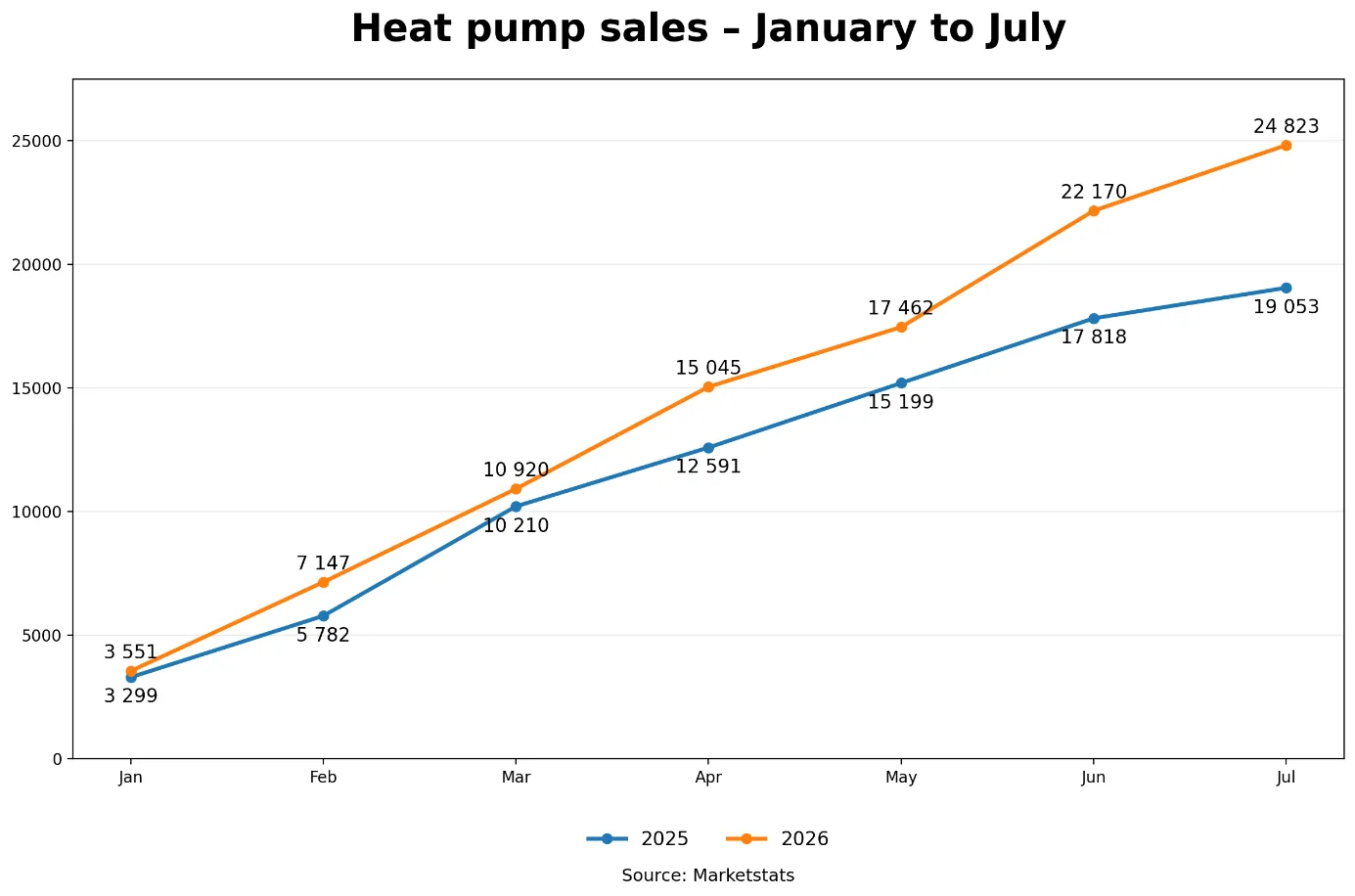
While air conditioning attracted most attention during the recent heatwave, an equally notable development was under way in the Belgian heating market. The latest figures from Marketstats, the partnership between Climafed, BtecCH, Frixis and Gas.be that tracks sales of heating appliances in Belgium, show that 24,823 heat pumps for central heating were sold in the first seven months of 2026. That is 5,770 more than in the same period last year, an increase of 30.28%. At the same time, sales of fossil-fuel heating appliances fell by 14.81%. Air-to-water heat pumps are seeing particularly rapid growth.
The figures confirm the recovery in the heat pump market that began to emerge tentatively last year. From January to July 2025, 19,053 heat pumps for central heating were sold. This year, the figure for the same period is 24,823.
“After a challenging period for the heat pump market, we are now seeing clear and sustained growth again,” says Patrick O, Public Affairs Manager at Climafed. “One good month does not tell us much, but growth of more than 30% over seven months is significant. Particularly as sales of fossil-fuel heating are falling at the same time.”
July confirms the trend
The monthly figures point in the same direction. In July 2026, 2,653 heat pumps for central heating were sold, compared with 1,235 in July 2025. That is an increase of almost 115%.
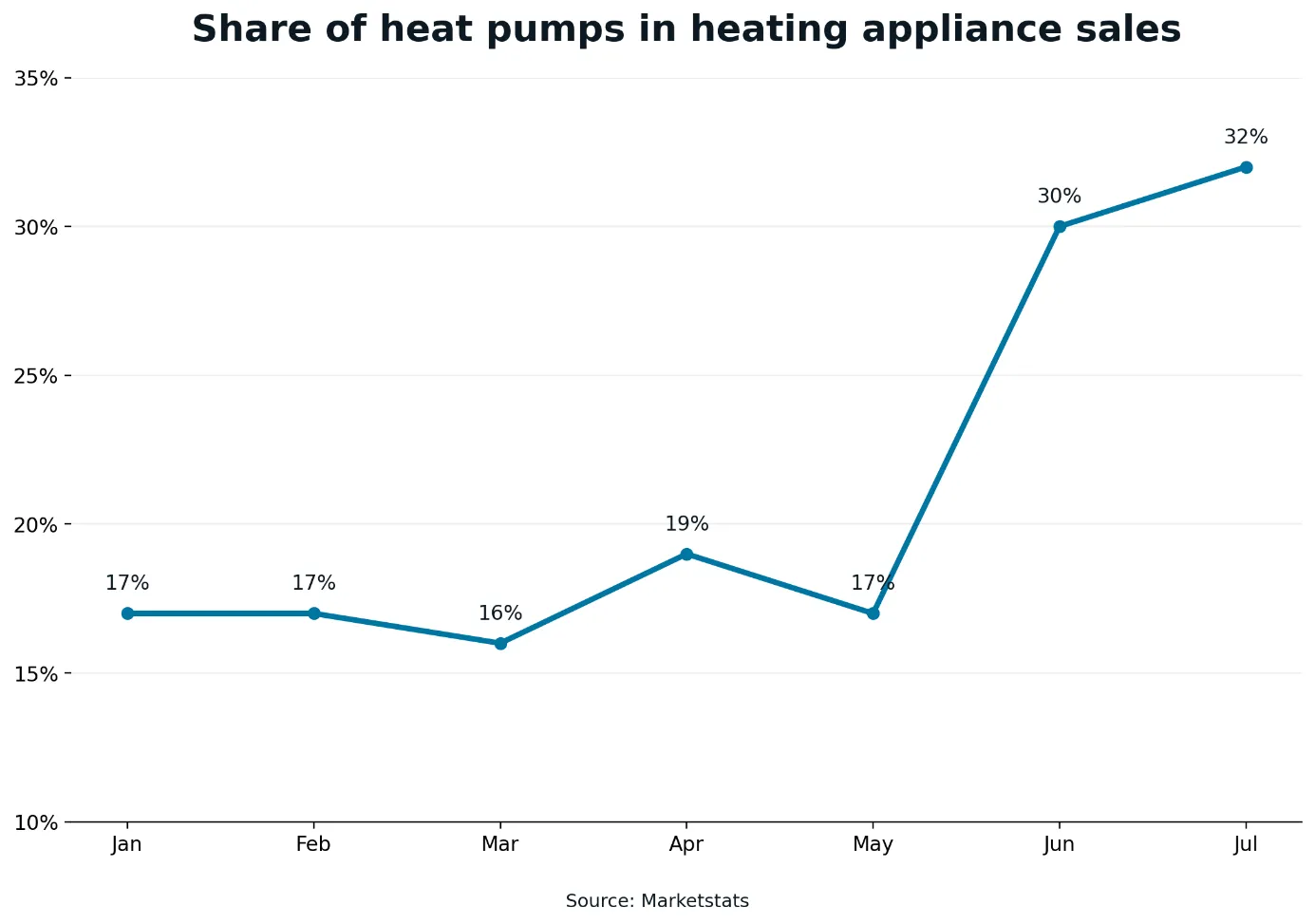
In July, heat pumps accounted for almost 32% of heating appliances sold. However, monthly market shares can fluctuate significantly, partly because of project-based deliveries, stock movements and seasonal effects. The sector therefore focuses primarily on figures over a longer period when assessing market developments.
Sales of fossil-fuel appliances are falling at the same time. In the first seven months of 2026, 100,239 fossil-fuel heating appliances were sold. That is 14.81% fewer than in the same period of 2025. This combination of more heat pumps and fewer fossil-fuel appliances is making the market shift increasingly visible.
“What is interesting is not just the growth in heat pumps,” says Herwig Coppens, chair of Frixis. “We are also seeing fossil-fuel heating lose ground. When both trends occur side by side, the heating market gradually begins to look different.”
Air-to-water heat pumps lead strong growth
Air-to-water heat pumps account for the largest volumes. In the first seven months of 2025, 15,935 units were sold. In the same period this year, the figure was 21,114, an increase of around 32.5%.
Within this category, the strong growth of monobloc systems stands out in particular.
From January to July, 6,120 monobloc air-to-water heat pumps were sold, compared with 3,382 in the same period last year. That is an increase of almost 81%.
Split systems remain the largest category for now, with 14,994 units sold. Last year, the figure was 12,553, representing growth of more than 19%.
Water-to-water heat pumps are also growing: sales rose from 3,117 units in the first seven months of 2025 to 3,709 this year, an increase of around 19%.
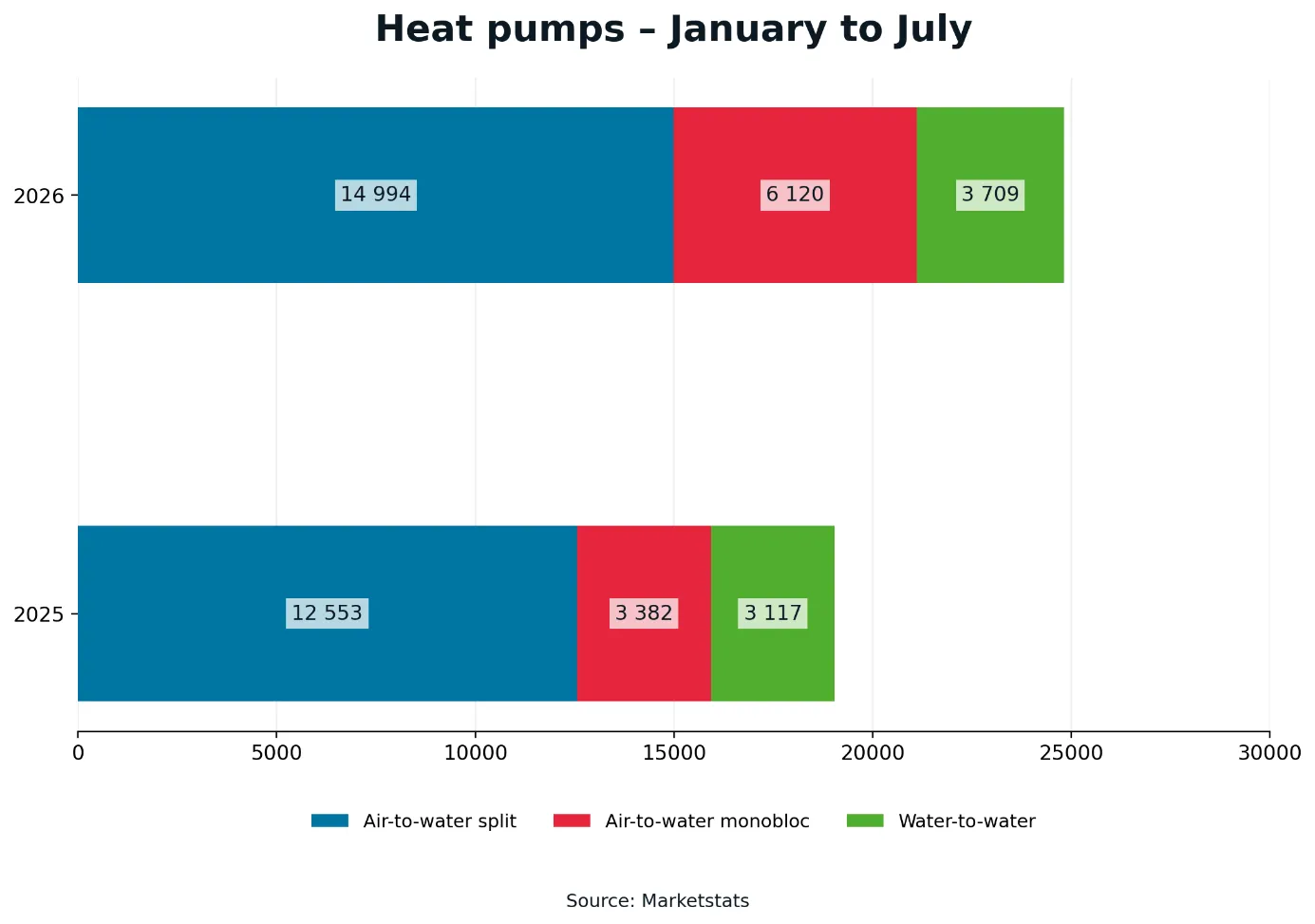
This is also changing the balance within the air-to-water market. In the first seven months of 2025, monobloc systems accounted for around 21% of air-to-water heat pumps sold. This year, the figure is around 29%. So the air-to-water heat pump market is not only growing: within it, monobloc systems are currently gaining ground much faster than split systems.
Propane propels monobloc growth
According to the sector, the rapid switch to propane (R290) as a refrigerant may also be contributing to this development.
The European F-gas regulations are further phasing out the use of refrigerants with a high climate impact. Manufacturers are anticipating this and bringing increasing numbers of appliances using natural refrigerants to market. In air-to-water heat pumps, propane is used mainly in monobloc systems.
However, the current sales figures should be interpreted with caution. The phase-out of certain F-gases may also temporarily result in increased sales of existing stocks of older appliances. Figures in the coming months will show how structural the shift is.
“Customers are already taking into account what will be standard in a few years’ time,” says Patrick O. “Propane is increasingly being chosen deliberately, particularly for projects. This is directly reflected in the growth of monobloc systems.”
Split systems will not disappear overnight. They still account for the largest volume, and many appliances using F-gases remain on the market. But the sales figures do show how quickly the balance is changing.
“Technology is evolving particularly rapidly at the moment,” says Herwig Coppens. “For installers, that also means their knowledge and training need to keep pace. The appliances growing strongly today are not necessarily the same systems the sector mainly worked with a few years ago.”
Heat pump water heaters also return to growth
Alongside heat pumps for central heating, heat pump water heaters are also worth noting. In July, 1,356 heat pump water heaters were sold, compared with 838 in July last year. That is an increase of almost 62%. Across the first seven months, sales rose from 8,891 to 9,688 units, or almost 9%.
According to Climafed, the potential of heat pump water heaters remains insufficiently well known. The appliance uses heat pump technology specifically to produce domestic hot water and can, among other things, offer an energy-efficient alternative to a conventional electric water heater.
“Heat pumps are rightly attracting a great deal of attention today, but this sometimes leaves heat pump water heaters under the radar,” says Hans Van der Perre, secretary of Climafed. “Yet when replacing an electric water heater, a heat pump water heater can be an effective way of significantly reducing electricity consumption for domestic hot water.”
From recovery to market shift
The figures for the first seven months do not yet allow conclusions to be drawn for the full year. But growth over seven months, combined with falling sales of fossil-fuel heating appliances, points to a broader trend than one exceptionally strong month. At the same time, temporary market effects, such as the clearance of appliances using older refrigerants, may affect the figures.
“That is why we would rather not call it a definitive breakthrough just yet,” concludes Patrick O. “But it is clear that this is more than a temporary uptick. Heat pumps are gaining ground, fossil-fuel heating is losing ground, and the technology within the heat pump market itself is changing rapidly. The coming months will show how far this shift continues.”
More information about heat pumps is available at InfoWarmtePomp.be.
Climafed is the Belgian federation for climate technologies. It brings together manufacturers and importers offering energy-efficient solutions for heating, hot water, cooling and ventilation, with the aim of reducing CO₂ at the lowest possible cost to society.
Frixis is the Royal Belgian Association of the refrigeration, heat pump/air conditioning and air treatment sector. It is the only trade association bringing together all installers, manufacturers, importers, distributors, training centres, schools, consultancies and experts in the refrigeration and air treatment sector in Belgium.
InfoWarmtePomp is a joint initiative by Belgian heat pump manufacturers and distributors affiliated with Climafed and Frixis. It provides impartial, up-to-date information for consumers, installers and policymakers.
Marketstats is a joint initiative between Climafed, BtecCH, Frixis and Gas.be. It regularly collects and publishes sales figures for boilers, heat pumps, solar water heaters and other products, and provides context for them.
Question about this story? Ask your question
Companies in this story

Keep following this
Get an email when a new story is published. No account needed.
- ThemeFossil-free heating and cooling
- SubjectHVAC
- CompanyGas.be