Grid congestion and electric vehicle charging create new opportunities for installers
Text Lieke BousemaImage reev

The transition to a more sustainable society brings major challenges, both for building owners and for installers, who are facing increasingly complex energy issues. “Many installers are no longer just the people who install solar panels or EV charge points. They are also becoming advisers to companies looking to become more sustainable,” says Jordi Steenman, country manager Benelux at reev. “By presenting and positioning themselves in this way, and using the right tools, they can increase recurring revenue, improve operational efficiency and provide more proactive support to customers in maintaining and optimising utilisation rates.”
“In the early years of electric vehicle charging, it was mainly company directors and sales representatives who started driving electric cars, with zero benefit-in-kind tax and the convenience of charging them at their company premises,” says Jordi Steenman. “There was no grid congestion, and in many cases solar panels generated enough power to meet EV charging demand. In the years that followed, we saw more and more electrical installers pioneering the EV charging market, sometimes in combination with solar panels and on-site energy storage. Some even built their business model around it and have since reaped the rewards. In more and more places in our country, it has become impossible to secure a grid capacity upgrade. Instead, alternative solutions are needed that qualify for subsidies and provide enough power for the entire electric vehicle fleet. These solutions also require expertise and the right hardware and software tools.”
‘Value Added Partners’
According to Jordi Steenman, electrical installers have three options in 2025: they can sit back, focus on another segment, or see developments as an opportunity and position themselves as advisers to companies. “The same applies to PV installers, who are increasingly exploring the energy storage and EV charging markets as demand for solar panels declines. Both electrical and PV installers can become ‘Value Added Partners’, whom we are keen to support and empower. For example, with the reev Dashboard and reev Balancer (energy management).
Intelligent energy management
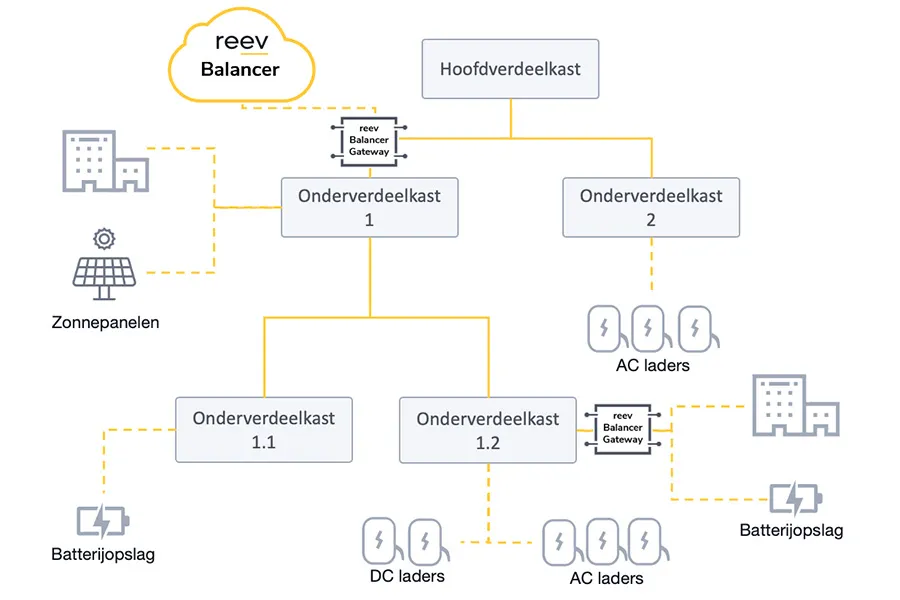
Reev Balancer enables available power to be distributed across all charging points according to exact requirements, using an OCPP (Open Charge Point Protocol) communication protocol. “Our energy management system prevents consumption peaks during day-to-day operations and makes cost-effective use of available power,” says Jordi Steenman. “Our software lets us connect and manage multiple new or existing charge points from different brands, both AC and DC. We can also proactively support customers in optimising utilisation rates and make expansions straightforward. Now that EVBox has unfortunately ceased trading, there are major opportunities for us and for installers to build on the vast number of charge points already in the field. Our solutions can defer the gradual replacement of these charge points until the right time. We can also take over the entire billing process if required.”

A clear advantage
“The basic principle of EV charging remains the same: electric vehicles need to be fully charged at the right time,” says Jordi Steenman. “But maximum available capacity, ageing infrastructure, plans for expansion, the right balance between DC and AC charging, Dynamic Load Balancing, and the need for different tariffs for different users all bring new challenges. We are also seeing more and more companies looking to integrate their EV charging data into their fleet management systems, or asking about possible connections to battery storage and solar systems. Electrical and PV installers who can advise on these issues have a significant advantage, especially if they can manage charge point availability and charging capacity intelligently and keep the future in mind. Grid congestion is unlikely to ease in the coming years.”
Supporting installers
Reev was founded in 2018 by a group of installers and now has 7,000 customers and 50,000 charge points. “Our founders’ roots are firmly embedded in the way we think and work,” says Jordi Steenman. “We are delighted to work with installers who install one or a few charge points and run our software on them. But we are also the go-to partner for installers managing hundreds or even thousands of charge points. We support both groups with onboarding and installing our software products, as well as with any subsequent expansions or replacements. We also offer installers the opportunity to become dedicated partners, with access to remote monitoring, proactive troubleshooting and performance optimisation. Our smart tools can, for example, make it possible to install more charge points. They also help make better use of surplus solar power. If a charging station unexpectedly goes offline, the installer receives an immediate alert so they can take the appropriate action. This keeps installers and their customers fully in control.”
Several new features will be added over the coming year. According to Jordi Steenman, algorithms will make it possible to achieve even higher uptime for charge points. The platform will also support energy trading on the imbalance market. Want to know how? We’ll be happy to tell you more in a forthcoming issue.
Een zakelijke vraag aan reev? Get in touch
Companies in this story

Keep following this
Get an email when a new story is published. No account needed.
- ThemeElectrical infrastructure under pressure
- SubjectElektroTech
- Companyreev