The opportunity of e-mobility for installers
Text and images Techlink
Vehicle electrification (EVs) is gaining considerable momentum, with charging infrastructure a crucial element in the energy transition. “Smart charging” is seen as a way to maintain grid balance by providing flexibility. Choosing a particular charging station and installing it are tasks for the installer. In April 2023, Techlink conducted an online survey to find out to what extent its installation companies use EVs and offer charging solutions to their customers.
Greening the company car fleet
As with any innovation, there are “early adopters” and a large group who are only convinced of its potential benefits later on. EVs are no different. 28% of respondents (business owners) currently drive mainly plug-in hybrids, and to a lesser extent 100% EVs (16%). 34% do not yet have an EV at all. “In my dealings with business leaders, I find that there are still many questions about taxation, regulations, technology and range, the still significantly higher purchase price and the more limited choice in the lower-priced market segment, uncertainty about charging infrastructure and the electricity tariff to be used, … all of this means that business leaders are still somewhat hesitant,” says Vincent Vancaeyzeele, Technology and Innovation Manager at Techlink.
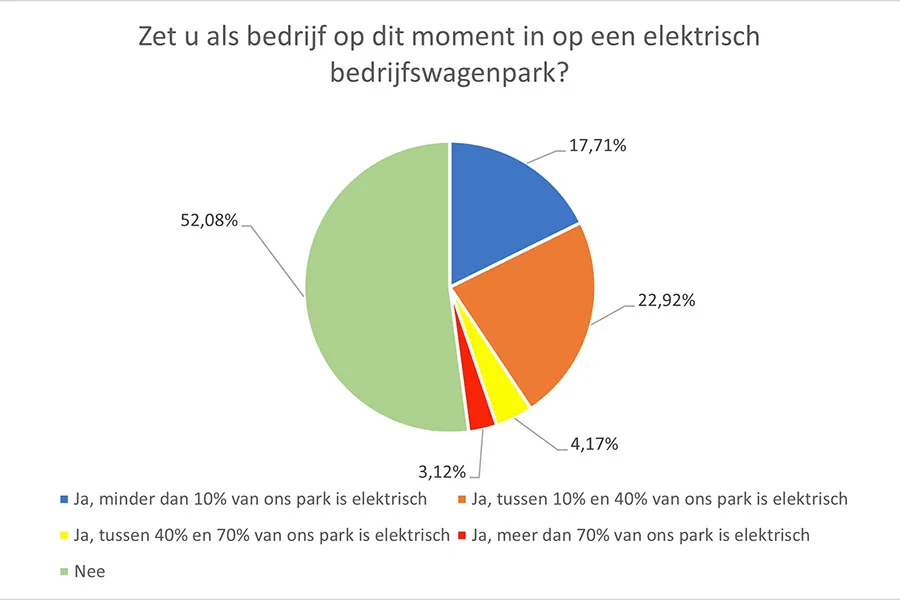
Graph 1 shows that around 48% of respondents are currently investing in an electric company car fleet. We can say that we are in a transition phase, with companies set to make definitive choices soon as they feel the impact of higher taxes on company cars and fossil fuels (e.g. diesel and petrol) become more expensive in the future.
The presence of charging infrastructure is often linked to the business owner having a vehicle that needs a charging point. But in a few years, many employees and visitors to companies will be driving electric vehicles. Company cars purchased from 2026 onwards will only be tax-deductible if they are electric. Charging infrastructure in a company car park could soon become essential for mobility. That is why it is important to carry out proper studies from the outset, including assessing the charging capacity required and available on site, so that the company’s infrastructure is ready for the future.
To integrate EVs into fleet management, companies need to make their car policy electric. However, 73% of respondents do not have an adapted car policy. The main reasons given are that the fleet is too small, there is not enough time to develop one, or it is simply not a priority. “An electric fleet requires a broader mobility strategy. The mobility mix (EVs and public transport) has a significant impact on the composition of the company car fleet and on parking and charging policy. As a thought leader in the energy transition, Techlink is not only working internally to green its own fleet and provide the associated charging infrastructure. This autumn, Techlink will also make an e-learning course on “Green in the car policy” available to its members,” says Lucine Albertian, HR Manager & Senior Legal Advisor at Techlink.
EV charging point installer
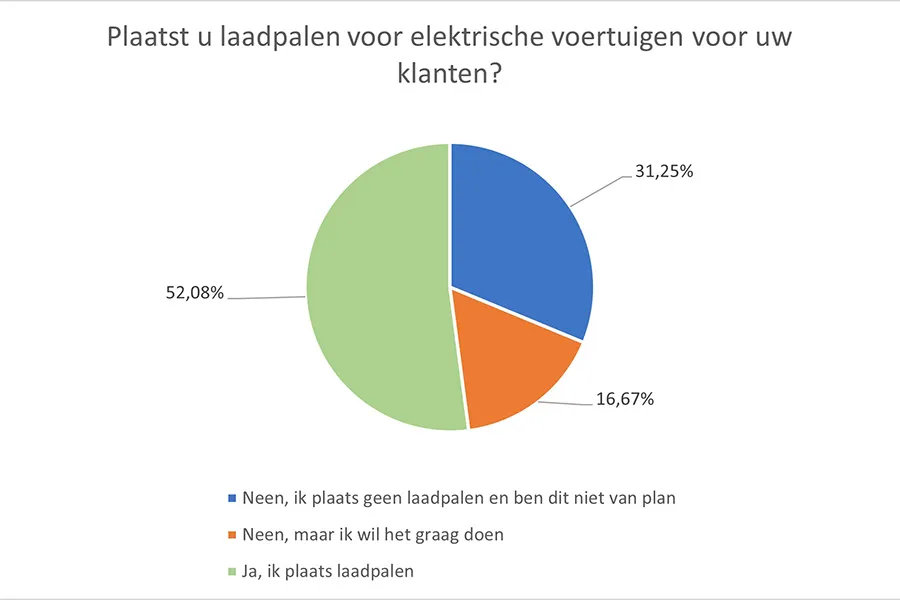
Smart charging solutions for EVs undoubtedly represent a major opportunity for installers. 52% of respondents say they install EV charging points (see Graph 2), and more than half of them started doing so in the past 2 years. Their customer base is evenly split between private and business customers, with a slight majority of B2B customers. Charging points are electrical installations that require a professional’s technical expertise. Their installation is, after all, always tailored to the specific situation. One size does not fit all when it comes to charging points, so installers need the expertise to choose the best solution for every situation.
“In response to the significantly increased ambitions of governments as a result of the obligations arising from the Green Deal, we are seeing our installation companies actively seek the expertise and skills needed to provide the charging infrastructure required to meet these ambitions. These skills are essential to enabling the transition to electric mobility. The main challenges are installing this infrastructure safely and in accordance with the AREI regulations for electrical installations, ensuring EV fire safety in car parks, and managing large-scale charging infrastructure in line with the capacity available on distribution networks,” says Eric Piers, CEO of Techlink.
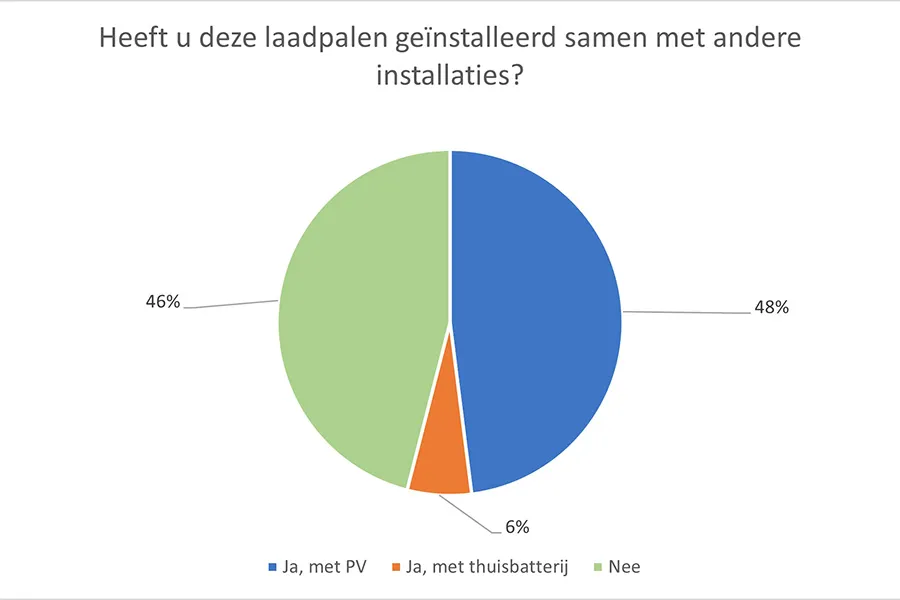
Charging points are playing an increasingly important role in integrated sustainable energy systems. The combination of PV panels and EV charging is becoming more common. Graph 3 shows that 48% of respondents install charging points alongside PV. Charging directly from your own solar power, or using battery storage when the sun is not shining, makes sense and offers cost benefits.
“Transport electrification will play an important role in integrating increasing amounts of renewable energy into the energy system. However, the flexibility that large numbers of EVs can provide through their batteries can only be harnessed if we act now on “smart charging” and system integration. It is crucial to avoid lock-ins by installing “dumb” charging infrastructure that cannot be used as part of an integrated energy system. It is clear that electric mobility can only play its full part in the energy transition if it happens not only quickly, but above all intelligently,” says Vincent.
Conclusion
In Techlink’s vision document, LINK2030 (www.link2030.be), the “War For Talent” is identified as one of the biggest challenges facing the ecosystem of multifunctional installations. To deliver the energy transition in the field of installation, we need a sufficient influx of young talent.
Techlink has found that companies not yet installing charging points would consider doing so if they could find more well-trained staff. This is particularly challenging in the current Belgian context of staff shortages in these jobs in sustainable installation technology, and sometimes limited IT skills. This can be seen as an obstacle to the energy transition.
“Techlink is fully aware of this, which is why we launched an awareness campaign at Install Day 2022 to encourage young people to pursue technical training. Through our Install Tomorrow campaign (www.installtomorrow.be), we are playfully challenging clichés and encouraging young technical talent to inspire others by highlighting the enjoyable aspects of their jobs. Installation is a team effort. So is campaigning! Technical jobs in our sector are incredibly rewarding and offer huge variety. The more visibility we generate, the more interesting and attractive our sector will be to everyone who works in it or wants to,” concludes Eric.
Question about this story? Ask your question
Keep following this
Get an email when a new story is published. No account needed.
- ThemeElectrical infrastructure under pressure
- SubjectElektroTech