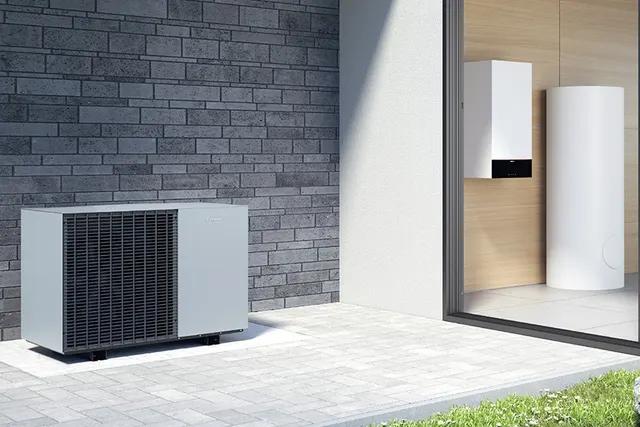
How can we make our heat supply more sustainable?
Text Eva Goossens
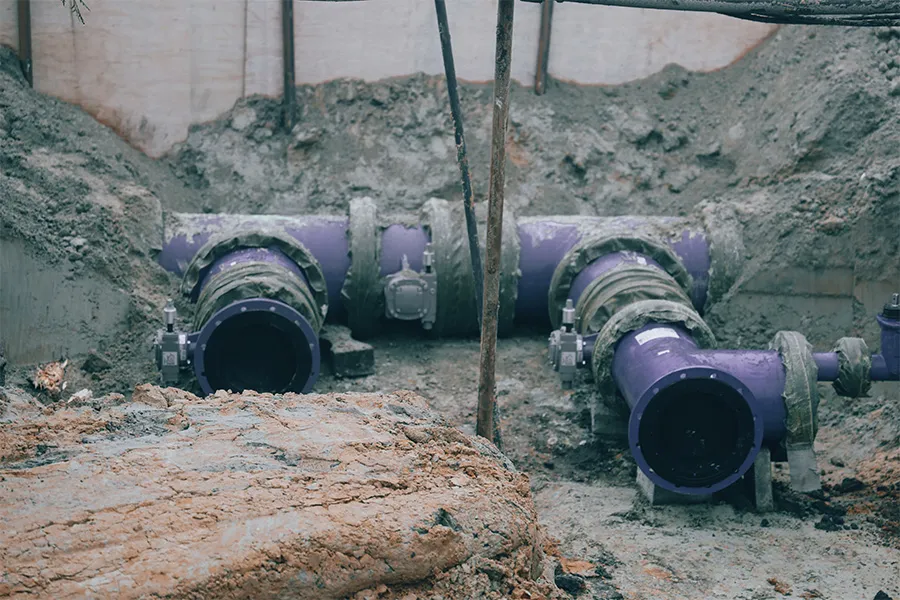
Making heat more sustainable is a major challenge in the context of 2050 and the energy transition. Individual heat pumps are one part of the picture, but the further roll-out of district heating networks in Flanders can also make, and will continue to make, a significant contribution. District heating networks are not a sustainable heat source in themselves, but they are an ideal means of bringing heat from large-scale, collective sustainable heat sources to our homes, offices, schools and other buildings.
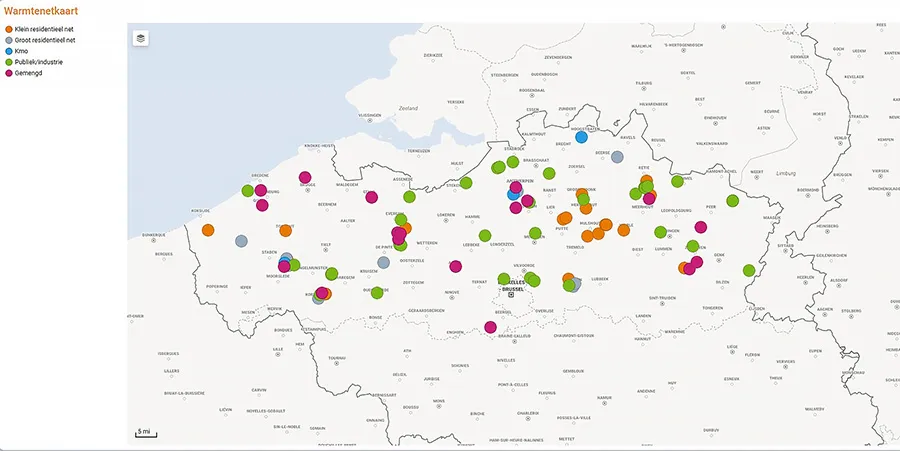
Compared with countries such as those in Scandinavia, Flanders still has considerable catching up to do when it comes to district heating networks. But there has been real progress in recent years. The VREG reports 84 registered district heating networks, which supplied exactly 1,139 GWh to 6,823 end users in 2021, and that number continues to grow.
District heating
Heat accounts for more than 50 per cent of energy consumption in Flanders, making it the largest component. For households, heating accounts for as much as three-quarters of energy consumption. It is no surprise, then, that there is considerable potential to make it more sustainable. District heating networks are one way to do this. Also known as heat networks, they use an underground system to transport heat from one or more large heat sources outside to heat customers. These sources may be conventional fossil fuels such as natural gas, which is still more efficient than individual boilers, but district heating really comes into its own when renewable energy or waste heat is used. It is also possible to combine different heat sources or switch to a different, more sustainable source over time. What is the potential? “The European STRATEGO study calculated that district heating networks could meet 40 to 65 per cent of heat demand in various European countries. In 2015, VITO conducted a cost-benefit analysis for the Flemish Region. It found that a network supplied with waste heat could cost-effectively meet 62 per cent of total heat demand in Flanders. This is particularly worthwhile in densely built-up town and city centres, as well as for heat exchange in industrial areas,” says Warmtenetwerk Vlaanderen. There are plenty of opportunities, then.
Making use of waste heat
There are many potential heat sources, including waste heat. Like many other cities, Ghent has a district heating network supplied by a waste incineration plant. The ‘De nieuwe Dokken’ neighbourhood, in turn, receives waste heat from the neighbouring company Christeyns, among other sources. The City of Antwerp has announced new heat sources for its southern district heating networks, including waste heat from Umicore in Hoboken. Another example is the Warmte Verzilverd network, which uses industrial waste heat from the Agfa-Gevaert factory in Mortsel and now supplies heat to the new-build Zilverkwartier and Minerve projects. Existing buildings have also been connected. It is therefore a misconception that district heating networks are only suitable for new-build properties.
Renewable energy
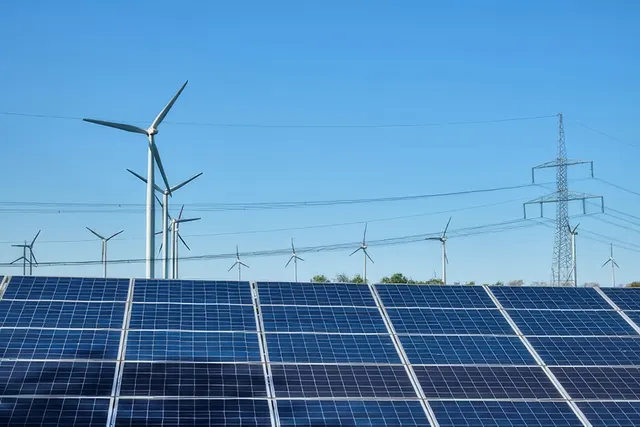
There are also several renewable energy sources to choose from, including shallow and deep geothermal energy, bioenergy and solar thermal energy. Germany, for example, already has successful district heating projects using solar energy. Around 50 large-scale solar thermal heating networks are in operation. Construction has begun in Groningen on the largest solar thermal park, which will supply heat to the district heating network. Closer to home, an innovative district heating network is being developed in Anzegem, West Flanders. The De Voerman site will have a network supplying heat to around 30 homes and a number of SMEs in winter, and cooling in summer. The most unusual aspect of the project is that heat and cooling will be extracted from De Watergroep’s main drinking water pipeline, which runs past the site. Brecht Vermeulen, chair of De Watergroep, explains: “De Watergroep aims to be energy-neutral by 2030. We are also happy to make our infrastructure available to facilitate the energy transition in Flanders. We see this as a pilot project that will help us gain experience with larger district heating networks, and we are actively promoting the concept to property developers.” Watch this space.
Sources: warmtenet.ode.be; De warmtegids, March 2022, published by VVSG and VEKA; Report on district heating network activity at the VREG in 2021-2022; www.vlaanderen.be
Question about this story? Ask your question
Keep following this
Get an email when a new story is published. No account needed.
- ThemeFossil-free heating and cooling
- SubjectSustainable energy