An innovative, affordable alternative to a home battery
Text Wouter PolspoelImage ClimaWays

The arrival of the digital meter marks the end of the benefit of the reversing meter when solar panels generate a surplus. Solar panel owners who do not want to give their surplus green electricity back to the grid for free can invest in Solvis PV2Heat, a solution for creating a thermal battery that can be easily integrated into a heating system, including an existing one, and offers an affordable alternative to a home battery. Jef Schelkens of ClimaWays, distributor of Solvis PV2Heat, explains how it works.
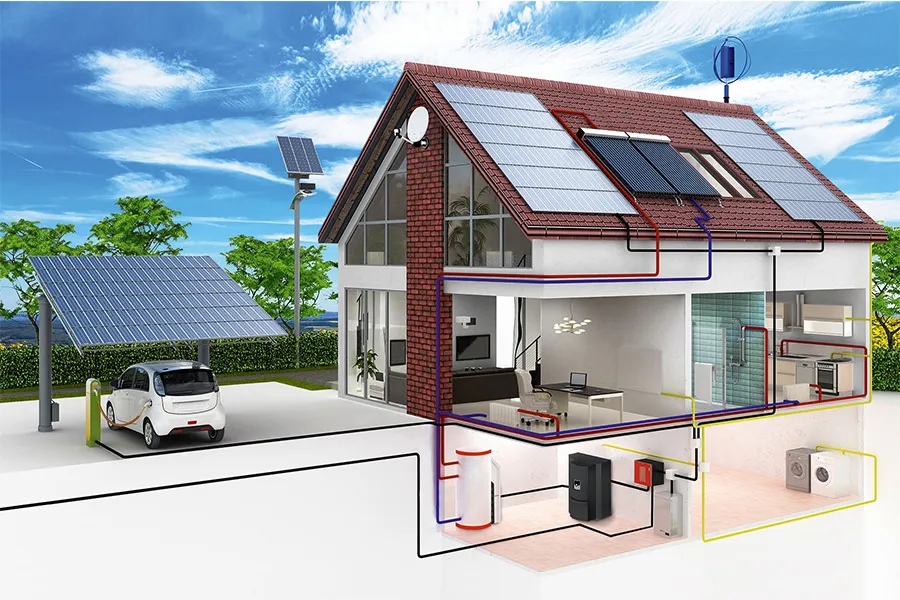
“Solvis PV2Heat is a hydraulic unit that converts surplus electricity from solar panels into heat via a heating element. The heat can then be stored in a gas- or oil-fired boiler with a stratified buffer tank, such as our SolvisBen or SolvisMax,” Jef Schelkens begins. “The boiler can then use the heat to produce hot water.”
In the case of SolvisBen or SolvisMax, this is not just domestic hot water, but technical hot water. “In other words, the boilers can be used not only to heat domestic water, but also as a source for underfloor heating or radiators,” says the managing director. “This means much more of the electricity generated by the solar panels is used on site than in a system that only provides domestic hot water.”

Stratified buffer tank
He explains exactly how the Solvis PV2Heat module works with SolvisBen or SolvisMax boilers, which differ only in output and capacity. The SolivisBen has a buffer capacity of 230 litres, while the SolvisMax is available with a capacity of 450, 750 or 950 litres. “The buffer tank in the SolvisBen and SolvisMax has two layers. The upper section acts as a conventional buffer tank, kept warm by the built-in oil or gas burner so that technical hot water is always available when required. The water in the lower section of the buffer tank remains cold and is heated exclusively by Solvis PV2Heat, using a power-controlled heating element, when the solar panels are generating a surplus. Solvis PV2Heat measures in real time how much electricity the solar panels are generating and how much is being used at that moment. It therefore prevents surplus electricity from being fed back into the grid and stores it as heat in the stratified buffer tank. When the solar panels are not generating electricity, the built-in burner provides the heat. The bottom section of the buffer tank thus acts as a thermal battery: it is never heated by the burner, only by free energy from the solar panels.”
Useful all year round
According to Jef Schelkens, the greatest savings are to be made in the spring and autumn shoulder seasons and during the summer, but he stresses that Solvis PV2Heat is useful all year round. “Water heated using surplus electricity from the solar panels stays properly warm for only a few days, of course. That may not sound like much, but you would be surprised how much difference this smart reserve makes to your energy consumption over the course of a year. In summer, and especially in spring and autumn, temperatures can change quickly: you may have plenty of sunshine during the day, but it can still get quite cold in the evening. You can then use the surplus solar energy stored during the day to switch on the heating for a while or take a hot shower in the evening, at no cost. That makes a real difference to your energy bill.”
Finally, Jef Schelkens underlines that SolvisBen and SolvisMax are ideal for use in multi-energy systems, helping to future-proof your installation. “There are three ways to use the boilers,” he explains. “They can operate as gas- or oil-fired boilers, or use heat from a district heating network, and only start up when there is a heat demand. They can also use their buffer tank to store heated water or solar energy for later use. Finally, they can be part of a hybrid heating system combining gas, oil, wood, heat pumps, solar thermal energy and/or heat from a district heating network. The intelligent system always selects the most efficient energy source at that moment. This versatility means that both SolvisBen and SolvisMax, with or without Solvis PV2Heat, offer maximum flexibility. They are easy to expand and can be combined with any energy source, helping you to be fully prepared for the future,” the managing director concludes.
Een zakelijke vraag aan ClimaWays BVBA? Get in touch
Companies in this story

Keep following this
Get an email when a new story is published. No account needed.
- ThemeEnergy generation and smart use
- SubjectSustainable energy
- CompanyClimaWays BVBA