











Passive cooling with a ground source heat pump: an expert explains
Text Wouter PolspoelImage Itho Daalderop en iStock
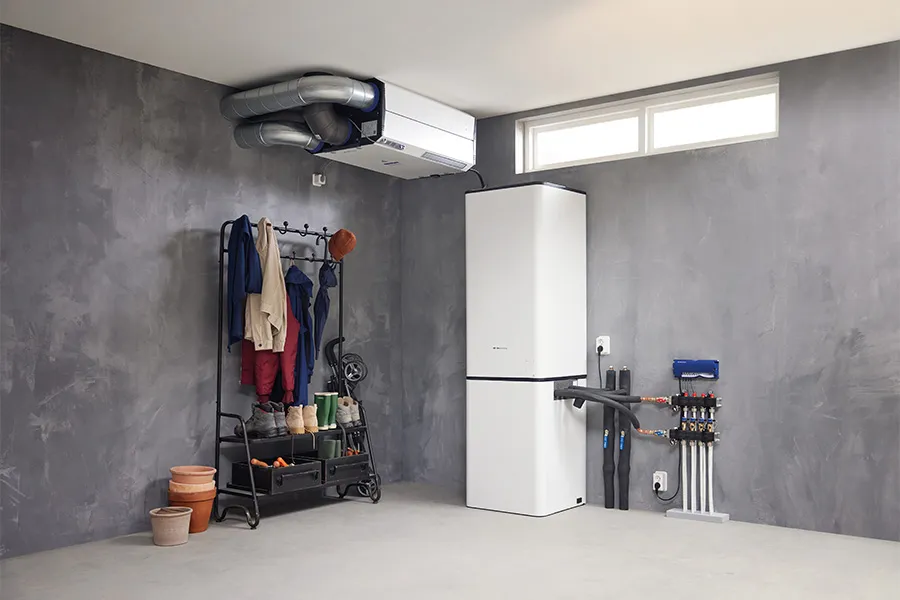
A ground source heat pump can do more than heat a building: it can also provide passive cooling. But what exactly does that involve? How does passive cooling differ from active cooling? And why is passive cooling considered sustainable? Olivier Van Vooren, business developer at Itho Daalderop, sets out the facts and explains how Itho Daalderop is seeking to make a difference in passive cooling with its ground source heat pumps.
“With passive cooling, the ground source heat pump, or more precisely a water-to-water heat pump, uses the natural temperature of the ground to cool the building without switching on the compressor,” explains Olivier Van Vooren, who is also a geothermal product specialist at HVAC solutions developer Itho Daalderop. “Only two small circulation pumps run, with almost negligible energy consumption. That is the fundamental difference from active cooling, the best-known example of which is conventional air conditioning. Passive cooling also produces no condensation.”
“Geothermal systems make use of the ground temperature, which remains relatively constant throughout the year, between 7 and 12 °C,” he explains. “With passive cooling, the ground source heat pump uses this ground temperature to cool the water circulating through the heat emitters, such as underfloor heating, fan coil units or chilled ceilings. This is done via a water loop in the ground. The cool water then draws heat from the indoor air, and that heat is carried away to the ground through the same water loop. All this happens without the heat pump compressor having to run or consume electricity. When operating in passive cooling mode, a heat pump effectively works in reverse to heating mode: instead of extracting heat from the ground, which is possible in winter because the ground is often warmer than the air, it returns excess heat to the ground. The difference is that the heat pump does not need to operate during passive cooling.”

Extracted heat remains available
According to Olivier Van Vooren, the sustainability of passive cooling lies not only in its exceptionally low, almost non-existent electricity consumption. “With active cooling, the heat removed from the building is released into the outside air. With passive cooling, the ground acts as thermal storage,” he explains. “Heat removed from the building in summer is transferred to the ground and stored around the ground loop, without disrupting the average ground temperature. In winter, this stored heat can then be used alongside the ground’s natural heat to warm the building. The ground effectively acts as a natural seasonal battery: what you put in during summer, you take out again in winter. This prevents thermal imbalance in the ground circuit, even with frequent passive cooling.”
Itho Daalderop’s ground source heat pumps offer an additional advantage. Olivier Van Vooren explains: “Our units come with an integrated cooling heat exchanger as standard, whereas some brands offer this as an optional extra. The integrated cooling heat exchanger also switches on automatically as soon as passive cooling is needed. With most geothermal systems, users have to activate passive cooling manually. As a result, cooling often starts too late: by then, the indoor temperature is so high that it is difficult to bring it back to a comfortable level using passive cooling.”
Thanks to this automatic control, Itho Daalderop’s heat pumps also offer a higher cooling capacity than the market average. “We deliver up to 22 W per m², while standard installations often manage only 12 to 16 W per m²,” says the business developer.
Tangible comfort
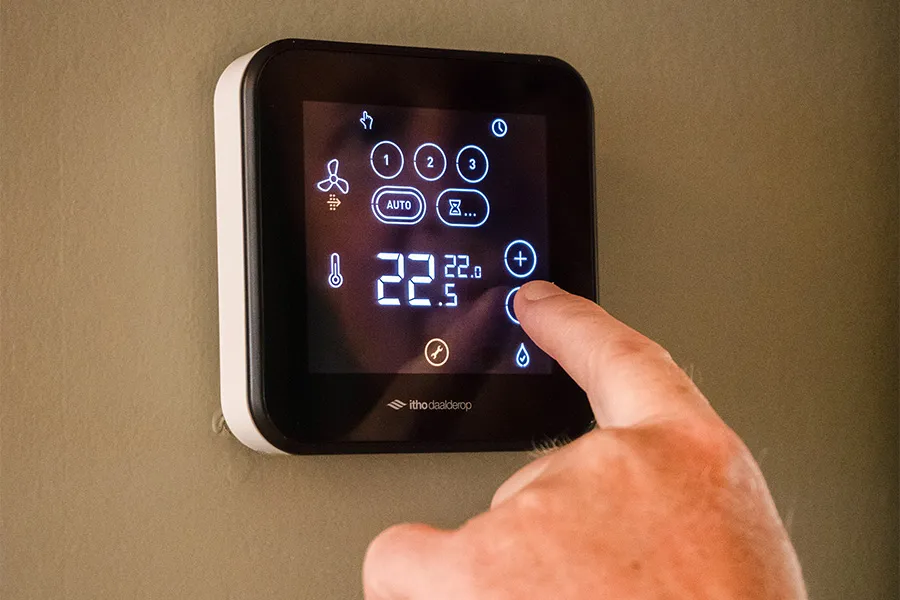
Olivier Van Vooren also wants to qualify a frequently heard claim about passive cooling. “I mean the idea that active cooling systems can achieve lower indoor temperatures than passive cooling,” he says. “That is true: passive systems are not designed to deliver the same cooling performance as conventional air conditioning. But comfort is about more than the thermometer reading,” he stresses. “With passive cooling through underfloor heating, heat is transferred directly to the body by conduction. A cooler floor therefore often feels fresher than cool, dehumidified air. Passive systems also avoid draughts and noise, two drawbacks that can occur with air conditioning.”
According to Olivier Van Vooren, passive cooling is gaining ground, partly thanks to energy performance regulations. “Passive cooling contributes to a better EPC rating, which is a decisive factor for many clients. And with increasingly stringent insulation standards and hotter summers, some form of cooling is simply essential,” he concludes.
Have a business enquiry for Itho Daalderop? Get in touch
Companies in this story

Keep following this
Get an email when a new story is published. No account needed.
- ThemeFossil-free heating and cooling
- SubjectHVAC
- CompanyItho Daalderop







