











How AI could fundamentally reshape the plumbing and HVAC sector
Text Wouter PolspoelImage STG en AI
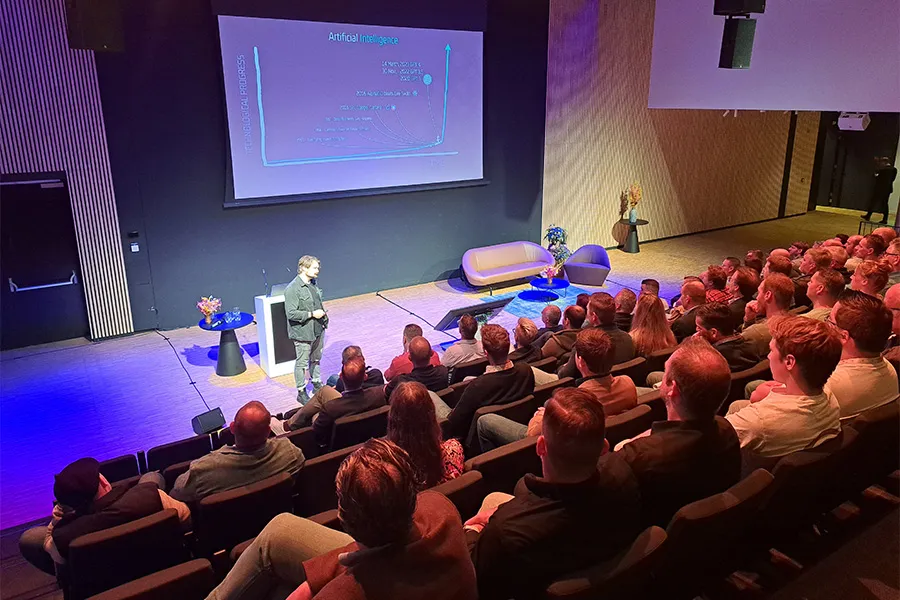
At the first edition of EXPO24, a trade fair organised by STG for plumbing and HVAC professionals, one of the highlights was a keynote on artificial intelligence (AI) by Aragorn Meulendijks. The Dutch speaker outlined how AI could fundamentally reshape the plumbing and HVAC sector. That prompted us to explore the topic in a little more depth.
AI is evolving at an extraordinary and exponential pace, continuing to astound the world with its capabilities. Aragorn Meulendijks, an AI expert, put the expected evolution into perspective in his keynote. “Over the next 4.5 years, we will see the equivalent of a hundred years of technological development and its impact on society and the economy,” he said.
According to him, the first effects of AI are already visible in the plumbing and HVAC sector. “Over the past year, AI has led to the discovery of no fewer than 2.2 million materials, including cooling fluids that are fully biodegradable. It goes without saying that, in view of climate targets, these will find applications in the plumbing and HVAC sector.”
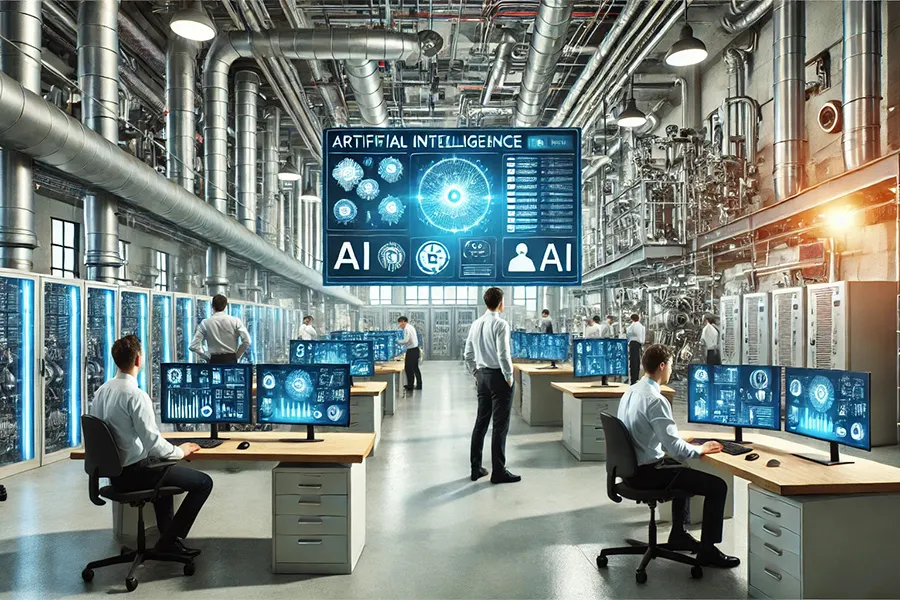
According to Aragorn Meulendijks, AI will also be a way to accelerate manufacturers’ internal processes, prospect more quickly and efficiently, and improve customer service, both in the plumbing and HVAC sector and beyond. Think chatbots that no longer require assistance from a real person. “But AI-run virtual factories are also far from unthinkable,” he added.
Robotics 2.0
Inspired by the keynote, we looked more closely at the role AI could play in the plumbing and HVAC sector, as well as in the installation industry. As we worked through numerous sources and interviews with experts, one particular topic came up repeatedly. It ties in with the virtual factories already mentioned by Aragorn Meulendijks. AI is set to bring about a renaissance in robotics in manufacturing, including mechanical engineering, which is concerned with making machines for industry and private users alike. This includes manufacturers of HVAC systems, as well as suppliers in related sectors such as metalworking and plastics processing.
Robots have been used in manufacturing worldwide since the 1970s, when the use of computers ushered in the third industrial revolution. The first began in the 18th century, driven by the invention of the steam engine, while the second came at the start of the 20th century, with the adoption of electricity and the invention of the production line.
Computers can be programmed and have memory, enabling them to take over tasks from people and automate production processes. The further development of the internet in the 1990s ushered in a fourth industrial revolution. This so-called Industry 4.0 brought further automation of manufacturing processes. In particular, the so-called Internet of Things, or IoT, turned robots into genuine cloud robots. These robots are no longer limited to a single task, like conventional robots, or to working alongside people, like cobots. They can also work with other robots, independently perform human tasks at software level, and suggest optimisations.
AI will now usher in the next step: the development of machines with human-like abilities, such as reasoning, learning, planning and creating. According to experts, these will enable companies to produce customised products at the cost of mass production.
However, HVAC manufacturers in Belgium and their Belgian suppliers still seem to be taking a wait-and-see approach. According to figures from the International Federation of Robotics (IFR), 10,300 robots were installed in Belgium in 2022. That amounts to a ‘robot density’ of 198 robots per 10,000 employees, around a quarter higher than the global average of 141. The IFR says, however, that the automotive industry is largely responsible for this.
Agoria figures also show that the potential for robotics remains considerable in other branches of Belgian manufacturing, including HVAC manufacturers and the plastics processing and metalworking industries. Adoption of robotics, and especially of AI robots, remains particularly cautious.
The same is true in Flanders. A 2023 report by Flanders Make, entitled ‘Towards a sustainable, digital and human-centric industry, 10 key trends in the manufacturing industry’, shows that many Flemish manufacturers are not yet convinced of the immediate benefits and are waiting for a clearer picture of the return on investment before further equipping their facilities with AI-based robots. According to the report, 70% of companies do recognise that this robotics 2.0 will have a major impact on future business operations. They also share the belief that the technology could enable production to be brought back here from countries such as China, because it would allow us to produce more efficiently and therefore more cheaply.
Taking the pressure off end users and installers
AI will also enable HVAC systems themselves to operate more autonomously. By learning adaptively from users, who need to operate them manually only a few times, systems can adjust their behaviour to users’ preferences and then start up automatically when needed, according to their preferred settings. AI-based HVAC systems will also be able to forecast the weather and respond appropriately, manage air quality even better than they do today, and automatically optimise energy consumption. It is clear that AI will give the term smart building an entirely new dimension, with energy savings across the whole building and user convenience reaching unprecedented levels.
AI is also expected to take over certain tasks from installers. Programming a system, for example, will no longer be necessary, and systems will be able to indicate for themselves when maintenance is genuinely needed. This is known as predictive management. Current HVAC systems can often already indicate when maintenance is due, but they do so using schedules set in advance.
More developments to come
But AI undoubtedly has many more developments in store that will affect the plumbing, HVAC and installation sectors. Aragorn Meulendijks is therefore absolutely right when he says that artificial intelligence will continue to astound us every day.
Incidentally, STG, which stands for Sanitair Technische Groothandel, is more than satisfied with the first edition of EXPO24, held on four different days in May and June in Oostende, Heusden-Zolder, Antwerpen and Gent. Across the four days and locations, more than 540 plumbing and HVAC professionals discovered the latest products and other innovations from the leading suppliers exhibiting at the trade fair, around 40 in total. They were also inspired by numerous talks from industry experts and had plenty of opportunities to network.
Question about this story? Ask your question
Keep following this
Get an email when a new story is published. No account needed.
- ThemeSafe and efficient water use
- SubjectHVAC







