The right tap for every building: Delabie showcases bespoke solutions at VSK
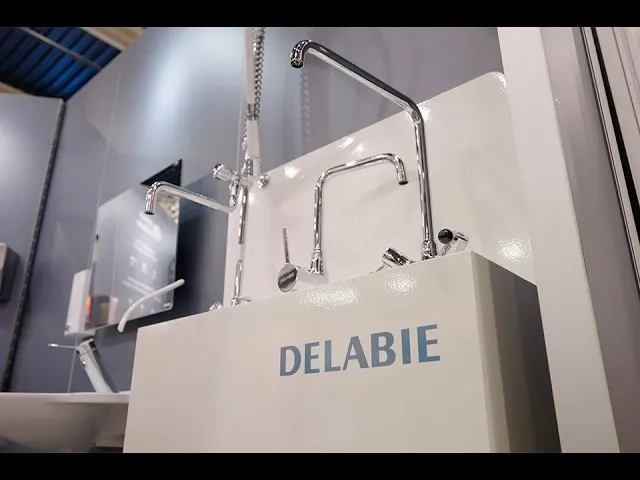
At the VSK trade fair, Delabie presented its water-saving tap solutions for both residential and non-residential buildings. The range includes self-closing taps and electronic sensor taps that use significantly less water than traditional taps.
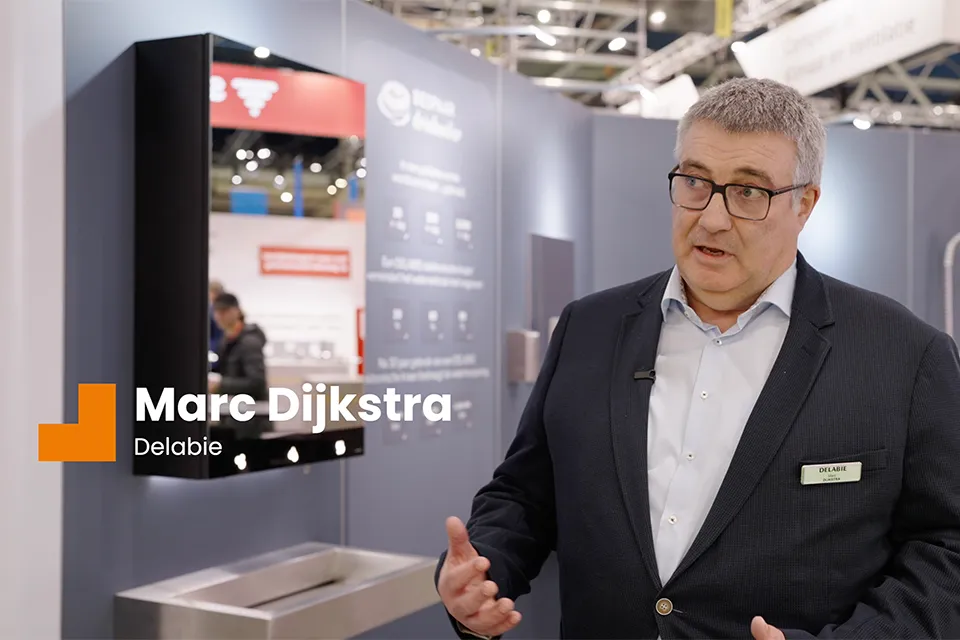
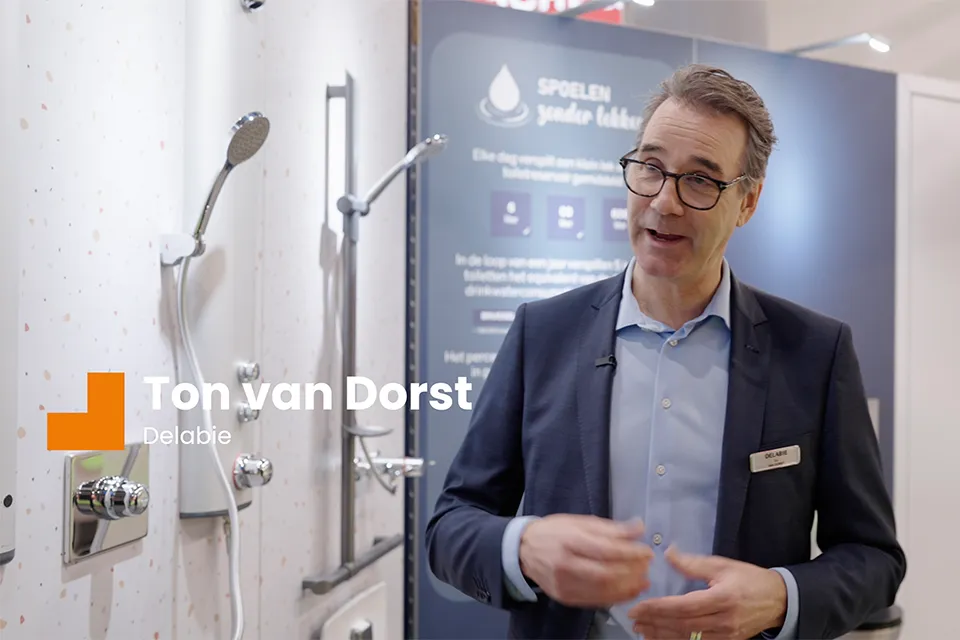
Whereas a standard tap at home often runs unnecessarily while you wash your hands, self-closing and sensor-controlled taps ensure that water flows only when needed. With a lower flow rate and an automatic shut-off function, water savings can reach as much as 80 to 90 per cent. This makes these solutions not only sustainable, but also cost-effective at a time when water is becoming increasingly valuable.
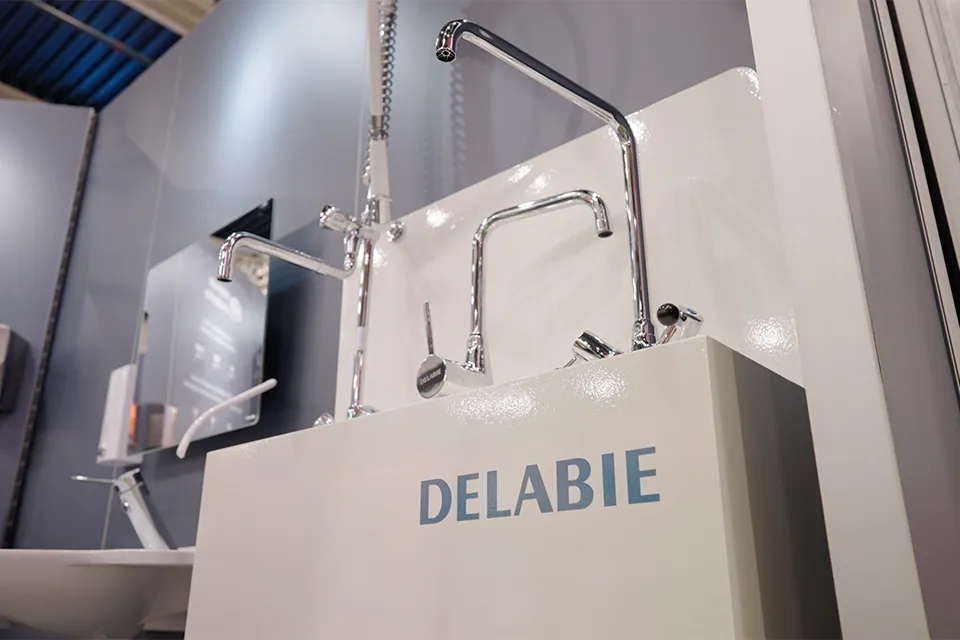
Delabie also stresses the importance of choosing the right solution for each type of building. In non-residential settings, such as offices, schools or airports, taps are used far more frequently than in homes. Products therefore need not only to save water, but also to be robust and withstand intensive use. The focus is on comfort, durability and functionality tailored to the specific application.
A business enquiry for Delabie? Get in touch
Full transcript
00:00:05 – 00:00:07
Delabie has
00:00:07 – 00:00:11
both self-closing and electronic taps,
00:00:11 – 00:00:12
with sensor control.
00:00:12 – 00:00:13
This means that for every
00:00:13 – 00:00:16
wash, you can save 5 litres of water with
00:00:16 – 00:00:17
a basin tap.
00:00:17 – 00:00:21
But overall, you can save 80 to 85, even 90% water
00:00:21 – 00:00:23
compared with a traditional tap at home.
00:00:23 – 00:00:27
Water is getting more and more expensive and valuable, so we need to use it responsibly.
00:00:27 – 00:00:29
And that is what we are trying to achieve.
00:00:29 – 00:00:32
Use as little water as possible, while remaining comfortable.
00:00:32 – 00:00:36
At home, you wash your hands at an average flow rate of 9 litres per minute.
00:00:36 – 00:00:37
You wet your hands.
00:00:37 – 00:00:39
Then you reach for the soap, but the tap keeps running.
00:00:39 – 00:00:41
For 20 seconds, 30 seconds.
00:00:41 – 00:00:44
Then you rinse your hands and turn off the tap.
00:00:44 – 00:00:47
With a sensor tap or a self-closing tap,
00:00:48 – 00:00:49
you wet your hands,
00:00:49 – 00:00:52
lather them with soap and then rinse them.
00:00:52 – 00:00:54
And the flow rate is 3 litres per minute.
00:00:54 – 00:00:55
So that is a huge saving.
00:00:55 – 00:00:57
An 80-90% saving in water.
00:00:57 – 00:01:00
That is why I think it is important to consider the function of the building.
00:01:00 – 00:01:02
Because there is never one solution for all
00:01:02 – 00:01:03
buildings or types of building.
00:01:03 – 00:01:06
There needs to be a specific solution for a specific building and
Read the full transcriptCollapse transcript
00:01:06 – 00:01:08
a specific use.
00:01:08 – 00:01:10
You can see the difference between the products we use at home
00:01:10 – 00:01:12
and the products we use in non-residential buildings.
00:01:12 – 00:01:14
One of the things we see is much more frequent use
00:01:14 – 00:01:17
in non-residential settings. That is one of the biggest differences we see, of course.
00:01:17 – 00:01:19
It is many times higher in non-residential settings.
00:01:19 – 00:01:22
To give you an idea, we use a tap at home 20 times a day.
00:01:22 – 00:01:24
And over that time, the number can rise quite
00:01:24 – 00:01:26
quickly to
00:01:26 – 00:01:28
at least 200 times, and perhaps even at an airport
00:01:28 – 00:01:30
to 14-1,500 times a day.
00:01:30 – 00:01:32
And a product ultimately needs to be designed for that, and
00:01:32 – 00:01:33
it needs to be able to withstand it.
Companies in this story

Keep following this
Get an email when a new story is published. No account needed.
- SubjectVSK+E 2026
- CompanyDelabie