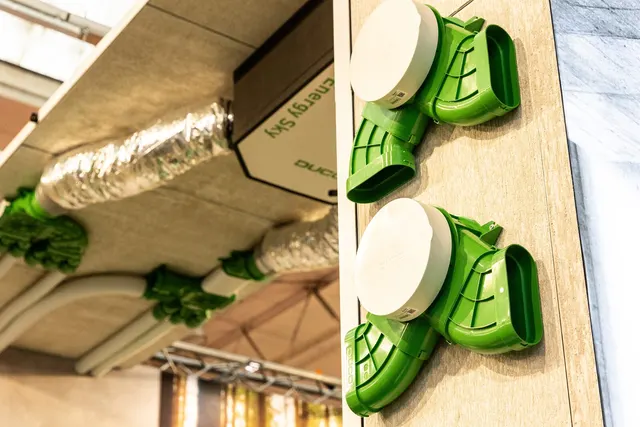
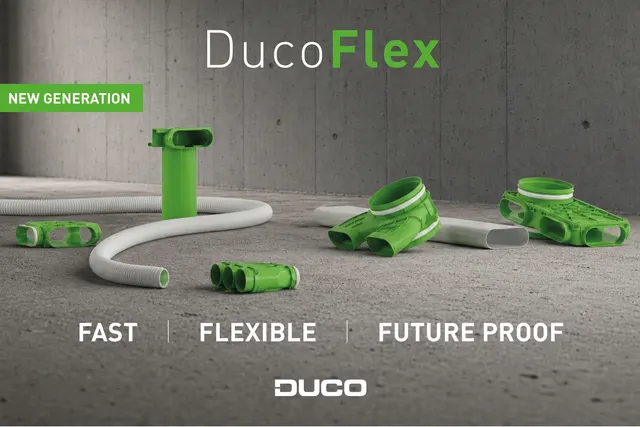
Compact, slim and future-ready: DUCO’s latest heat recovery ventilation solution

At the VSK trade fair, DUCO unveiled its latest innovation: the DucoBox Energy Comfort D250. This compact heat recovery ventilation unit has been specially developed for small spaces such as utility cupboards and kitchen cupboards, and is aimed primarily at small-scale housing projects.
Alongside compactness, connectivity is a key focus. DUCO is investing heavily in smart monitoring, giving residents insight into their indoor climate and supporting installers with maintenance and system balancing. The systems use demand-controlled ventilation based on CO₂ and humidity sensors, with data used to tailor ventilation to residents’ behaviour and needs.
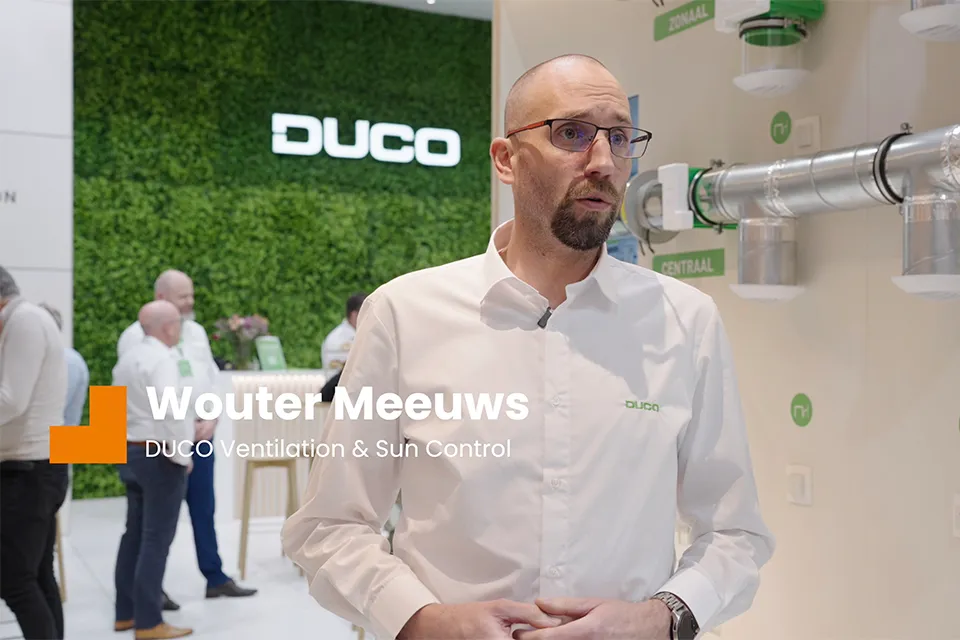
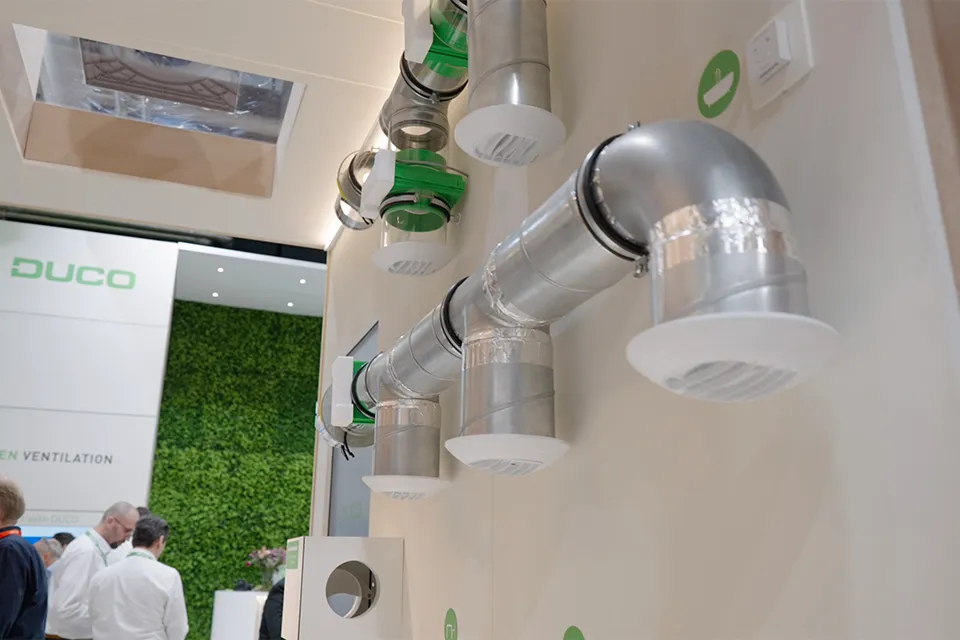
DUCO also offers solutions for renovation projects. Although upgrading to more sustainable systems with new ductwork affects residents, DUCO emphasises the long-term benefits: a healthier and more comfortable indoor climate.
Have a business enquiry for DUCO? Get in touch
Full transcript
00:00:06 – 00:00:08
At this trade fair, we’ve launched our
00:00:08 – 00:00:11
latest development, called the DucoBox Energy Comfort D250.
00:00:11 – 00:00:13
A compact heat recovery ventilation unit,
00:00:13 – 00:00:16
specially developed for installation in small spaces,
00:00:16 – 00:00:19
utility cupboards, kitchen cupboards, you name it, in terms of dimensions
00:00:19 – 00:00:22
And specifically designed for small-scale housing projects.
00:00:22 – 00:00:23
We’ve also recently been doing more
00:00:23 – 00:00:26
with connectivity, which is increasingly
00:00:26 – 00:00:28
high on our agenda.
00:00:28 – 00:00:30
Why? On the one hand, because we want to give residents more insight
00:00:30 – 00:00:33
into what’s happening in their home in terms of the indoor climate.
00:00:33 – 00:00:34
On the other hand, we also want to be able to
00:00:34 – 00:00:38
give installers a clearer picture of
00:00:38 – 00:00:40
the maintenance condition of the
00:00:40 – 00:00:42
systems they have installed. And then we can
00:00:42 – 00:00:44
help them balance the systems.
00:00:44 – 00:00:48
The systems are, of course, generally demand-controlled by design.
00:00:48 – 00:00:50
So we use room CO2 sensors and
00:00:50 – 00:00:52
and/or humidity sensors.
00:00:52 – 00:00:53
We also capture that data, of course.
00:00:53 – 00:00:57
On the other hand, we also look at residents’ behaviour and where the main need
00:00:57 – 00:01:00
lies, so that we can provide good ventilation in the home.
00:01:00 – 00:01:03
In existing homes, you’re simply dealing with
Read the full transcriptCollapse transcript
00:01:03 – 00:01:05
residents who are living there.
00:01:05 – 00:01:07
The homes often need to be upgraded to make them more sustainable
00:01:07 – 00:01:08
with a new duct system.
00:01:08 – 00:01:12
On the one hand, that means residents have to give up some space
00:01:12 – 00:01:15
and, on the other, it also causes some disruption during
00:01:15 – 00:01:16
the entire installation process.
00:01:16 – 00:01:20
Ultimately, you have to convince residents that they’ll be better off in the long term.
00:01:20 – 00:01:22
And all of that ultimately leads to a
00:01:22 – 00:01:23
healthy indoor climate.
Companies in this story

Keep following this
Get an email when a new story is published. No account needed.
- ThemeHealthy air and summer comfort
- SubjectVSK+E 2026
- CompanyDUCO