The thermal imaging camera: an essential tool for heating engineers
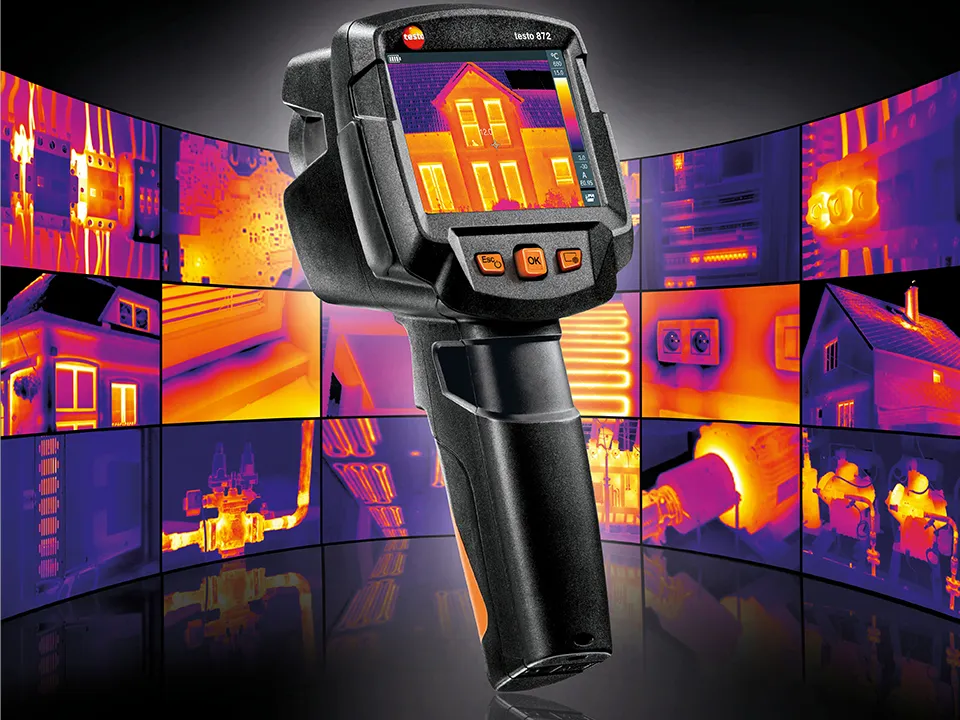
Thermal cameras are increasingly becoming standard equipment for today’s installers.
Specialist Testo offers four cameras of this type in its range. The installer’s requirements will determine which of the four models is the right choice.
Words Filip Van der Elst | Images Testo
A thermal imaging camera can detect leaks, other anomalies and temperature-related faults in, for example, a radiator, pipe or underfloor heating system, without the need for any building work. Koen Van Nieuwenhove, Product Manager HVAC at Testo: “We have been offering thermal cameras for 12 years, but in the early years these devices were particularly expensive. They were used almost exclusively in industry. Now, however, we have an entry-level model starting at €1,000, making it an essential tool for every heating engineer.”
Thermal sensitivity
The Testo 865, 868, 871 and 872 are all accessible thermal imaging cameras that can prove useful. However, there are significant differences between the four models. Image resolution, for example, varies from one camera to another. Another important feature is thermal sensitivity. The Testo 865 has a thermal resolution of 120 mK, equivalent to 0.12 °C. By contrast, the Testo 872 can detect a difference of just 60 mK (0.06 °C). This is an important distinction for an installer looking for, say, a leak in an underfloor heating system. “You can see rising heat much sooner with the Testo 872. The deeper the pipes are, the more sensitive the camera needs to be,” says Van Nieuwenhove.
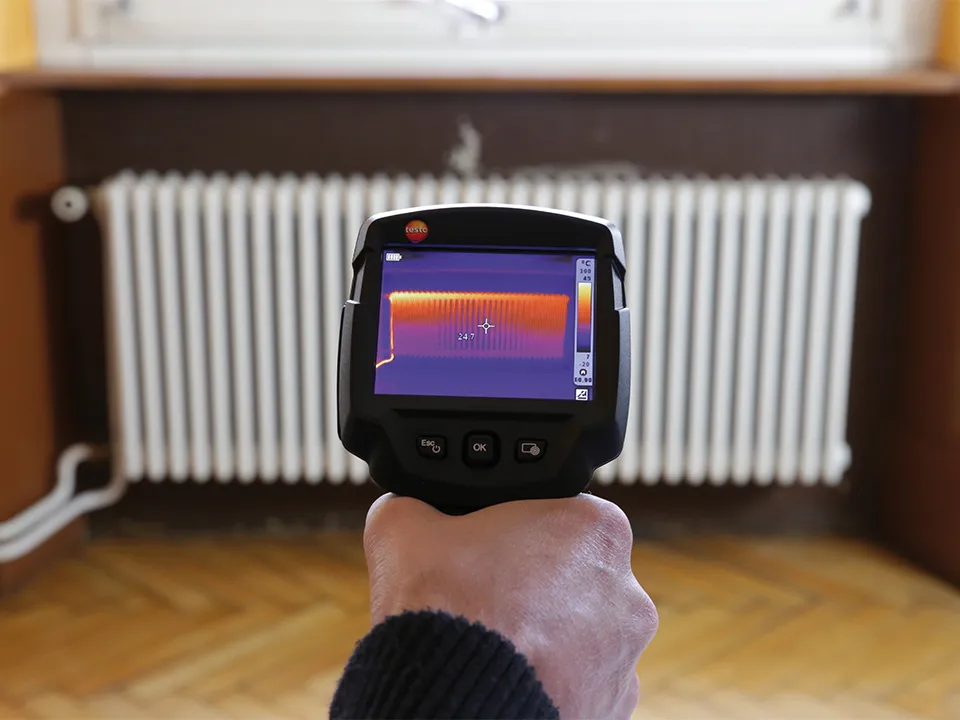
However, installers do not always need the more expensive Testo 872, since thermal sensitivity is irrelevant for some other applications. “For example, when checking the hydraulic balance in a radiator,” says Van Nieuwenhove. “You can see this immediately with a thermal imaging camera, whether its sensitivity is 60 or 120 mK. The Testo 865 is perfectly suitable for this. The same applies when checking for overheating in a fuse box.”
Testo thermal imaging cameras operate fully automatically. Automatic focus gives the installer a clear image straight away. Each image taken by the thermal cameras is saved in two versions: the real image and the thermal image. TwinPix software lets users superimpose the two images. The installer can create a report to show the customer exactly where the problem is.
Knowledge
The thermal imaging camera does not replace the installer, it simply makes their work easier, Van Nieuwenhove adds. “The camera does not tell you where the leak is, but alerts the installer to a potential problem. It is up to the installer to analyse and interpret the situation and the images, drawing on all their experience and knowledge. They must, for example, take a material’s absorption and reflection levels into account. A stainless steel boiler, for instance, has a high reflectivity, which means the installer risks measuring their own body temperature. To avoid this, they need to set the emissivity coefficient correctly.”
Een zakelijke vraag aan Testo NV/SA? Get in touch
Companies in this story

Keep following this
Get an email when a new story is published. No account needed.
- SubjectProduct information
- CompanyTesto NV/SA