Smart lighting is essential for smart buildings

We are all convinced of the benefits of perfect lighting. Better concentration at work, improved overall wellbeing, … When we talk about smart lighting, the focus is often on the potential energy savings. But smart, connected lighting does more than that. It forms the basis of a vast network that gathers data. After all, lighting is everywhere. We can link many of the processes that make a building smart to the data collected.
Smart lighting is a broad term covering a wide range of applications and associated solutions. Just think of all the places where lights are on. Lighting is installed everywhere, and intelligent lighting can prove useful in any setting. Smart lighting comes in countless forms. This means it is always important to consider which form is useful for each application. Everyone is convinced of its benefits, particularly when that conviction is backed up by calculations from recognised bodies.
For example, last year Agoria Vlaanderen calculated that if cities and municipalities switched to smart LED street lighting, they could save €680 million over time. The lighting does not even need to be connected: a fixed dimming schedule is enough to achieve savings of up to 50 per cent. “If we opt for genuinely flexible, remotely controllable connected luminaires, energy savings could rise to 60 per cent,” Agoria calculated. Flemish cities are increasingly turning to smart technology to address challenges relating to mobility, safety, the environment and health (noise and air quality), connectivity and more. A smart lighting infrastructure is the foundation of the smart city of the future, just as smart lighting is the foundation of a smart building.
What does smart mean?
Smart is a subjective concept. Some people consider using presence and motion detection to switch lights on and off to be ‘smart’ already. Others set the bar higher, reserving the term for systems where a whole network of luminaires with built-in sensors is installed and the data collected is used to develop a whole range of processes. Clearly, both examples have their place. Consider the lighting in the toilets or corridors of a large office building. There is no need for a state-of-the-art system to control the lighting smartly in these areas. However, the data collected can be useful for deciding whether or not to send maintenance teams to meeting rooms or even entire floors of an office building. If the data show that a meeting room has not been used all day, the cleaning team can be told not to go in.
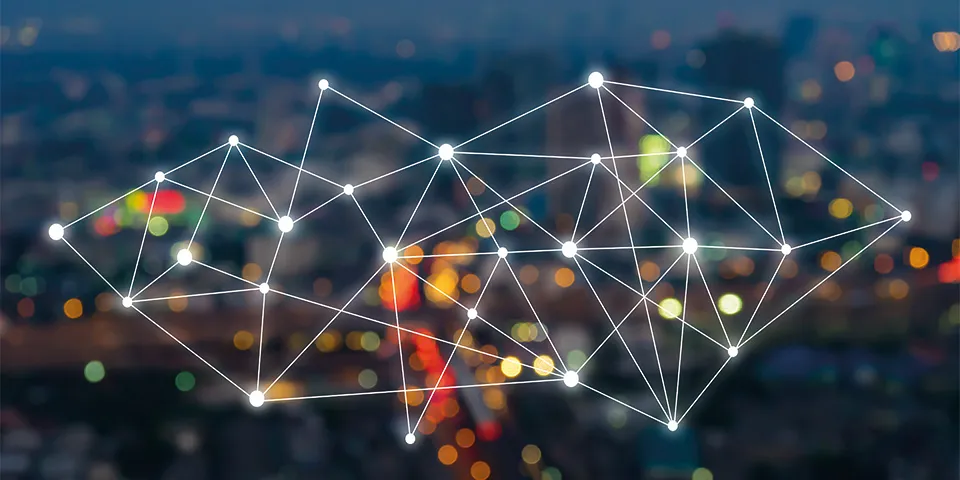
By making different smart luminaires work together, you create a connected network with great potential for applications and solutions.
Some possible processes
It is hard to think of anything that cannot be measured with a sensor or small device. Integrating a sensor into a luminaire is also highly feasible from a technical standpoint. Temperature, humidity, presence, noise, CO2, … These are all data that sensors can detect and collect. This makes it possible, for example, to analyse office occupancy. That data can then be used to make more efficient use of the office, better direct the cleaning team, and set the heating and air conditioning more efficiently. Other possibilities include using the data collected to find an unoccupied workstation or meeting room.
LED is the foundation
The shift from traditional light sources to LED lighting paved the way for the concept of ‘intelligent lighting’. LEDs offer a whole range of benefits: a long service life, straightforward control and ever-increasing efficiency. Above all, the ease with which LED lighting can be connected to an existing network makes it an ideal building block for intelligent lighting. Lighting characteristics (on/off, colour temperature, light output) can be adjusted easily, and integration with other networks is simple. The LED revolution has also helped the concept of smart buildings, and by extension smart cities, gain popularity rapidly.
Question about this story? Ask your question
Keep following this
Get an email when a new story is published. No account needed.
- ThemeSmart building integration
- SubjectProduct information