











‘This is the solution to our energy problem’
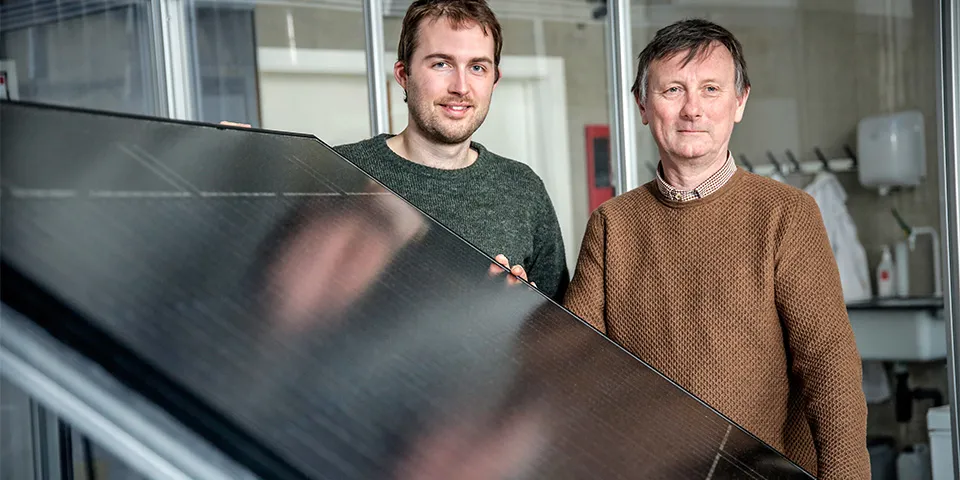
Leuven scientists develop solar panel that produces hydrogen from the air
A solar panel that produces hydrogen from moisture in the air, up to 250 litres a day. Researchers at KU Leuven have recently achieved this world first. “Our solar panel is the missing piece of the puzzle for running a home entirely on renewable energy”, says Professor Johan Martens. Production could start in as little as two years.
Professor Johan Martens and his research team at the Centre for Surface Chemistry and Catalysis have spent ten years developing their solar panel, and unveiled their invention to the public at the end of February. “We started with the idea of building an energy system that works anywhere”, explains Professor Johan Martens. “Sunlight and water are available everywhere, even in the desert. Our panel captures water from the air and converts it as efficiently as possible into hydrogen and oxygen, which are collected separately.” For obvious reasons, the professor is unwilling to disclose the technical details, but the innovation lies in how the water is captured and split. Today, hydrogen is generally produced by electrolysis. This technology is mainly used to relieve pressure on the grid when there is excess production. Conventional technology operates on a large scale and is energy-intensive, whereas Professor Martens’ system works at much lower current densities because it is designed around the sun’s energy density. It is 100% renewable.
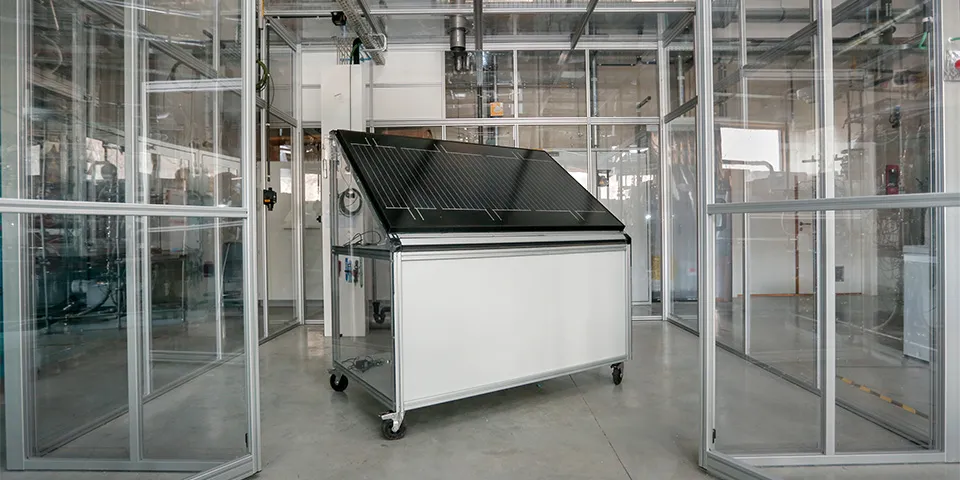
The panel captures water from the air and converts it as efficiently as possible into hydrogen and oxygen, which are collected separately.
The missing piece of the puzzle
Ten years of research have yielded an output of 250 litres of hydrogen a day. Twenty panels could supply a household with electricity and heat for an entire winter, although that is not really the aim. “If you need electricity, it is better to use a PV panel that generates electricity directly”, says Professor Martens. “Hydrogen can, however, prove useful for covering shortfalls in winter.” That is exactly what the research team will test in a pilot installation at a home in Oud-Heverlee. The house already runs on renewable energy, but despite having dozens of electric batteries, it is impossible to get through the cold winter months. “In April, we will install our hydrogen panels in this house and see how they perform in practice over the next two winters”, says Professor Martens. “Our solar panel is the missing piece of the puzzle for running a home entirely on renewable energy: directly with solar panels, thermally with a solar water heater, and with hydrogen replacing natural gas. For a single home, this combination of technologies is fairly complex, but it could be very interesting in a neighbourhood or a large building.”
What about natural gas?
Will hydrogen completely replace natural gas in the future, then? Professor Martens says that is unlikely to happen, and there is no need for it to, either: “The formula for natural gas is CH4. That means it contains four hydrogen atoms and one carbon atom. Our economy will never be completely carbon-free. But hydrogen can help solve the CO2 problem. Our technology releases no carbon into the air and can also be used to produce synthetic natural gas, for example. You can combine a CO2 source with our hydrogen to make new natural gas. In this way, you replace the natural cycle with a faster artificial one. CO2 in itself is harmless; it is just that the concentration in the air is now far too high, so if we keep CO2 in the cycle for longer, we solve the problem too.”

The first hydrogen panel is now in Leuven, but it will not be long before it reaches the market.
Synergy between energy sources
Professor Martens does not expect the transition to a hydrogen economy to have now definitively begun, but he does want the technology to become as widely used as possible in our energy supply. “We do not claim to have invented the system”, he says. “The energy supply will always be a mix of different energy sources. But we do have an important piece of the puzzle for solving the energy problem. A great deal has been written about the hydrogen economy, including by its critics. We must not forget that enormous interests are at stake in the energy sector. A pure hydrogen economy will never become a reality. Every technology has its advantages and disadvantages, and one technology will be preferred depending on the application. Today, our energy mix consists of 80% fuel and 20% electricity. That balance will evolve, but it will never be 100-0 or 0-100. There will always need to be synergy. The same applies to hydrogen as a means of powering vehicles. Electric vehicles are best suited to short distances and lighter vehicles; hydrogen is more interesting for heavier transport and long distances. Our system works at the pace of the sun. You cannot simply replace the entire vehicle fleet with our technology. There are simply not enough ways to produce hydrogen for that.”
On the market in the short term
The first hydrogen panel is now in Leuven, but it will not be long before it reaches the market. Over the next two years, the research team will run pilot installations in various application areas: alongside the residential market, these include agriculture, aquaculture and hospitals, where hydrogen could be used to power emergency generators during power cuts, for example. “If the demos show that our panel offers added value, we will set up a spin-off”, says Professor Martens. “The company will not be focused on maximising profits, but on spreading the technology as widely as possible. That is why we will also offer the panel at affordable prices.” At the same time as the trials, the research team will set up a production line. If the trials prove successful, the panel could be brought to market in two years.
Question about this story? Ask your question
Keep following this
Get an email when a new story is published. No account needed.
- ThemeEnergy generation and smart use
- SubjectNews







