











Sealing linear joints and service penetrations properly and safely requires expertise
Text Maxime BervoetsImage Bostik
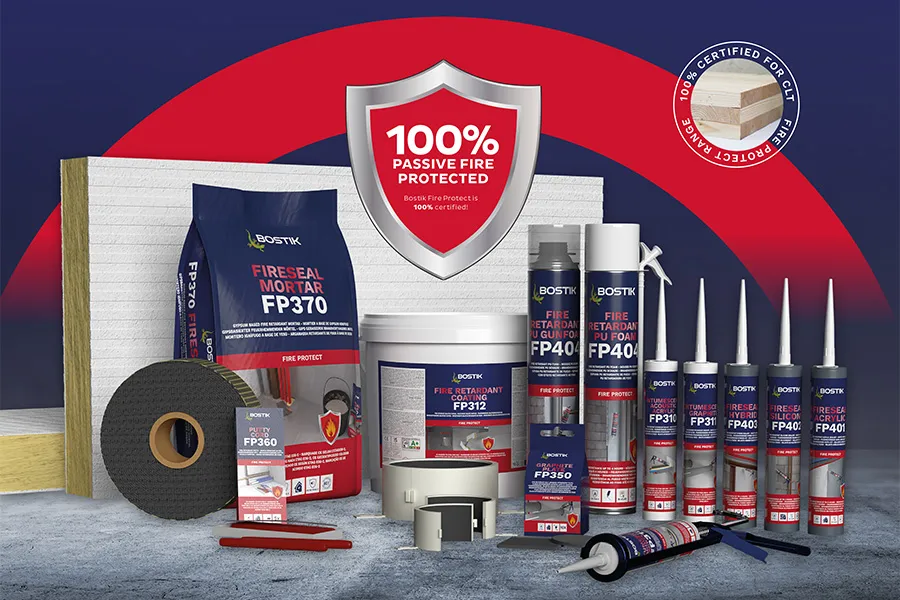
Building fires are sometimes unavoidable. Even the safest building in the world can go up in flames. “Prevention is better than cure” does not always apply to building fires, unfortunately, says Nick Haring, business developer for Fire Protect and Airtight Building at Bostik. “But we can minimise the consequences of a fire. Careful fire and smoke compartmentation is essential. This applies to both residential and non-residential buildings, where linear joints and service penetrations play an important role.”
The importance of compartmentation
To understand why compartmentation is necessary, it is important to know that more than half of the people who die in fires were not in the room where the fire started. Moreover, most victims do not die from the fire itself, but from smoke, which spreads rapidly through a building. “More people die from smoke than from fire,” says Nick Haring. “They do not even have to be in the same room. 60 minutes of flame resistance means 90 minutes of smoke resistance. This applies to construction joints, as well as service penetrations, an area in which Bostik specialises.” Fire and smoke compartmentation is mandatory in residential buildings to prevent flames, smoke and toxic fumes spreading from one dwelling to another. “But non-residential buildings must also have appropriate fire and smoke compartmentation, depending on their size, function and contents.”
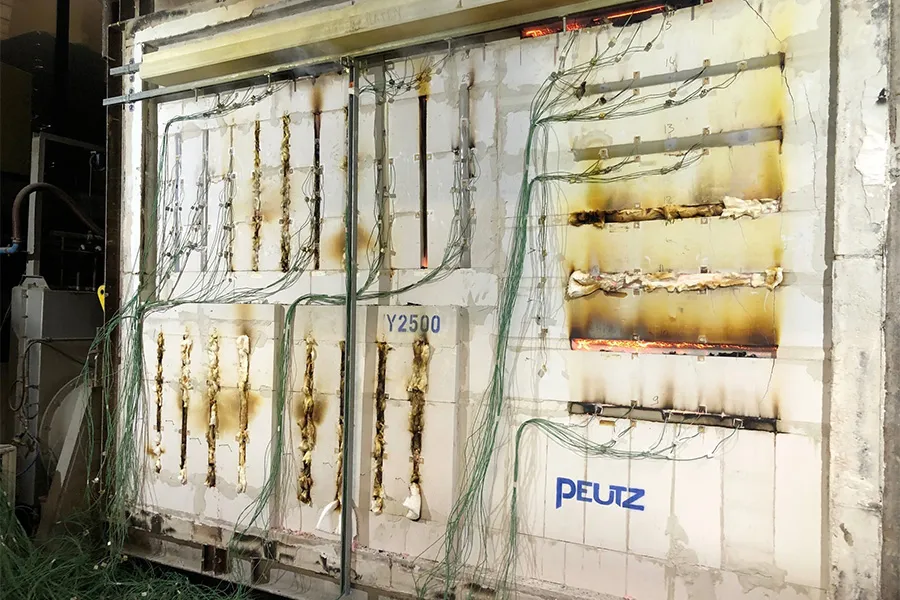
Tested in practice
Alongside the construction of fire- and smoke-resistant barriers, particular attention must be paid to linear joints and service penetrations. Only when these have been sealed correctly to provide fire and smoke protection can the spread of flames, smoke and toxic fumes be effectively stopped. “By linear joints, we mean the construction joints between a fire barrier and a ceiling, a fire barrier and a wall, or a fire barrier and a frame,” explains Haring. “Safely sealing these joints requires products and systems that comply with EN 1366-4.” Bostik offers an extensive range of products that comply with this standard. “All our products have been tested in real-world conditions by an independent certified laboratory, in various constructions and across a wide range of joint widths. The test results are set out in classification and test reports, which can be downloaded free of charge from our website.”
Polymer sealant or foam
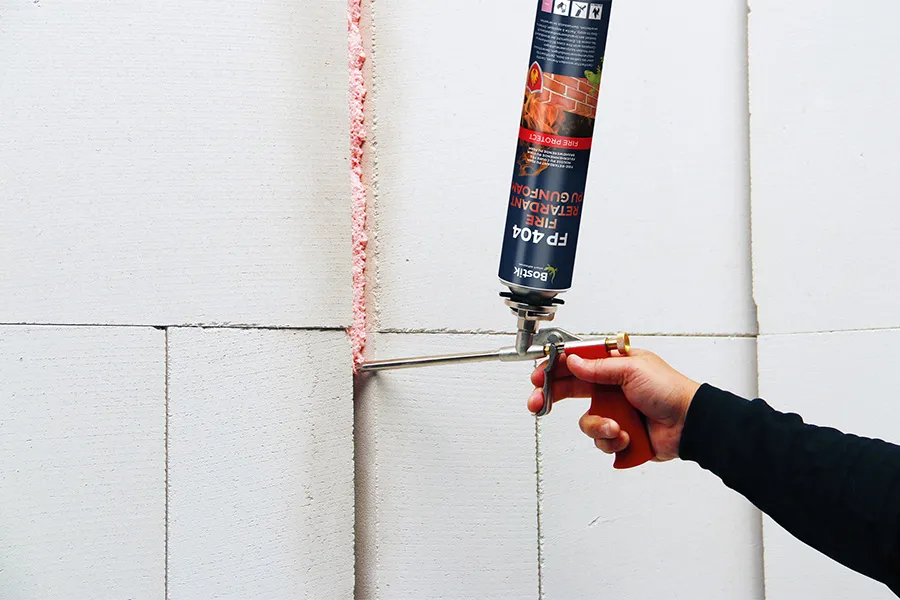
A unique product for sealing linear joints is Bostik FP 403 Fireseal Hybrid polymer sealant, which has been tested and certified for use with horizontal and vertical joints, perimeter joints, timber and steel frames, mineral substrates and all metal stud applications. In some configurations, it can be used for joints up to 60 mm wide, Haring explains. The sealant can also be painted over easily. “Our FP 404 Fire Retardant PU Foam is also popular. It has been successfully tested in masonry walls from 70 to 200 mm thick, making it highly suitable for off-site construction companies and contractors.” However, these products cannot simply be used without consideration, he stresses. “A good product on its own does not guarantee a fire- and smoke-resistant joint. The exact right products must be used correctly, at the right thicknesses and in the right positions. That is why it is important to request the classification reports for the products you intend to use during the engineering phase. Do the product and project classifications match? Is a product suitable for the wall or floor thickness in question? And what is the maximum width of the horizontal and vertical joints?” Bostik is keen to work with the relevant stakeholders as early as possible, offering advice and support. “That way, we can prevent mistakes and costly workarounds, and bring building safety up to the highest possible level.”
Fire-resistant service penetrations
Alongside linear joints, Haring also draws attention to fire-resistant service penetrations in fire and smoke compartments. There is still considerable room for improvement in this area, he notes. “Unfortunately, we still too often see all the penetrations for, say, electrical cables and pipes crammed into one corner when several need to be installed. This may seem efficient, but it does nothing to improve fire and smoke safety. In that situation, it is no longer possible to achieve a proper, safe seal.” Penetrations should generally be at least 3 cm apart and 3 cm from the wall, he stresses. “Choosing the right product is essential here too. The product must be suitable for the construction material in question. In addition, the right screws must be used for each application.”
Also for CLT
Bostik also offers an extensive range of products for sealing service penetrations in fire and smoke compartments, successfully tested in accordance with EN 1366-3. “What makes our range unique is that, as well as solutions for masonry walls and floors, we also offer certified solutions for Cross-Laminated Timber (CLT). In addition to intumescent sealants (acrylic and graphite), our range includes boards in various thicknesses of stone wool, pipe collars, pipe wraps, putty cords and mortars. These not only ensure fire and smoke safety, but also make it possible to work considerably faster. All our products meet EMICODE® EC1 Plus requirements and are well suited to BREEAM projects. We would be happy to discuss the options in more detail in person.”
A business enquiry for Bostik Benelux? Get in touch
Companies in this story
Keep following this
Get an email when a new story is published. No account needed.
- ThemeFire safety in building services
- SubjectNews
- CompanyBostik Benelux







