











Prevent corrosion in heating systems? The new AQA Therm Move Power from BWT makes it possible!
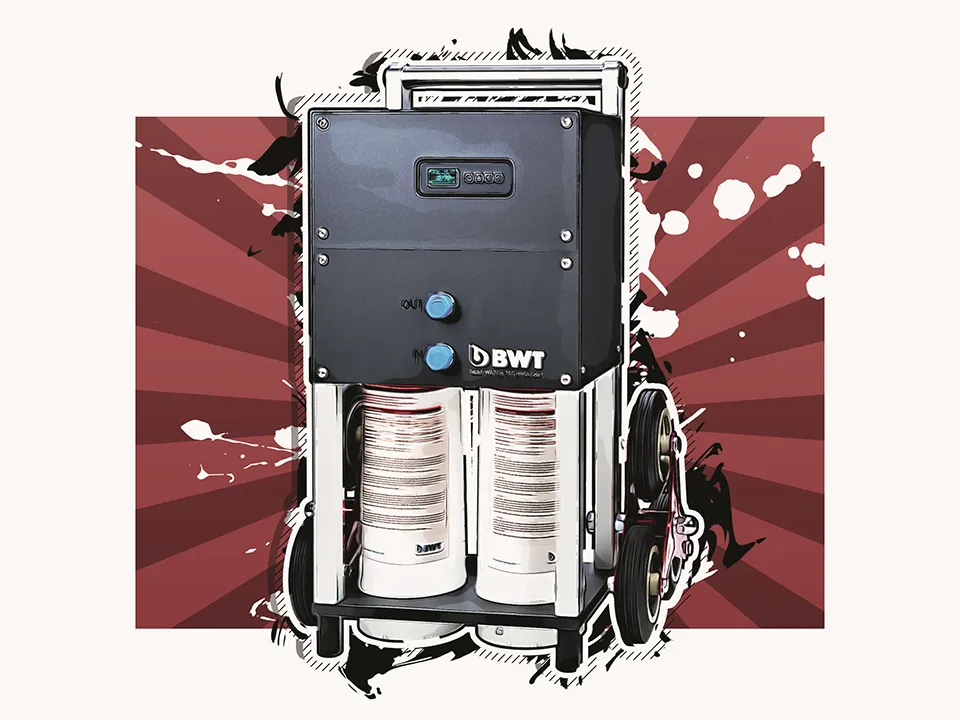
Need water with a very low salt content to fill systems, in line with the German VDI 2035 guidelines and the recently published TV 278 from the WTCB? Consider the new AQA Therm MOVE Power from water treatment specialist BWT. Wherever water with a very low salt content is required, this super-compact, super-convenient RO unit delivers: whether used as a mobile or stationary unit, it always meets the strictest requirements.
Water treatment is becoming increasingly common in Belgium. But it is still too often associated only with domestic water. Yet the water flowing through heating systems, underfloor heating pipes or solar collectors must also be of good quality to prevent deposits. These affect heat transfer and the service life of the system, and lead to a significant loss of efficiency.
That is precisely why the German Association of Engineers, VDI, issued guidelines on the quality of
heating water: the ‘VDI 2035 guidelines’. They set out target values for hardness, pH, conductivity and salt content, depending on the metals used and boiler capacity.
Since July 2021, the Belgian WTCB (Scientific and Technical Centre for the Construction Industry) has also highlighted the importance of high-quality filling, make-up and system water for heating systems. Its Technical Information Note (TV) 278 contains numerous recommendations for preventing deposits and corrosion in heating systems.
Corrosion: a hidden problem
Corrosion is a common problem in heating systems in Belgium. It leads to the formation of corrosion sludge (from black magnetite to even reddish rust) and is almost entirely due to the presence of oxygen in the system, an incompatible mix of metals, an excessively high pH (acidity) or an excessive salt content in the heating water.
One major cause of oxygen ingress is inadequate pressure maintenance in the system. To prevent negative pressure, the expansion vessel must be correctly sized, checked regularly and replaced if necessary.
Plastic pipes and flexible connecting hoses that are not sufficiently oxygen-tight can also be a source of oxygen ingress into the system. It is therefore advisable not to use these types of pipe and hose.
As corrosion is a gradual process, it is recommended that the quality of the heating water be monitored closely, even in smaller systems. An excessively high pH (acidity) and an excessive salt content in the heating water will accelerate corrosion. It is best to use water with a very low salt content for filling. The lower the salt content of the heating water, the lower the rate of corrosion.
Water with a very low salt content, thanks to reverse osmosis
Water can be demineralised using a unit that works on the principle of reverse osmosis (RO). Water is pumped under pressure through a membrane, which allows only water molecules to pass through. Organic molecules, micro-organisms and salts (minerals) are retained.
Reverse osmosis can remove 95 to 98% of the salts present in water. What remains is precisely the pure water required for the heating system.
The solution for HVAC professionals
For professionals needing to produce water with a very low salt content to fill a range of systems, a mobile RO unit is the most convenient option.
That is why water treatment specialist BWT developed the AQA Therm MOVE Power for HVAC professionals: a compact, mobile unit with a high flow rate. It delivers up to 360 l/h and around 80,000 l of water with a very low salt content using a single membrane set. It can run continuously, and several units can be combined when higher flow rates are required.
The water’s conductivity is constantly monitored, and the user receives an alarm if the limit values are exceeded.
The unit is also easy to use. When the membrane set is worn out, it can be replaced easily, with no special tools required. The filling process is controlled automatically: filling stops as soon as the pre-programmed system pressure is reached.
Also for other (industrial) applications
As well as being the ideal solution for filling heating systems in line with the German VDI 2035 guidelines and the recently published TV 278 from the WTCB, the AQA Therm MOVE Power can also be used for other applications requiring low-mineral or demineralised water, such as humidification systems, industrial processes or professional cleaning.
Question about this story? Ask your question
Keep following this
Get an email when a new story is published. No account needed.
- ThemeSafe and efficient water use
- SubjectNews







