











Passive fire protection: challenges for the future
At the recent Fireforum Congress, ing. Liesbeth Jacobs took a moment to consider the future challenges facing passive fire safety.
Can we be sure that passive fire safety solutions are always installed correctly and work as they should? And what about the interaction between active and passive fire safety?
Before exploring future developments and challenges in passive fire protection in more detail, it seemed useful to take another look at the concept itself. “Passive fire safety can be described as preventive safety measures put in place before a fire occurs, which limit the fire or prevent it from spreading,” says Jacobs.
Fire in Pelt
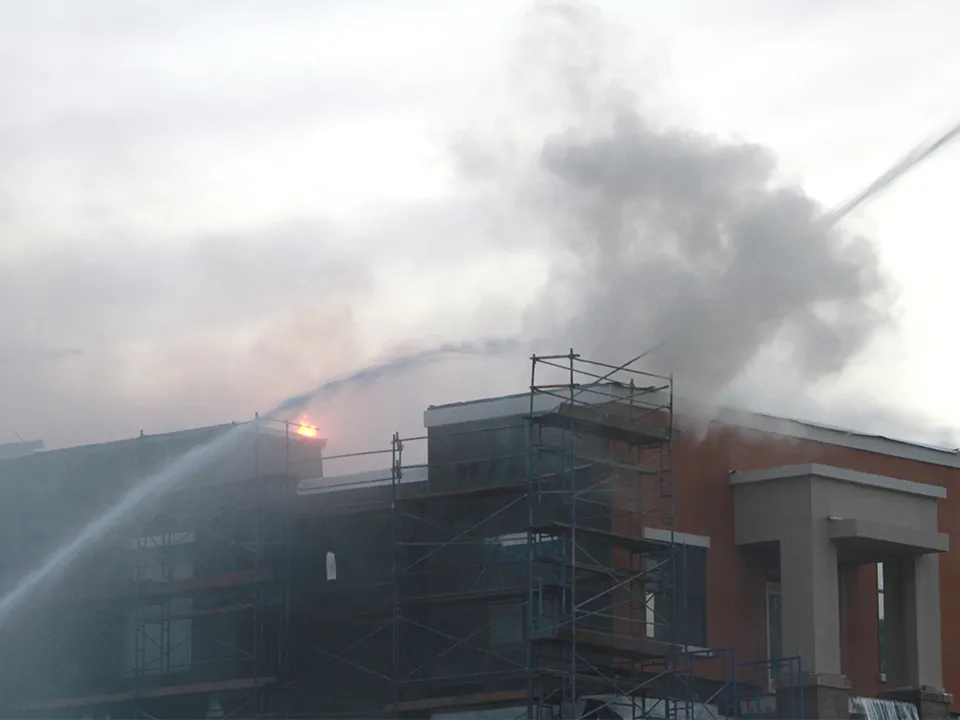
Jacobs illustrated the importance of passive fire safety with a straightforward real-world example: the fire at the Jezet Seating commercial building in Pelt, in June 2019. “The warehouse contained all kinds of products for fitting out theatres or sports halls, for example, such as seats for a stand. These seats are made largely of synthetic foam and are therefore highly susceptible to fire.”
Thanks to effective compartmentation, the office areas were unaffected. “Although we can also see smoke rising here, indicating that the compartmentation was fire-tight but not smoke-tight,” Jacobs points out. “It is important to bear this in mind. Smoke-tightness is not yet routinely considered in Belgium. I have the impression that insurers sometimes have to pay out following a fire even when the compartmentation performed as it should, because smoke damage occurred in part of the building. Smoke-tightness is therefore certainly an area to focus on in the future.”
Reaction to fire and fire resistance
Two basic concepts in passive fire safety are reaction to fire and fire resistance. “Reaction to fire concerns how a material behaves at the start of a fire, while fire resistance comes into play as the fire develops and relates to the function the building element performs in the event of a fire,” Jacobs explains. In practice, she finds that the two concepts are sometimes used interchangeably:
“There is a great deal of confusion around the terminology. I still see these terms being mixed up every day in practice, even though both concepts have been part of the legislation for many years.”
Lack of inspection
Various certificates are available to help ensure the quality of passive fire safety products and installations, covering products, systems and installation companies. “Such certificates obviously help improve quality, but they do not guarantee that something has been installed correctly,” Jacobs notes. “Sometimes there is a lack of inspection to ensure the work has been carried out correctly. Responsibility for this lies partly with the architect, particularly at the design stage, but also with the installation company. Inspection is more routine in active fire safety, where it is also built into the standards, but I would advocate voluntary inspection of both the design and installation of passive fire safety solutions.” The mandatory maintenance, at least once a year, should not be overlooked either.
Well-founded, creative solutions
The theory sounds promising, but Jacobs still regularly encounters problems in practice. Issues can arise particularly when several products are combined in a single application. Jacobs says: “For example, installing a fire-resistant hatch in a fire-resistant ceiling. It may seem straightforward, but you must always make sure that the combination works as intended. It is crucial to give this sufficient attention. Look for creative solutions, but above all make sure they are properly substantiated. Consult specialists or manufacturers, and even carry out a small-scale fire test if necessary.” Jacobs also regularly receives questions about combining passive and active fire safety systems. “Much more research is needed into the interaction between the two systems. Could fire resistance, for example, decrease once the sprinklers have been activated and the building is fully saturated with moisture? This is an important question, because effective fire safety depends on optimal interaction between active and passive fire protection.”
Question about this story? Ask your question
Keep following this
Get an email when a new story is published. No account needed.
- ThemeFire safety in building services
- SubjectNews







