











Optimising energy savings with artificial intelligence
Artificial intelligence is having an ever greater impact on our daily lives and surroundings. Both individuals and businesses are taking an increasingly considered and innovative approach to energy and climate issues. This is leading to more and more buildings being equipped with energy optimisation solutions.
Innovative solutions
Kieback&Peter was founded in Germany in 1927. Its Belgian branch, Kieback&Peter Belgium, has been operating since 2014. Wim Heylens, Managing Director at Kieback&Peter Belgium: “Kieback&Peter is a manufacturer and systems integrator focused on implementing systems tailored to customers’ specifications. We provide systems and services for building automation, including the control of HVAC systems, lighting, solar shading, fire detection and more. We also provide after-sales service through our own service organisation. Since 2014, we have delivered a number of excellent projects in schools, university buildings, offices, healthcare, industry, hotels and other public buildings.”
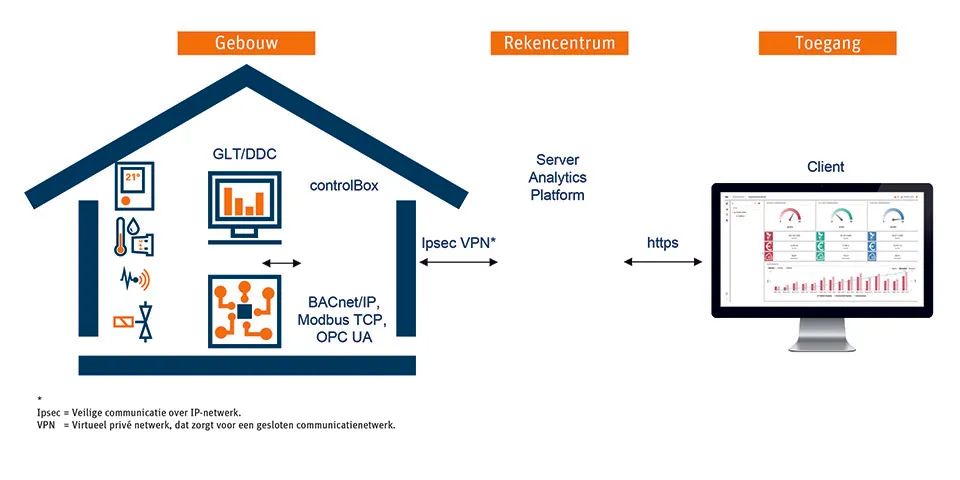
Using artificial intelligence, predictive behaviour and computational models, MPC2.0 optimises the control of the underlying systems.
No longer science fiction
Using artificial intelligence to control HVAC systems is no longer science fiction. New technologies make it possible to analyse a building’s energy use and optimise heating, cooling, ventilation and overall energy consumption accordingly. Previous studies, for example, have shown that buildings use too much energy during holiday periods. Thanks to artificial intelligence, this is gradually becoming a thing of the past. The system used for this purpose is MPC: Model Predictive Control. It is particularly suitable for larger buildings or infrastructure with annual consumption exceeding 100,000 EUR. Wim Heylens: “As its name suggests, MPC2.0 is a service based on mathematical models and predictive algorithms. Traditional control
technology is effectively extended with an extra dimension, taking into account external data such as weather forecasts and expected visitor numbers. Using artificial intelligence, predictive behaviour and computational models (the virtualised building), MPC2.0 optimises the control of the underlying systems. Traditional control technology only takes current measurements into account, which often leads to ‘overshoots’ and, as a result, additional energy consumption.”
More comfort, less energy
Lower energy consumption can go hand in hand with greater comfort. Smaller fluctuations and monitoring of the outdoor climate make the temperature feel more comfortable to users. Wim Heylens: “Users benefit from a more stable control system that is continually optimised, ensuring optimum comfort and reduced energy consumption. The potential savings range from 15% to 35%.”
Question about this story? Ask your question
Keep following this
Get an email when a new story is published. No account needed.
- ThemeEnergy generation and smart use
- SubjectNews







