











Integrated energy systems accelerate the decarbonisation of large residential buildings
Text Remeha en Wouter PolspoelImage Remeha
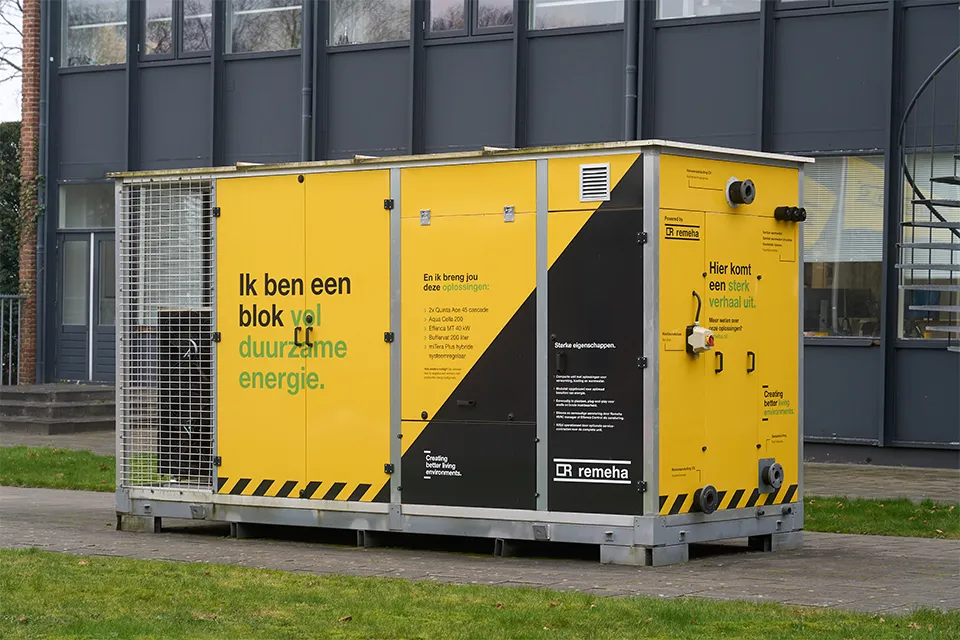
The various geopolitical and economic crises have driven oil and gas prices sharply higher in recent years. As a result, decarbonising energy supplies, already essential in the face of climate change, has become more important than ever. According to BDR Thermea, parent company of heating and indoor climate specialist Remeha, integrated energy systems offer a response to this challenge. By intelligently combining different technologies, it is possible to heat and cool even complex residential buildings efficiently and in a way that is fit for the future.
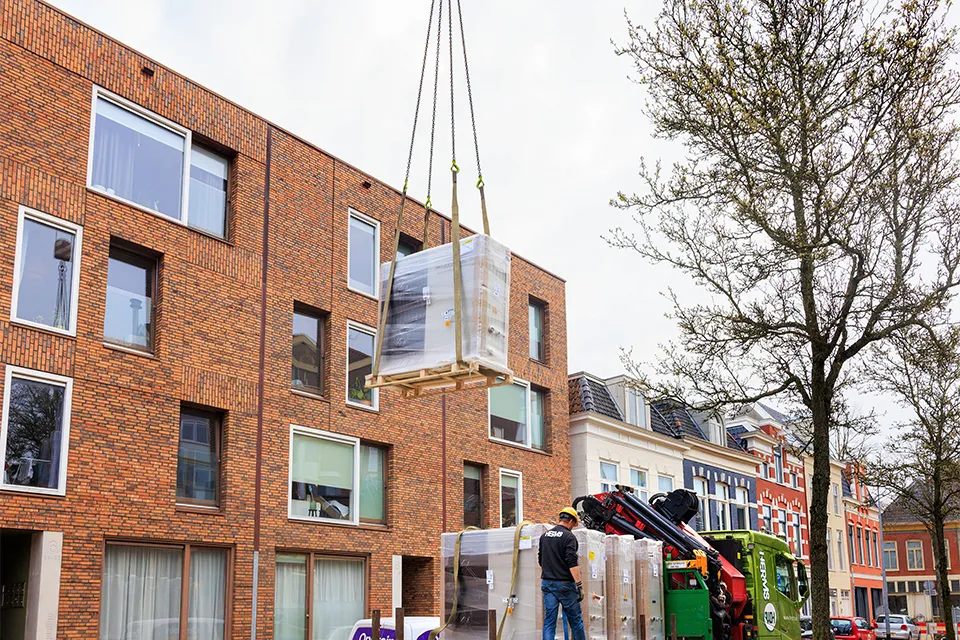
More and more clients, contractors and installers are opting for prefabricated and modular construction to work more sustainably. This shifts much of the design work to the preparation phase. “Using prefabricated and modular solutions means there is no need to start from scratch every time,” says Siebo Horenberg, group product manager at BDR Thermea, parent company of Remeha, a supplier of indoor climate solutions. “That is why we have a library of standardised system solutions. At our partners’ request, we provide descriptions and 3D models, helping design and construction processes run faster and with fewer errors.”
Siebo Horenberg says it is important for Remeha to be involved in construction projects at an early stage. “If we are consulted from the design phase onwards, we can take account of technical constraints and future developments. Our broad product range enables us to put together systems that help make building heating and cooling more sustainable in almost any situation. The key is to combine different technologies intelligently, so they do not necessarily require more capacity, but make more efficient use of the capacity available.”
District heating networks play a key role
Different technologies complement one another particularly well in larger buildings and neighbourhood projects. This reduces energy consumption while also easing the load on the electricity grid. The latter is becoming increasingly important as grid congestion poses a problem in more and more locations.
Heating and cooling networks play an important role here. These can be micro-networks within a single building, or local networks supplying an entire neighbourhood with sustainable heating and cooling. Siebo Horenberg says: “Traditional district heating is well known, but smart neighbourhood networks and local energy networks within buildings still receive too little attention. Yet they are important for the energy transition. They can draw on a range of heat sources, such as waste heat, heat pumps and, where necessary, gas boilers. Additional heat sources can easily be connected later.”
“Insulation measures reduce the heating demand of homes and buildings. As a result, lower flow temperatures are often sufficient for heating. This has enabled the development of fourth- and fifth-generation district heating networks. Unlike traditional networks, which supply water at 75 to 90 °C, these networks operate at lower temperatures. Depending on the heat source and application, we distinguish between medium-temperature networks, with flow temperatures of 55 to 75 °C; low-temperature networks, with flow temperatures of 30 to 55 °C; and ultra-low-temperature networks, with flow temperatures of 10 to 30 °C. The lower the network temperature, the more efficiently sustainable heat sources such as heat pumps and waste heat can be used.”
Efficient heat transfer
The heat supplied to the building must then be adapted to suit its heating system. For medium-temperature and most low-temperature networks, a heat interface unit is sufficient to transfer heat from the network to the building’s installation. Ultra-low-temperature networks also require a heat pump, in addition to the heat pump supplying the district heating network, to raise the temperature to the level needed for heating and domestic hot water.
Fortes Energy Systems, a subsidiary of BDR Thermea, specialises in transferring energy from collective district heating networks. The company develops and manufactures both its own heat interface units and large-scale transfer stations. “As Siebo says, we see a lot of potential in fourth- and fifth-generation heating and cooling networks,” says Timo van Kasteren, district heating network specialist at Fortes Energy Systems. “Combined with Remeha’s hybrid and all-electric solutions, our solutions create comfortable energy systems for apartments and homes in neighbourhoods connected to a fourth- or fifth-generation district heating network. Our systems are changeover systems, which means they provide heating at low temperatures in winter and cooling at a higher temperature in summer. This approach works in large district heating networks as well as smaller networks or micro-networks within a single building. In existing apartment blocks, we replace the old central heating boiler with a compact heat interface unit and a booster for domestic hot water. This creates a comfortable communal heating and cooling system.”
Timo van Kasteren and Siebo Horenberg say one conclusion is clear: “To make buildings and neighbourhoods fit for the future, it is better to look beyond any one technology. It is the intelligent combination of different solutions that will determine how sustainable, efficient and flexible our energy supply will be.”
Een zakelijke vraag aan Remeha België? Get in touch
Companies in this story
Keep following this
Get an email when a new story is published. No account needed.
- SubjectNews
- CompanyRemeha België







