











How to detect efficiency losses in solar panels
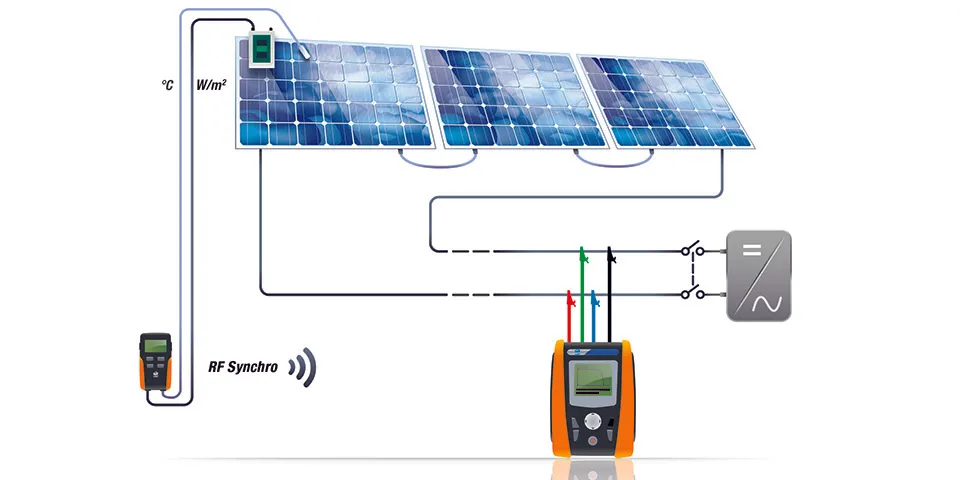
Generating electrical energy with photovoltaic cells remains popular. More and more installation companies are involved in installing and maintaining these systems. It is important for installation companies to have sufficient knowledge and the right testing equipment to ensure photovoltaic systems perform at their best.
When measuring solar panels, various factors that affect the performance of photovoltaic cells must be taken into account. In addition to the physical properties determined during the manufacturing process, these include factors such as cell temperature and the amount of solar radiation captured by the panels. The geographical location, orientation and angle of the panels also have a significant effect. Atmospheric pollution and/or surface reflection also affect the amount of solar radiation reaching the cells. Finally, solar panels deteriorate over time, resulting in efficiency losses.
To obtain reliable measurements and draw conclusions from the results despite all these variable conditions, the measurements must be converted to STC (Standard Test Conditions) values. These STC values are listed in the technical specifications of a solar panel. To establish STC values, the panels must be exposed to exactly 1,000 watts of light per m2 at a temperature of 25 °C. STC also specifies requirements for the light spectrum.
Measuring photovoltaic systems therefore involves much more than measuring voltage and current. The amount and angle of incidence of the light (inclination), as well as the temperature of the panels, also play a major role and must be measured accurately.
IV curve
Solar panels deliver almost the same voltage at high and low light levels when there is no electrical load (open-circuit voltage). The current, however, depends on the intensity of the solar radiation, rather than on the ambient temperature.
To determine a panel’s power output, it must be electrically loaded, causing current to flow. Gradually reducing the load resistance increases the current until the voltage suddenly drops. This point is known as the Maximum Power Point (MPP). The result of this measurement is an IV curve, a graphical representation with voltage on the horizontal x-axis and current on the vertical y-axis.
Maintenance
A well-installed photovoltaic system can last a long time. Solar cells, however, are subject to ageing, so the panels will eventually need to be replaced. External factors such as storms or hail can of course cause physical damage. But installed panels can also be affected by localised shading as they gradually become dirty. Dust or, for example, bird droppings can prevent the cells in certain areas of a panel from receiving enough light. Cold climates and rainwater can also cause faults.
The inverter has a shorter service life than the solar panels and must be replaced at least once during their lifetime.
Question about this story? Ask your question
Keep following this
Get an email when a new story is published. No account needed.
- ThemeEnergy generation and smart use
- SubjectNews







