











Extreme weather and new technologies call for adapted fire protection
Text Marlies DecavelImage Pexels
Innovative technologies such as electric cars and bicycles, PV façades and timber-frame construction require a different approach to fire protection systems in businesses, institutions and homes. The sector is doing its utmost to develop innovative and safe solutions. What exactly does the future hold for fire protection? Here are some of the trends.
Last summer once again brought home the reality of climate change: heatwaves with temperatures above 40 degrees, extreme weather with flooding and lightning strikes, prolonged rain and cold. The effects of global warming are clearly being felt. Every effort is being made to build and live more sustainably and in a more environmentally friendly way to protect the climate. Examples include timber-frame construction, photovoltaic façades, electric cars and bicycles. However, this shift brings new risks. Adapted and innovative fire safety solutions are therefore essential.
Smoke control is a key element
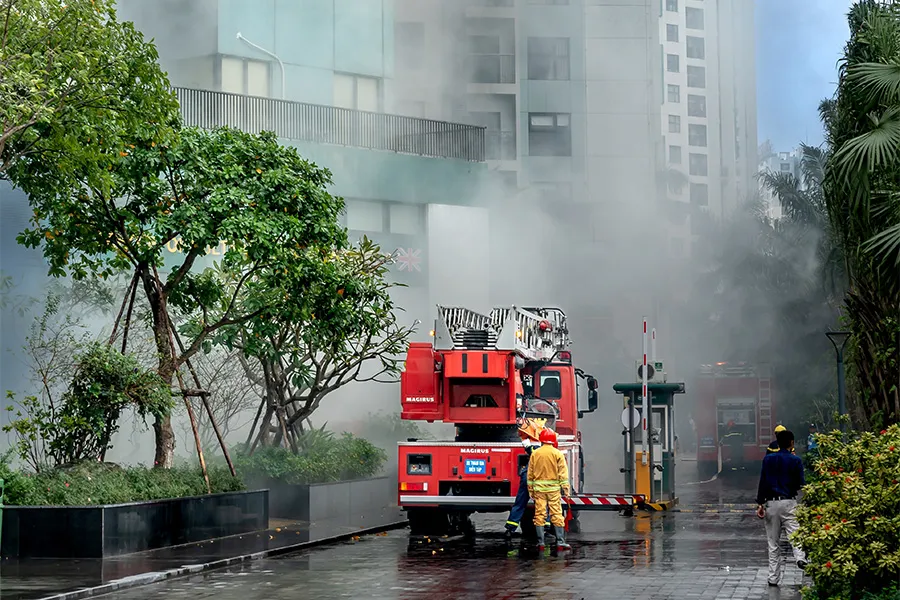
Smoke often claims more victims than the fire itself, as has been demonstrated repeatedly. This is why increasing attention is being paid to smoke control in buildings, to limit exposure to smoke and heat in the event of a fire and provide the best possible visibility for evacuating people. Installing the necessary fire doors and smoke control dampers is therefore a logical choice for new-build and renovation projects.
Ventilation ducts also play an important role in fire safety. Fire dampers are needed in ventilation ducts to prevent fire or smoke from spreading from one compartment to another. These dampers are often concealed within a fire-resistant compartment wall. Efficient fire dampers always comply with the international quality standard EN 1366-2.
Optimising fire resistance
In addition to smoke extraction, it naturally remains essential to contain the fire itself. A well-considered layout with the necessary compartments and compliant active fire protection are one part of the equation, but integrating fire-retardant building materials is just as important. That is why there are many passive fire protection systems designed to anticipate a potential fire, from fire-retardant coatings, foams and mortars to fire-resistant ceiling panels and floor tiles. They all help to prevent or slow the spread of fire.
Insulation, including in façades, also plays a very important role. The fire at London’s Grenfell Tower in 2013 remains etched in many people’s memories. The façade cladding there did not comply with regulations, with disastrous consequences. Since 2022, Belgium has had new regulations addressing various gaps and ambiguities in current fire safety legislation. These are based on the European reaction-to-fire classification, in which class F denotes highly combustible materials and classes A1 and A2 denote non-combustible materials. Class A1 materials also prevent flame spread and flaming droplets, and produce no toxic gases and virtually no smoke when they burn. Façade systems are subject to requirements at two levels: both the façade cladding and its essential components, such as the supporting structure, fixings and insulation. To ensure a façade complies with fire safety standards, both levels must meet the requirements.

Understanding the fire behaviour of innovative building applications
Sustainable building materials and solutions such as timber construction, photovoltaic façades and integrated charging systems for bicycles and cars bring new risks, but also new insights. The use of PV façades is growing rapidly. Various studies are under way to understand how these façades behave in a fire. They show that fires in PV panels are usually caused by electrical faults, but are often difficult to extinguish. This is partly because small fires continue to flare up as a result of carbon conductivity, and partly because photovoltaic panels continue to generate power.
Alongside the rapid growth in PV façades, timber-frame construction is also gaining ground. Although fire safety is still often cited as a reason not to choose timber, this material is in fact a safe option. Fire services and insurers confirm this too. Timber burns in a highly predictable way. The fire resistance of timber is a matter of physics. In a fire, timber chars evenly at a rate of around one millimetre per minute. This enables designers to predict accurately both its fire resistance and the risk of its load-bearing capacity being exceeded. In addition to the thickness needed to support the specified load, designers also allow extra thickness that can char in a fire. This oversizing ensures that the load-bearing capacity is not compromised in a fire. These insights provide important guidance for today’s construction sector.
The human factor as a weak link
Ultimately, human behaviour often remains the biggest cause of fire safety failures. Try asking residents of high-rise apartment buildings how they would evacuate as efficiently as possible. Or ask homeowners how to deal safely with faults in their own electrical distribution boards. They will often be unable to give you an answer. However far we go in improving and protecting our buildings, well-trained and prepared people remain the most important factor. That is why training, prevention and follow-up are essential. Installers and fire protection companies should take this aspect on board as part of their services. With the right materials, good fire detection and accessible training, we can ensure the best possible fire safety and minimise casualties.
Question about this story? Ask your question
Keep following this
Get an email when a new story is published. No account needed.
- ThemeFire safety in building services
- SubjectNews







