











Energy savings with a connected 6-way valve

Where heating alone was once essential for thermal comfort, cooling is now also indispensable in our climate. Most climate control systems are therefore designed to provide both heating and cooling. A thermal valve system is needed to switch smoothly between the two. These valves have undergone an interesting evolution over the past decade.
Yves Roemen, Senior Business Development at Giacomini, explains the history and importance of the thermal valve. The manufacturer’s latest patented development is a remarkable feat of engineering. The preset valve saves installers the time-consuming task of balancing on site and reduces energy consumption by monitoring flow rates in conjunction with the central building management system.

From 2-way to 6-way valves
“With heating and cooling provided by a single system, hot and cold water can be sent to the terminal unit through the same pipe. But this means you cannot cool one room and heat another at the same time. That is why four-pipe systems are generally used, particularly in commercial applications,” explains Yves Roemen.
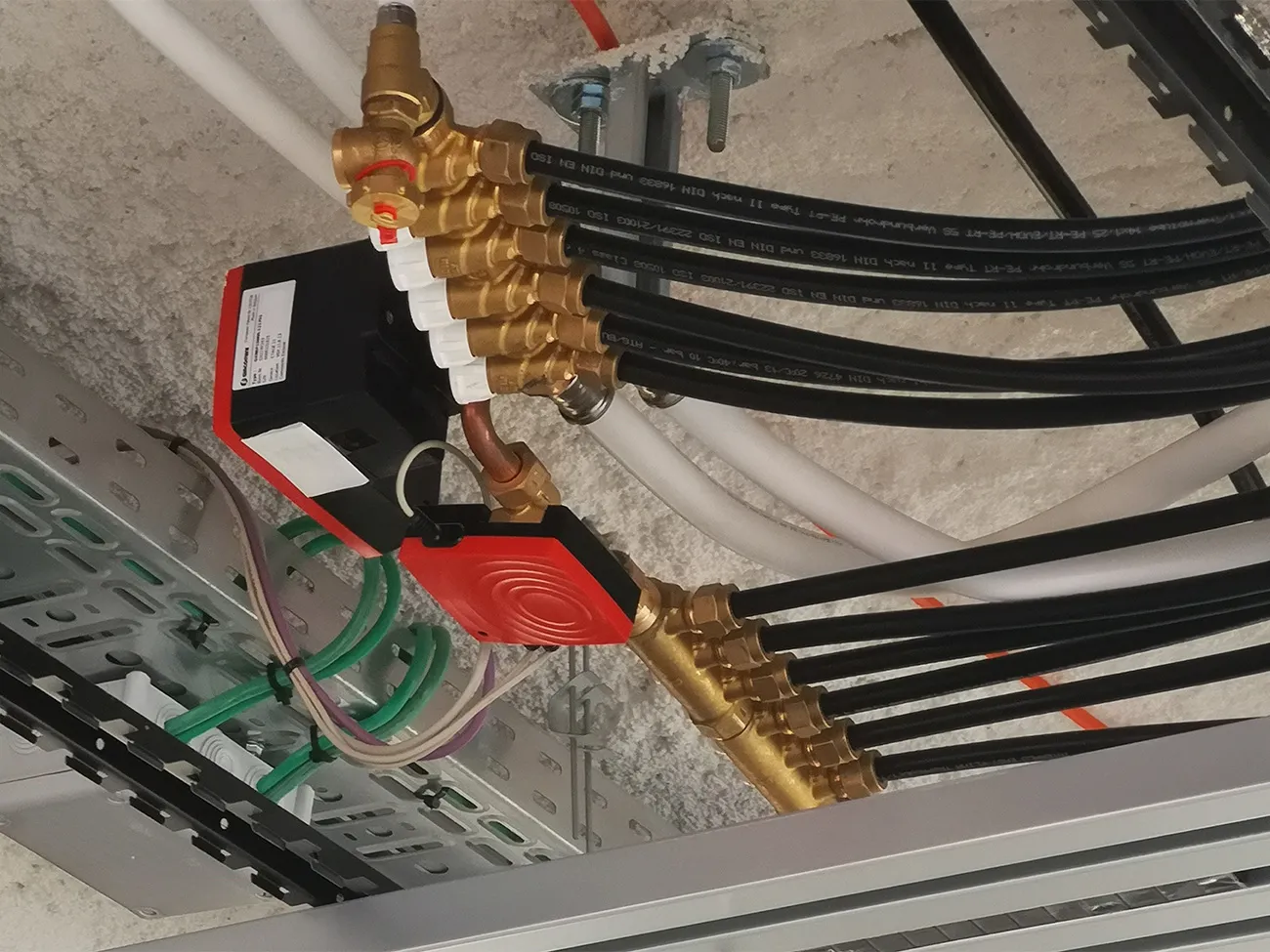
“The fluids must not mix, and they have different expansion characteristics. A valve system is therefore needed. Initially, four 2-way valves were installed, each with a motor. If one of the motors failed, a valve could remain open. Two 3-way valves were therefore preferred, although this still required multiple signals to operate the two motors. The solution was the 6-way valve: two 3-way valves on the same spindle, completely eliminating the risk of the fluids mixing. Having just one motor also reduces cost and energy consumption.”
Preventing overpressure and seizure
A conventional 6-way valve carries a risk of overpressure. “That is why our valve has a very fine connection between the two circuits, which equalises the pressure when the valve is closed,” says Yves. The manufacturer’s valves have synthetic balls instead of brass ones. “They are less likely to seize due to poor water quality, which is a common problem.”
Dynamically balanced
Balancing is important to ensure the energy efficiency of the system. If it is carried out during commissioning and flow rates are never checked again, there is a considerable risk that the system will consume more energy over time. “That is why we launched a patented dynamic balancing system. Each 6-way valve contains an ultrasonic flow meter. The measured flow rates can always be compared with the preset values. Any deviations are visible in the BMS. The valves also have contacts for open-window, occupancy and humidity detection, as well as a sensor to control them according to the set temperature. They can also be controlled in master/slave mode,” says Yves.
A dynamic 6-way valve does cost a little more. According to Yves, the price difference is quickly recouped because installers do not have to balance the valves, a task that takes a great deal of time. The as-built report is also generated automatically for a preset valve.
Bluetooth communication with the BMS
Giacomini’s dynamic 6-way valves are equipped with Bluetooth. They can be operated remotely for maintenance or fine-tuning and communicate directly with the building management system, independently of the control system. This makes them compatible with all systems and avoids the cost of call-outs by the control system supplier. A welcome extra that rounds off this innovative solution.
Question about this story? Ask your question
Keep following this
Get an email when a new story is published. No account needed.
- SubjectNews







