











Ventilation in renovated public buildings
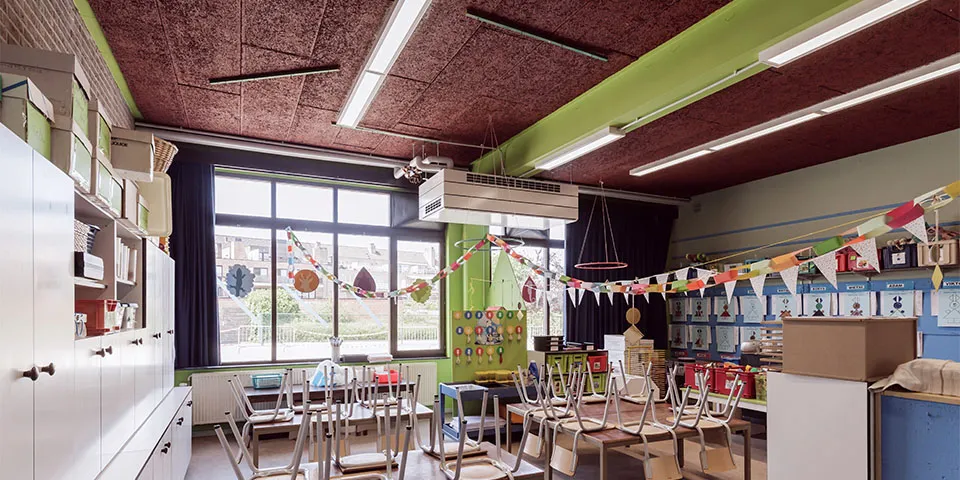
Public authorities are required to renovate a proportion of their buildings each year to improve energy efficiency: replacing windows, adding insulation … But if airtight renovation is not combined with ventilation, the result can be humid air, condensation problems and the risk of mould and bacteria. The city of Geel found this out when it went looking for a flexible ventilation system for individual rooms in its municipal school, youth centre, music academy and meeting rooms, without ventilation ducts.
Many school buildings in Flanders are outdated. After a school day, walking into a classroom can mean being greeted by a stale smell and the feeling that there is no oxygen in the air. Classrooms can thus become breeding grounds for micro-organisms. One reason why viral infections circulate so widely in winter is poor indoor air quality. Humidity levels above 40% significantly reduce the spread of viruses. With the coronavirus in mind, ventilation is therefore even more important. Opening the window regularly is a good start, but its effect is only temporary.
Fresh air
“For the city of Geel, we installed a ventilation unit in several classrooms at a nursery school,” says Maarten Diels, Area Sales Manager at Airmaster. “The children now play and learn in fresh air all day, so they can think clearly too. No nasty bugs, and CO2 levels stay within acceptable limits, as our units are fitted with CO2 sensors. We also installed units in the toilets at the same school. CO2 is not a problem there, but unpleasant odours are. The ventilation responds to movement, switching on when someone enters and turning off again after a few minutes. We also have units in the youth centre, where ventilation is essential when lots of people come to parties and events. Several meeting rooms in the town hall are being fitted with an Airmaster unit. And several rooms at the music academy are also equipped with an Airmaster unit.”
Self-regulating decentralised ventilation
Airmaster is a Danish manufacturer of decentralised type D ventilation units. The advantage of the
system is that no central extract system is needed: you only install units in the rooms you
want to ventilate.
Installation requires just two holes: one for the air supply and one for the extract. Plug it in and you’re ready to go. The Airmaster extracts stale air and draws in fresh air in response to its sensors, with as little heat loss as possible.
Online control of ventilation units
Maarten Diels: “Our units have sensors that switch the ventilation on and off as needed. You can also programme or operate the units directly. The city of Geel chose not to install local control panels. It monitors and controls everything online. The city’s technical department
has access to a dashboard with information from all the units. Each building’s end user only sees the units in their own rooms on their dashboard.”
Energy meters to save energy
Airmaster also fitted energy meters in the ventilation units for the city of Geel to monitor energy consumption. Maarten Diels: “A partner of the city keeps a close eye on the meters and looks for further opportunities to save energy. For example, by switching off the ventilation sooner in the toilets or running the classroom units only during lessons. If a unit is no longer working properly, they can see this immediately from its energy consumption and take action.”
Preventive maintenance
Airmaster also signed a maintenance contract with the city of Geel. Twice a year, it replaces the filters in the ventilation units and checks that everything is still working properly. If the maintenance technicians find that a unit is not performing at 100%, they resolve the problem or make any necessary adjustments.
Question about this story? Ask your question
Keep following this
Get an email when a new story is published. No account needed.
- ThemeHealthy air and summer comfort
- SubjectHVAC







