











The heat pump: a positive story (in times of climate change)
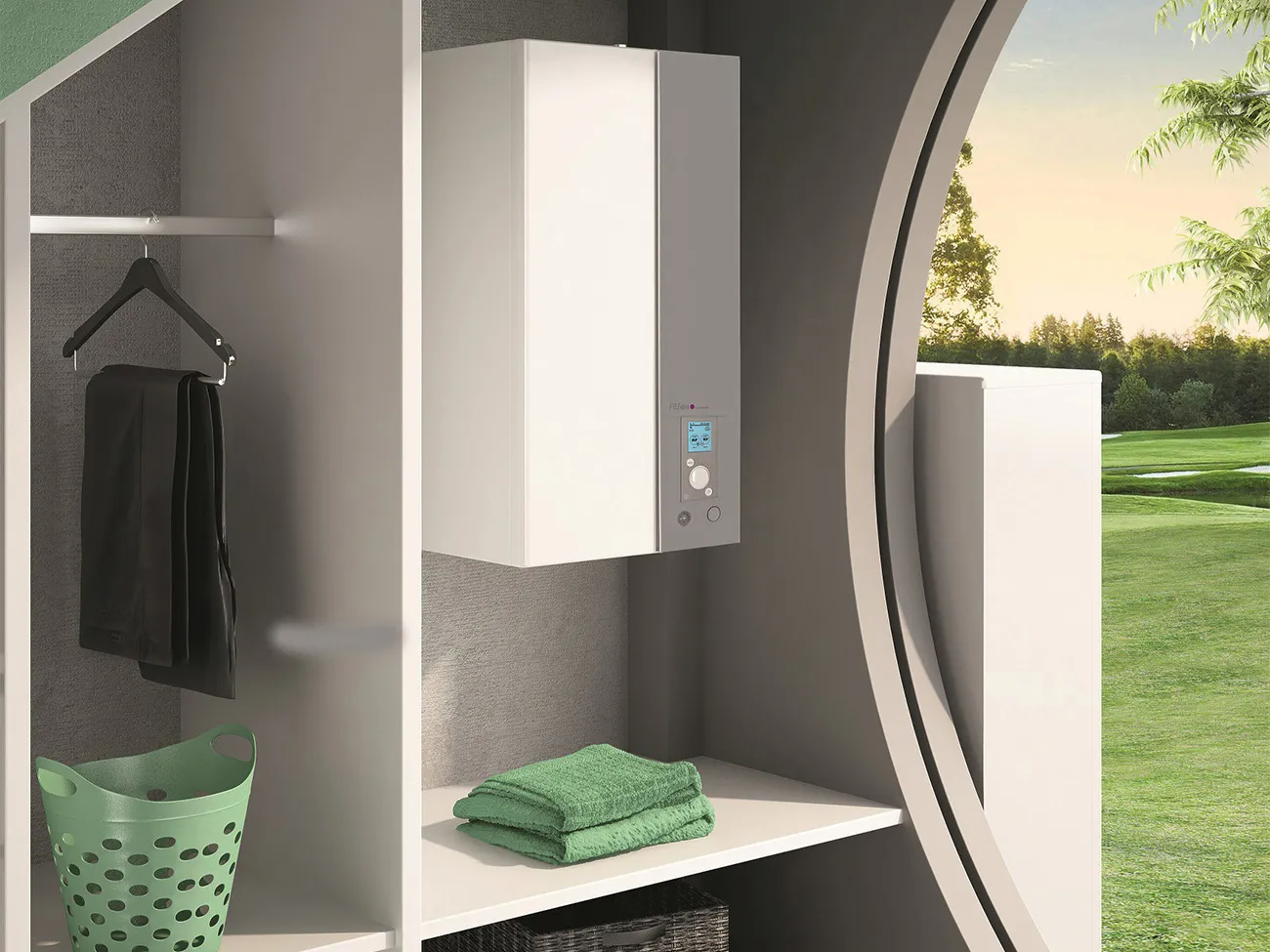
Today, we take central heating in our homes for granted. And more and more people are choosing to combine it with a heat pump as the most efficient way to use renewable energy.
Both technologies are now taken for granted and widely accepted, but from a historical perspective they are actually very recent developments, the heat pump even more so than central heating. Heating our buildings has undergone a long evolution.
In Roman times, most homes were heated with a wood fire or an open fireplace. In the 2nd century BC, baths, other public buildings and larger private homes were sometimes already fitted with underfloor heating fuelled by wood. The first stoves were made in the 17th century, and the first central heating system in a home was installed in London in 1819. However, it was not until around 1965 that central heating became commonplace. Heat was initially produced by burning wood and coal, and later mainly by heating oil or natural gas. All of these are fossil fuels. But that era is gradually coming to an end.
The end of the fossil fuel era is fast approaching…
As we become more aware of humanity’s negative impact on the climate, now more than ever following last summer’s disasters and the latest UN report on climate change, attention is increasingly turning to sustainable heating that drastically reduces CO2 emissions. Heat pumps are the most obvious choice.
…but major steps still need to be taken
In 2017, an interfederal Energy Pact was agreed in Belgium with the aim of making the country climate-neutral by 2050. One of the first steps in the pact is to phase out our fossil fuel heating systems, starting with heating oil. But that is not so easy.
35% of homes in Belgium are still heated with heating oil. The figure is even higher in Wallonia, at 50%.
In Flanders, 16% (or a quarter?) of households still heat their homes with heating oil. Since the beginning of 2021, it has been prohibited to install an oil-fired boiler in a new-build home or as part of an energy-efficient renovation. It is likely that replacing a boiler with an oil-fired one will also be prohibited from 1 January 2022.
In the Brussels-Capital Region, where 16% of homes are heated with heating oil, similar steps are being taken, with a ban on oil-fired boilers due to come into force in June 2025. There are plans to offer Brussels consumers a grant if they want to remove their oil-fired heating system between 2021 and 2025.
As mentioned, in Wallonia, where half of consumers use heating oil as their heat source, a ban will certainly not be introduced before 2035.
Heating with natural gas will also gradually come under pressure. Energy supplier Eneco has already decided to stop supplying natural gas from 2035.
Heat pumps are ready for the future
Our homes are becoming better insulated, which is good news for heat pumps
The government is increasingly urging homeowners to ensure that homes are well insulated, not only when building new homes but also during renovations. This reduces the required heating capacity, making the investment in a (smaller) heat pump more attractive.
The capacity tariff and smart meter can work in heat pumps’ favour
As the outdoor temperature changes only gradually, the heating demand is low (low-temperature heating, around 35 °C) and the building is well insulated (or should be), a heat pump will have a fairly steady electricity consumption profile. During normal operation (with a constant indoor temperature), there are no peaks.
According to the current plans, a new electricity tariff will be introduced in Flanders from 1 July 2022: the ‘capacity tariff’. Part of your bill will no longer be calculated on the basis of the amount of electricity you take from the grid (kWh), but on the basis of the peaks in your consumption (kW). With the capacity tariff, the VREG (Flemish Regulator of the Electricity and Gas Market) wants to encourage consumers to use the existing grid more efficiently: those who cause high peaks will pay more than those who spread their consumption. This can be good news for heat pumps.
A smart meter is needed, among other things, to make it possible to implement the capacity tariff. Given how heat pumps operate, they will generally benefit from a smart meter. The controls that a smart meter makes possible for a heat pump can prevent consumption peaks, for example by avoiding running the tumble dryer, washing machine and oven at the same time.
Consumers will avoid consumption peaks and spread their usage more evenly, reducing the load on the electricity grid. If there are fewer or no peaks, less investment will be needed to adapt the grid, and distribution costs will not have to rise unnecessarily. In the long term, this should have a positive effect on energy prices.
A smart meter also enables suppliers to offer dynamic energy tariffs. This means you can buy electricity at lower rates when there is plenty of (renewable) energy available. In time, this will prevent peaks not only at the consumer’s premises but across the entire grid.
Heat pumps are easy to control
The controllability of installations that use electricity is very important for avoiding peaks. The government is well aware of this and offers grants for installations that meet quality requirements and are preferably controllable.
Incidentally, grants are still available for insulation and for removing the exclusive night meter.
A green tax shift would be the icing on the cake
Back in 2017, our governments proposed a green tax shift: by levying more tax on fossil fuels and less on electricity, the aim is to make the latter more attractive to use. The high levies on electricity mean that certain renewable energy applications, such as heat pumps, still have too small a market share. Yet they are by far the most appropriate way to reduce CO2 emissions from heating. The current governments are still seriously considering implementing this shift in taxation.
All the advantages, points to consider and myths surrounding heat pumps are covered on our website: https://www.infowarmtepomp.be/nl/

Question about this story? Ask your question
Keep following this
Get an email when a new story is published. No account needed.
- ThemeFossil-free heating and cooling
- SubjectHVAC







