PODCAST: System water in HVAC systems: causes of problems and solutions for better performance
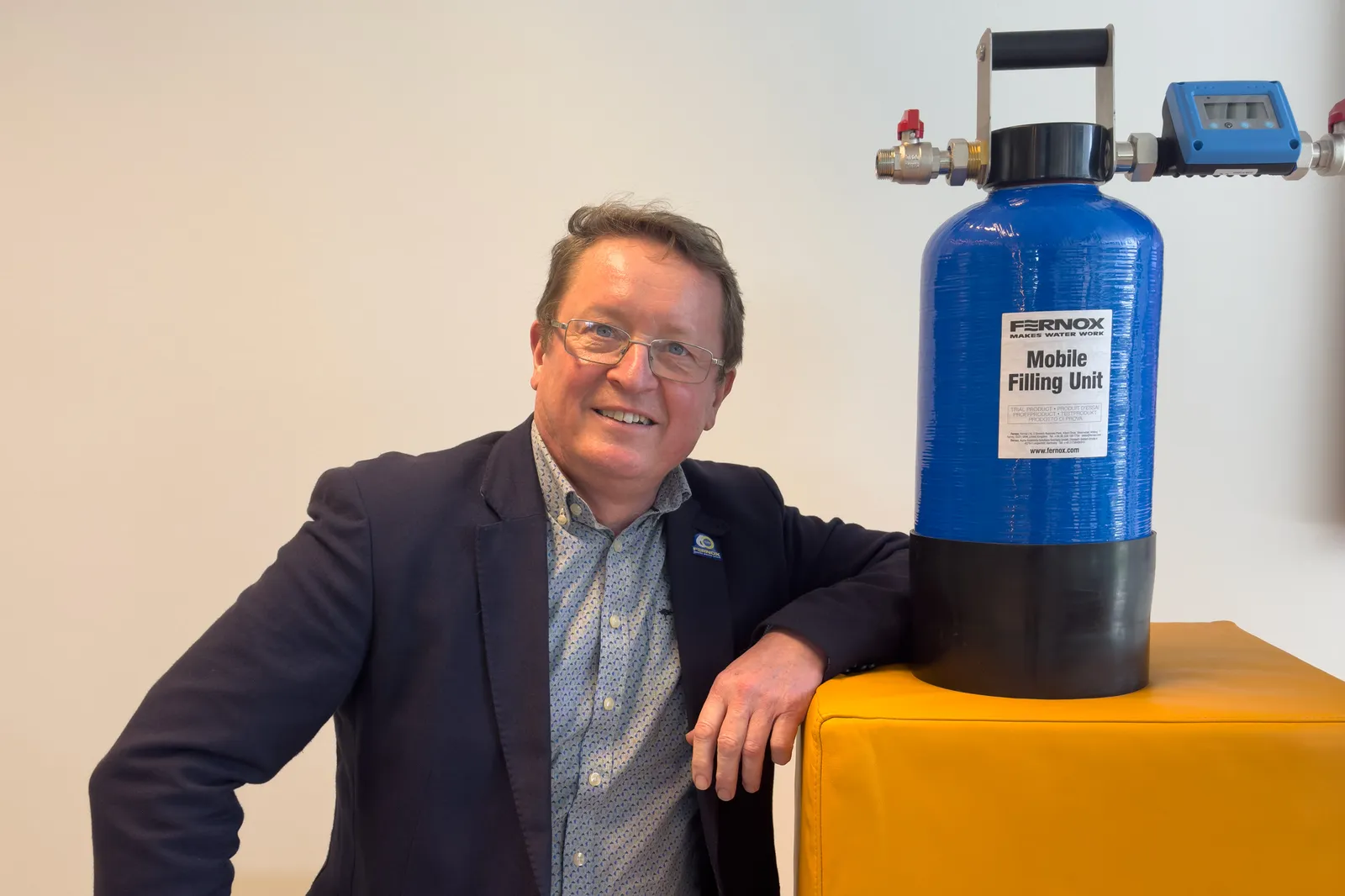
A conversation with Yves Desplenter: Host: Wouter Polspoel
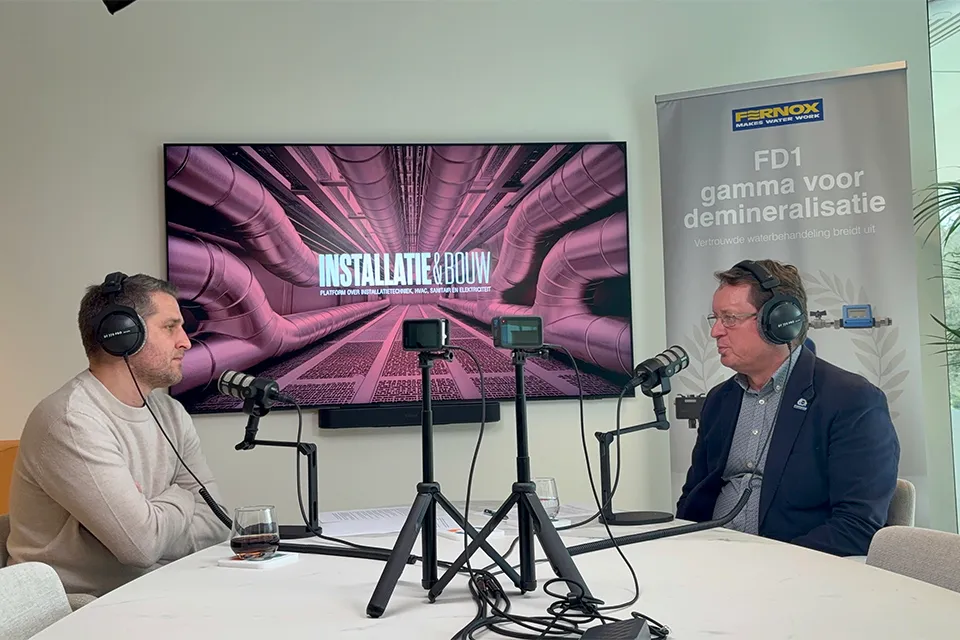
System water plays a crucial role in the performance and service life of HVAC systems, but often gets too little attention in practice. In this episode of the Installatie en Bouw podcast, Wouter Polspoel talks to Yves Desplenter (Fernox) about the impact of water quality on heating and cooling systems. From sludge formation and corrosion to heat pump faults: find out why problems are often addressed too late and what preventive measures installers can take to improve efficiency, reliability and service life in the long term.
Een zakelijke vraag aan Fernox? Get in touch
Full transcript
All chapters (21)
- Introduction and the importance of system water
- Introducing Fernox
- The problem of water quality being underestimated
- The myth about black water
- Causes of problems in HVAC systems
- A combination of factors
- Heat pump sensitivity
- Reasons for increased sensitivity
- Component sensitivity
- The role of water quality in faults
- Risks when renovating
- Preventive measures
- Monitoring and maintenance
- Responsibility for maintenance
- Water quality and warranty conditions
- Consequences of faults
- Practical solutions in the industry
- A change in mindset in the sector
- Expectations for the future
- Recommendation for the sector
- Closing
Introduction and the importance of system water
Wouter Polspoel Welcome to a new episode of the Installatie en Bouw podcast. Water is present in every heating and cooling system, but rarely takes centre stage. Yet this seemingly mundane system water often determines the performance, service life and reliability of the system. Today, I’m discussing the subject with Yves Desplenter from Fernox. What exactly goes wrong in practice? Why is the issue still underestimated? And, above all, how can it be tackled systematically? Hello, Yves.
Yves Desplenter Hello, Wouter.
Wouter Polspoel First of all, Yves, could you briefly introduce Fernox?
Introducing Fernox
Yves Desplenter Fernox is a British company specialising in water treatment for heating, cooling, solar panels and heat pumps. We do this using chemical products as well as other methods, such as a magnetic filter.
The problem of water quality being underestimated
Wouter Polspoel Yes, thank you. Yves, you’ve just taken part in a round-table discussion we recorded on this subject, and the report is in the second issue of Installatie en Bouw this year. One thing that stood out in the discussion was that the quality of system water in heating and cooling systems often only gets attention when problems arise. Why do you think system water quality remains such an underestimated issue?
Yves Desplenter Very often, installers only take action when problems do arise. The industry knows that untreated central heating water often causes problems and that preventive action is needed. Fortunately, we’re seeing installers take more and more steps in the right direction, thanks to greater support from boiler and heat pump manufacturers, as well as specific guidance from the industry.
Read the full transcriptCollapse transcript18 more chapters
The myth about black water
Wouter Polspoel All right. Is there anything said or observed during that round-table discussion that has stayed with you?
Yves Desplenter The persistent myth in our industry is that black water is dead water, and dead water is good water. I’m pleased that, together with heat pump manufacturers, we’re taking a clear step forward. Contamination has no place in a central heating system, especially not in a heat pump system. Dirty water can never be good water, whether it’s black or not.
Causes of problems in HVAC systems
Wouter Polspoel Clear. If you had to identify one technical mechanism that is most often at the root of problems in HVAC systems, what would it be? Magnetite formation,
Yves Desplenter oxygen ingress, limescale deposits, sludge? Very often, these phenomena go hand in hand. It often starts with a small amount of limescale build-up. People try to remedy this by flushing the system. After flushing, it is refilled with fresh water. Fresh water, air and oxygen: hence corrosion, hence sludge formation. So one effect can reinforce another if you go about things the wrong way. It’s rarely just one of the phenomena I mentioned that causes the problem. It’s usually a combination of several.
A combination of factors
Wouter Polspoel And what exactly happens in a system when magnetite, sludge or one of the other problems we’ve mentioned develops? Where in the system does things usually go wrong?
Yves Desplenter There are several critical components in a central heating system. Very often, the pump becomes less effective at circulating the water, control devices and three-way valves seize up, pressure sensors trigger fault messages, and eventually the boiler goes into fault mode or the heat pump has insufficient flow. So several components are particularly vulnerable to contamination and limescale flakes.
Heat pump sensitivity
Wouter Polspoel You mentioned heat pumps and boilers. If I’ve understood correctly, heat pumps and other low-temperature systems are more sensitive to poor water quality than conventional boiler systems. Is that right?
Yves Desplenter That’s right.
Reasons for increased sensitivity
Wouter Polspoel And why is that exactly?
Yves Desplenter Heat pumps are less able to remove air from a system than, for example, a conventional gas-fired wall-hung boiler fitted with a microbubble air vent. In practice, this means that domestic heat pump systems often contain a lot of air, and therefore a lot of oxygen, making them highly susceptible to corrosion.
Wouter Polspoel And is that because of the lower temperature?
Yves Desplenter The lower temperature is one factor, but it’s also because underfloor heating involves a high proportion of plastic pipework. There are usually still some metal components, though, and these are exposed to oxygen, resulting in significant localised corrosion.
Component sensitivity
Wouter Polspoel Yes, and is it also true that the pipes in a low-temperature system are narrower than those in conventional central heating systems? And that this makes them more susceptible to problems? Or not so much
Yves Desplenter the pipes, but the heat exchanger in a heat pump. It has very specific, narrow channels that are indeed highly susceptible to even light contamination. Heat pumps often also have a built-in strainer, which can quickly become clogged, reducing circulation and the heat pump’s energy efficiency.
The role of water quality in faults
Wouter Polspoel Yes, all right. When you at Fernox analyse underperforming systems, how often does water quality turn out to be the cause or a contributing factor?
Yves Desplenter We’re very often called out when problems have already arisen. So we’re often there when things have gone wrong. In 9 out of 10 cases, water quality is part of the problem. Of course, if there are fundamental design faults in a system, water treatment alone won’t solve them. But the reverse is also true: even if a system has been properly designed and installed, water quality always affects its overall performance.
Risks when renovating
Wouter Polspoel During renovations, heat pumps are often connected to existing circuits. Does this create specific risks for system water quality?
Yves Desplenter Absolutely. In renovation projects where part of the system is retained, whether the radiators or the pipework, to avoid the cost of replacing the entire system, there is almost always some form of contamination in a system that is fifteen years old. It’s therefore essential to assess these systems beforehand, estimate how much dirt may be present and decide on the best way to clean and flush the system.
Preventive measures
Wouter Polspoel Yes. In your view, Yves, what are the three most important measures installers can take when installing a heating or cooling system to
Yves Desplenter prevent problems with system water? With a new system, you’re starting from the ideal point: the water is clean, so take every precaution to keep it that way. That means demineralising the water and protecting it with F1 Protector corrosion inhibitor. For an existing system with contamination, the first step is to clean it, then fit magnetic filters on the return pipe to remove as much contamination as possible from the central heating system.
Monitoring and maintenance
Wouter Polspoel All right. How do you monitor system water quality over the lifetime of a system, and does this happen in practice?
Yves Desplenter Systems are still supposed to be serviced, and under technical specification 278, water quality should also be checked during central heating system maintenance. Unfortunately, for many, this specification is a dead letter. We see that not all installers monitor the system in this way. Magnetic filters are sometimes not cleaned, even though maintenance is the ideal opportunity to check the quality of the water circulating in the system.
Responsibility for maintenance
Wouter Polspoel But is it the installer’s responsibility to do this periodically, or should the end user be the one to ask for it?
Yves Desplenter There is a legal requirement for gas-fired wall-hung boilers to be serviced every two years, so responsibility for arranging this lies with the end user. However, when carrying out the service, the installer is responsible for inspecting the entire system and checking what else needs to be done, including cleaning any magnetic filter that is fitted.
Water quality and warranty conditions
Wouter Polspoel To what extent does water quality affect warranty conditions? Do manufacturers actually set specific requirements for
Yves Desplenter system water? Definitely. If you look at the installation manual from any manufacturer, you’ll usually find requirements for the hardness, conductivity and pH of the fill water in the central heating system.
Consequences of faults
Wouter Polspoel All right. So, assuming the warranty applies, what happens if a system fails because of poor system water? Will the manufacturer simply replace the entire system, meaning the heat pump?
Yves Desplenter Usually, the first step is to establish exactly what the problem is. If there is contamination and a component needs replacing, the installer and heat pump manufacturer will often discuss the costs and who is ultimately responsible. Besides being a technical issue, it is also a purely economic one, so the installer and manufacturer often reach a practical solution between them.
Practical solutions in the industry
Wouter Polspoel Yes, because that also came up during the round-table discussion. Replacing the entire installation is very expensive and, of course, users cannot do without it. So the problem is often resolved quickly, and things do not come to a complete replacement or even taking the manufacturer to court or anything like that.
Yves Desplenter: Those proceedings always take a long time. The sector generally tries to avoid that and instead looks at whether the parties can find a solution together.
A change in mindset in the sector
Wouter Polspoel Yes, you may have touched on this briefly earlier, but are you seeing a change in mindset among installers and design firms when it comes to system water quality in heating and cooling systems?
Yves Desplenter: There are two sides to it. Let us start with the positive. There are indeed a number of people, both design firms and installers, who are seeking guidance and advice from heat pump manufacturers. What exactly has changed between a conventional wall-mounted gas boiler and a heat pump? What has changed technically? What do we need to do differently? How can we guide this process? That gives me reason to be hopeful. There are still some players in the market who are trying to apply the simple principle of taking one boiler off the wall and putting another one up in its place to heat pumps. Just quickly remove the old boiler, install the heat pump and hey presto, everything is ready. My hope is that the first group will grow large and strong enough to guide the energy transition in the right direction.
Expectations for the future
Wouter Polspoel And is that just a hope, or is it also an expectation?
Yves Desplenter: It is an expectation, and many players in the sector are working towards it. Among other things, by continually highlighting water quality, explaining its importance, offering the opportunity to attend training, providing access to information and simply applying the right techniques.
Recommendation for the sector
Wouter Polspoel Yes, all right, one last question, Yves. If you could make one recommendation to the installation sector to improve system water quality in heating and cooling systems, what would it be?
Yves Desplenter: Seek guidance from qualified professionals. Ask your heat pump manufacturer about training. Ask why water quality can be important and what benefits it brings to the heating system as a whole. If you have questions, ask them.
Closing
Wouter Polspoel Yes, and just to be clear, that advice is for installers, not end users.
Yves Desplenter: Installers are the ones who should have the knowledge to bring about this energy transition in
Wouter Polspoel the right way. All right, that is a good conclusion. Thank you, Yves. I should also mention that you took part in the round-table discussion on this subject, which is covered in this year's issue 2 of Installatie en Bouw, due to be published in the second half of April.
Yves Desplenter: Thank you, Wouter.
Companies in this story
Keep following this
Get an email when a new story is published. No account needed.
- ThemeImproving building services performance
- SubjectHVAC
- CompanyFernox