











Pixii study day tackles the problem of overheating

‘Combine passive strategies with sustainable cooling systems’
Climate change is also affecting how we will need to manage our buildings in the future. More heatwaves mean greater heat stress and potential risks for vulnerable people. To address these major challenges, Pixii organised a virtual Expert Day devoted entirely to overheating in buildings.
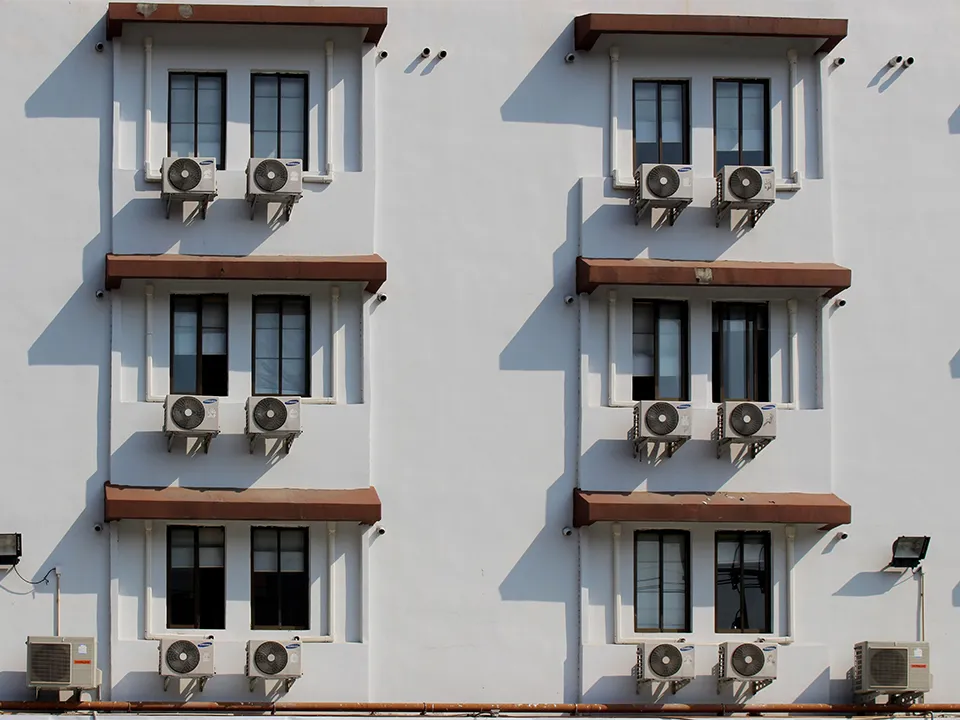
Words Filip Van der Elst | Image Pxhere
Pixii opened the Expert Day with an unequivocal call to the government: “We will need a way to cope with the rising number of heatwaves, and to recognise the associated costs without losing sight of our CO2 emissions targets”, it said. Should design rules and EPB requirements, for example, be revised?
It is no secret that the Earth is warming, but to explain the precise situation, Pixii invited Steven Caluwaerts, a climate scientist affiliated with Ghent University and the Royal Meteorological Institute of Belgium. He got straight to the point: “Heatwaves have a huge impact on people’s health. During the recent heatwave, in July and August 2020, there were 1,460 additional deaths in Belgium.”
Occupant behaviour
A 2016 survey of 149 low-energy homes, conducted as part of the Walloon MEASURE project, left little room for doubt. “More than half of the residents complained of excessive heat in the living room, and in the bedroom the figure was as high as two in three”, said Jeroen Van der Veken of WTCB. The main factors contributing to overheating are not necessarily design choices. Much more often, it is significantly different occupant behaviour, as well as whether passive cooling measures are properly implemented, that plays a role. Consistent use of solar shading and night ventilation in particular has a major impact. One of the key challenges in tackling overheated homes and offices is how to do so in an energy-efficient way. Most experts emphasise passive cooling: solar shading is an obvious first step, fully in keeping with the ‘trias energetica’ philosophy. Keeping heat out is a better solution than removing it from the building afterwards. The next step is passive cooling.
Ventilative cooling
Hilde Breesch, professor in the Department of Civil Engineering at KU Leuven, made the case for ventilative cooling. This uses outdoor air to cool the building. Night ventilation is a good example. It can be natural, mechanical or hybrid. “Generally, it is not enough to eliminate active cooling entirely, but it can reduce the capacity required and therefore the energy consumption of active cooling systems”, said Breesch. “Ventilative cooling is an attractive solution, because many homes already have a ventilation system.”

Breesch also noted that the cooling season is getting longer. “In nearly zero-energy buildings, overheating is a problem all year round”, she said. “What’s more, this year we even had very warm days at the end of September. Cooling is also increasingly needed during the shoulder seasons. That is precisely when night cooling comes in useful, because outdoor temperatures are generally a little lower at night.” A number of barriers are still preventing ventilative cooling from making a real breakthrough. Not only is the principle less effective during a summer heatwave, when it is just as warm or even warmer outside than indoors during the day, but there are also challenges relating more to the design process. “Ventilative cooling is not a standalone device that you can simply order from a supplier. The concept is based on cooperation between the building envelope and the building services, in other words, between the architect and the HVAC engineer. The controls are also crucial.”
A combined approach
WTCB believes the key lies in an intelligent combination of passive strategies and sustainable cooling systems. The TETRA project SCoolS, run by Thomas More Kempen and WTCB, is studying alternative sustainable cooling technologies that could offer an additional solution. Systems based on free geocooling and (indirect) adiabatic cooling can achieve very high efficiency ratios and contain no refrigerants.
“We are not opposed to reversible heat pumps either. They allow us to kill two birds with one stone, because using this type of heat pump for cooling also enables us to electrify heating during the winter months”, said Van der Veken. There is, however, a caveat: “Many lower-quality air-conditioning systems are also being installed, including portable units from DIY stores, with far too low an efficiency. They use F-gases with a high GWP.”
Question about this story? Ask your question
Keep following this
Get an email when a new story is published. No account needed.
- ThemeHealthy air and summer comfort
- SubjectHVAC







