Comparing sustainable cooling systems
Although a building’s cooling demand can be greatly reduced through appropriate design and the use of passive cooling strategies, a cooling system will still be needed in many cases to ensure good thermal comfort, even during increasingly hot summers. However, these cooling systems differ considerably in terms of cooling capacity, thermal comfort, energy consumption, cost and environmental impact. It is therefore important to understand their possibilities and limitations. The WTCB compared sustainable cooling systems for this article, which appeared in WTCB-Contact n° 76.
Since sustainability is a broad concept, a comparison of various cooling systems was carried out as part of the CORNET project SCoolS. The focus was on cooling systems that achieve very high energy efficiency and contain as little refrigerant as possible. Where neither a compressor nor refrigerants are involved, the system is also referred to as free cooling.
There are several forms of free cooling. In office buildings, for example, systems with heat exchangers on the roof are often chosen, whereas free geocooling is more commonly used in residential buildings. These systems consist of a geothermal heat pump, an additional heat exchanger and a modified control system. These additions mean that the heat pump does not need to run in summer and that the cooling stored in the geothermal source during winter can be transferred to the heat emission system via the heat exchanger, without an active cooling component. However, the installation must meet a number of requirements. In particular:
- the geothermal source must be correctly sized. A closed-loop system in particular must be cooled sufficiently by the heat pump during winter to provide enough cooling in summer. After all, the ground temperature must still be low enough at the end of summer, typically 16 °C for free cooling
- the heat emission system must provide sufficient cooling capacity even at higher flow temperatures, generally 16-18 °C, since the geothermal source and heat exchanger cannot deliver lower temperatures at peak times. Just as heating systems work best when heat is emitted at low temperatures, cooling systems should aim for the highest possible flow temperature. This also reduces the risk of condensation forming on the cooled surface as a result of humid indoor air. The downside, however, is that the air cannot be dehumidified.
Different heat emission systems
The comparison of cooling systems assumed that the source was correctly sized, but included several different heat emission systems, namely:
- a ‘hybrid’ or ‘dynamic’ convector or radiator that can also provide cooling (see Figure 1). However, its output is limited by the small temperature difference. For example, a hybrid convector that emits 40 W/m² of heat in winter at a flow temperature of 40 °C can emit around 15 W/m² in summer at 16 °C. Since these systems are not designed to collect and drain condensate, an additional control system must be installed to keep the heat exchanger temperature above the dew point of the indoor air. This can further reduce the output
- two floor cooling systems: a conventional system with pipes in the screed and a system with a ‘dry’ construction, with maximum cooling output ranging from 30 to 40 W/m² at a flow temperature of 16 °C. Here too, a control system must be provided to raise the flow temperature if the relative humidity at the surface threatens to become too high, thereby preventing condensation on the floor.
- a cooling coil in the supply air duct of a balanced ventilation system. This can be connected to a sustainable source at a higher temperature, such as a geothermal loop at 16 °C. However, this results in limited cooling capacity, typically 0.6 kW at a flow rate of 300 m³/h.
Evaporative cooling
Evaporative cooling was also included in the comparison. This process involves extracting heat from the surrounding air as water evaporates. Finally, two more conventional cooling systems were included in the comparison:
- a cooling coil in a balanced ventilation system connected to a low-temperature compressor cooling system, which can almost double the output compared with a high-temperature cooling coil. However, this comes at the expense of generation efficiency.
- a convective cooling system that can in principle be sized to meet any demand, but was capped at 50 W/m² of cooling in this study. This could be a reversible air-to-air heat pump with indoor units, or fan coil units connected to an air-to-water heat pump.
How do these cooling systems perform in terms of comfort and energy?
Dynamic energy simulations were used to investigate 9,200 combinations, varying the following parameters:
- five dwelling types
- two window sizes
- two thermal mass levels
- two insulation levels
- four orientations
- three types of solar shading
- three levels of ventilation cooling
- eight different cooling systems.
Although these simulations were originally intended to develop a tool and enable case-specific comparisons in terms of comfort and energy, they can also provide an overall picture of the performance of the various cooling systems.
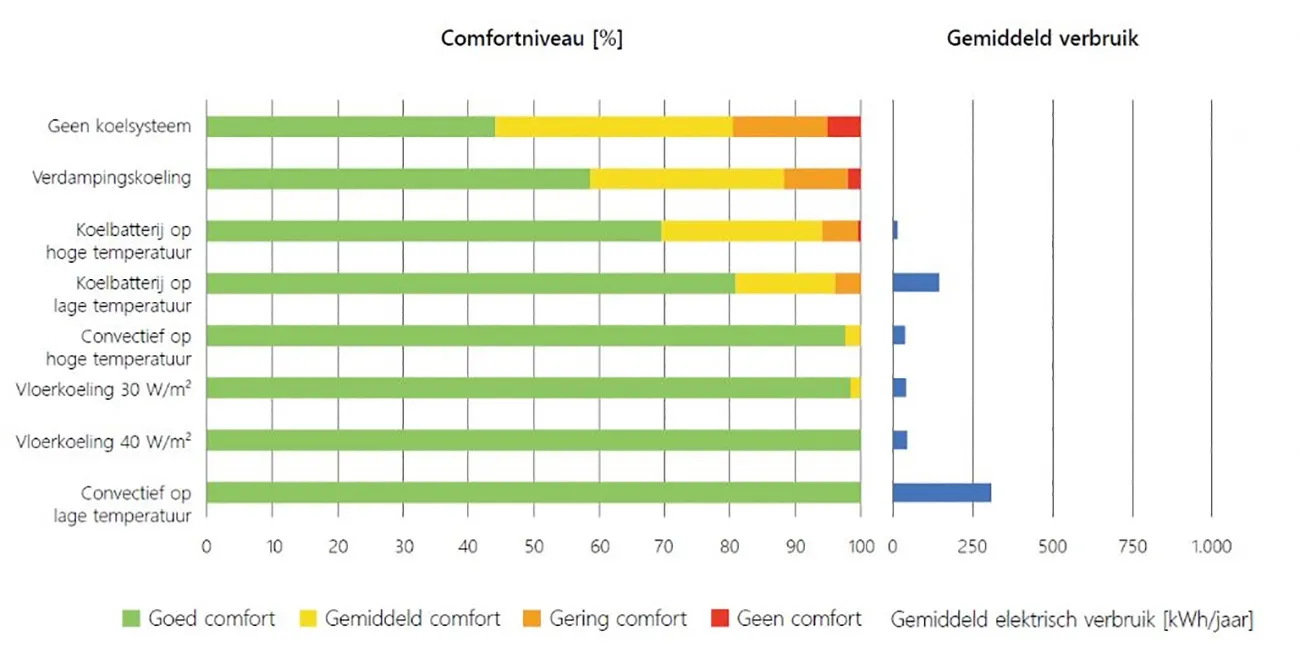
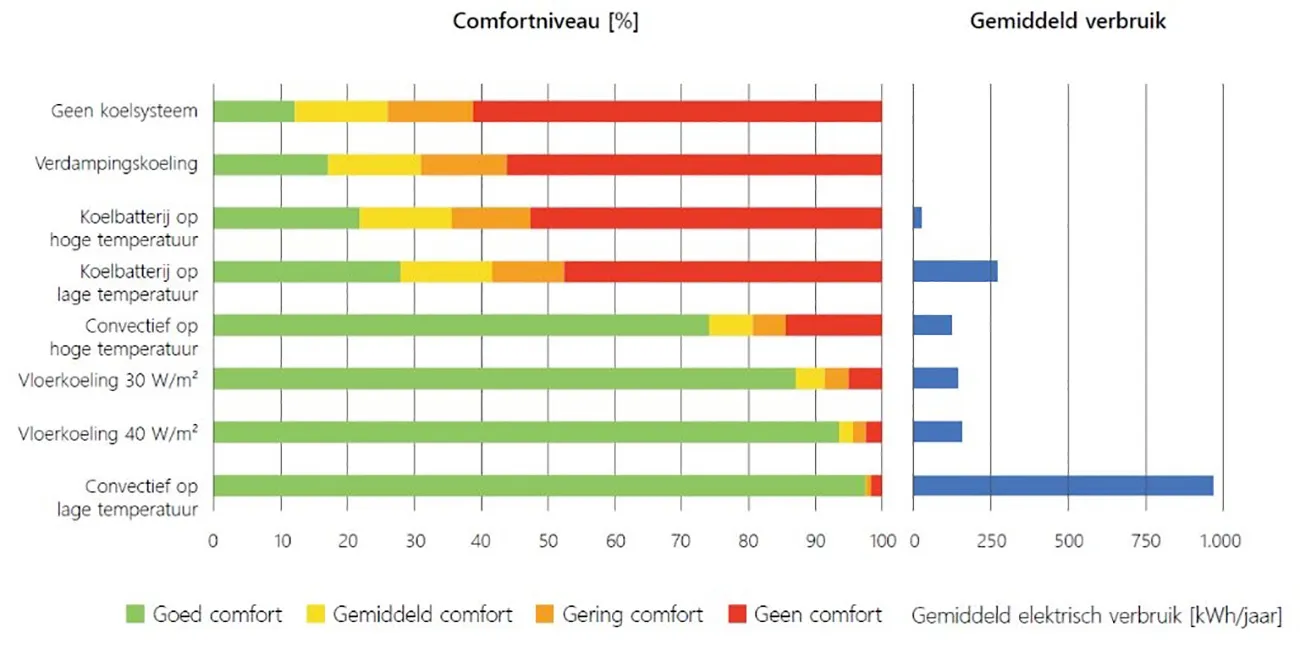
Comfort levels were determined on the basis of the maximum permissible temperature in the home, namely 28 °C during the day and 26 °C at night. If the simulated indoor temperature exceeds these limits for less than 33 h over the entire summer, summer comfort can be considered good. Between 33 h and 100 h, comfort is average, and up to 250 h, it is limited. Above that, comfort can be considered poor.
The graph shows that 60 per cent of the simulated homes without a cooling system have only limited summer comfort, and barely one eighth of the homes achieve good comfort. Although comfort does improve after installing indirect evaporative cooling or a cooling coil in a balanced ventilation system, three quarters of the dwelling variants only achieve good comfort after installing a system with greater cooling capacity, such as a hybrid convector delivering 15 W/m² of specific cooling output at higher cooling temperatures, floor cooling (30-40 W/m²) or conventional low-temperature convective air cooling at 50 W/m².
Energy consumption also increases as cooling capacity rises, although it remains within reasonable limits. Consumption stays low with high-temperature systems, such as high-temperature convective cooling or floor cooling, thanks to the high efficiency of the associated free cooling. Even with conventional cooling systems, using low-temperature convective cooling, average consumption remains just below 1,000 kWh/year.
Comfort improves dramatically when solar shading and ventilation (night-time) cooling are used. If we consider only combinations that include these passive cooling strategies, we find that almost half of the homes achieve good summer comfort even without a cooling system. Evaporative cooling and cooling coils in the ventilation system also perform much better. Systems with separate heat emitters, particularly convective cooling or floor cooling, provide good comfort in these cases. Finally, energy consumption falls considerably, to an average of around one third of that across all homes.
Sustainable cooling systems and passive measures
The simulation results show that it is indeed possible to achieve good summer comfort while keeping energy consumption low. Combining free cooling with heat emission systems operating at higher temperatures also makes it possible to avoid potentially harmful refrigerants. Since these sustainable systems often have a lower output, selecting and sizing them is not always straightforward.
Where cooling via the ventilation system can be sufficient when combined with these passive measures, it is mainly hybrid convectors and floor cooling that guarantee good summer comfort.
Question about this story? Ask your question
Keep following this
Get an email when a new story is published. No account needed.
- SubjectHVAC