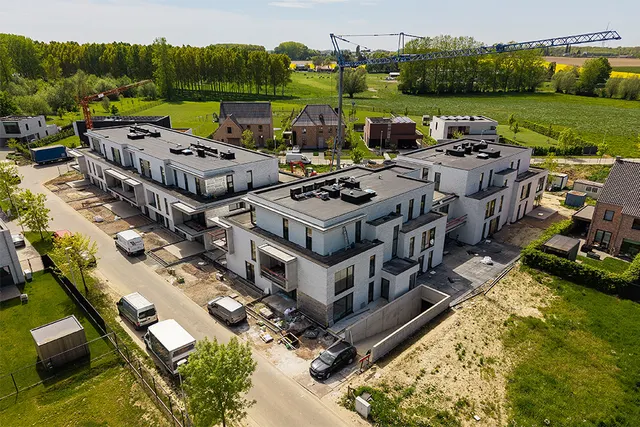
Cascade configuration ensures reliable operation of monobloc heat pumps in logistics centre
Text Buderus en Wouter PolspoelImage Marco Mertens
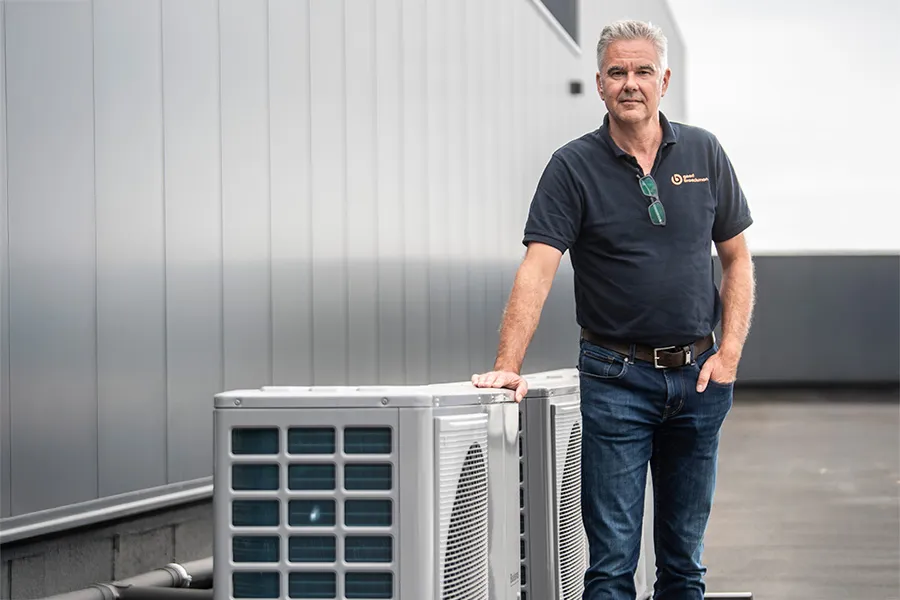
A logistics centre in Herne, which stores professional construction tools, decided to heat and actively cool its offices with heat pumps, making use of a structural surplus of self-generated solar electricity. To ensure reliable operation, the Buderus air-to-water heat pumps were installed in a cascade configuration.
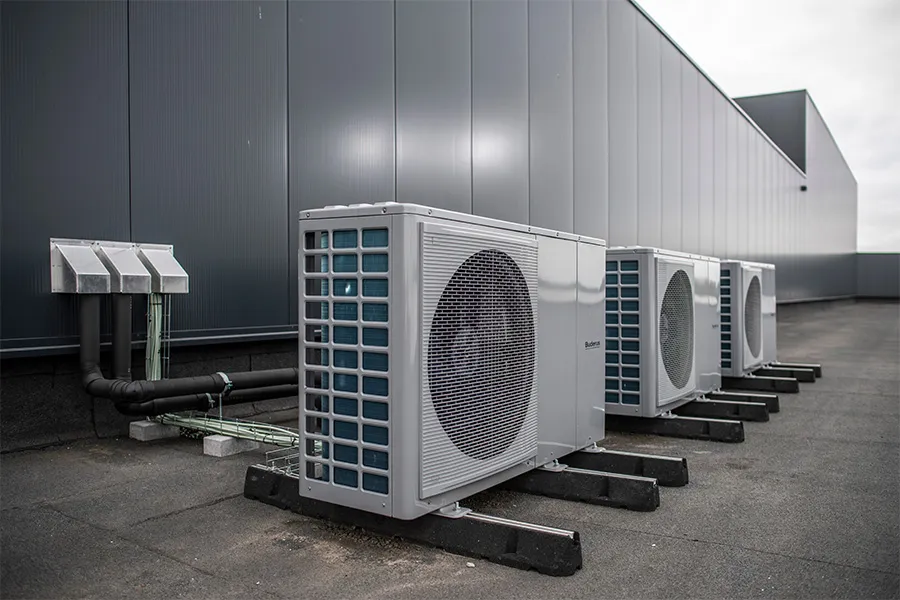
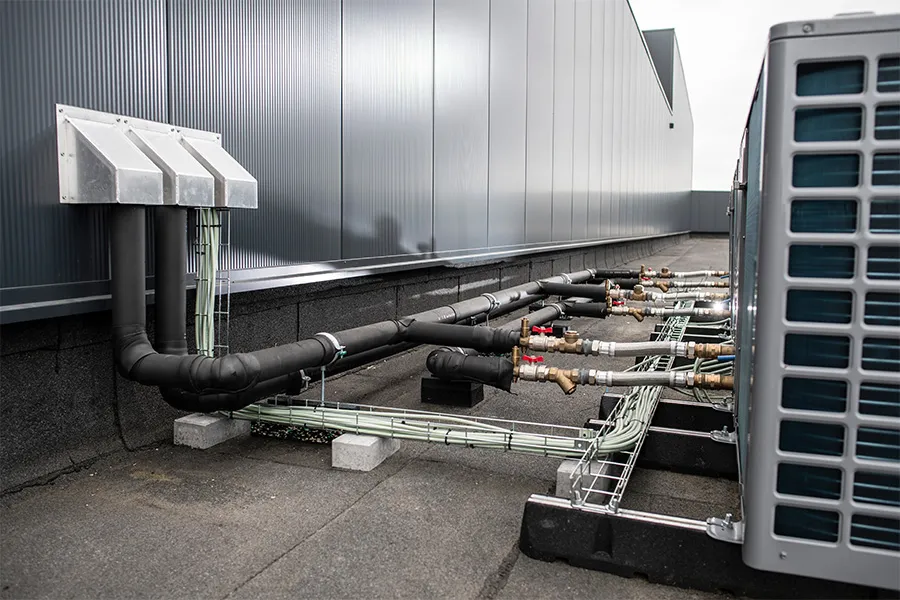
Geert Braeckman from Serskamp, a building services specialist, installed the Buderus air-to-water heat pumps. “Three in total, in a cascade configuration,” he begins. “They are monobloc heat pumps that work together to deliver the required output, while also acting as back-up for one another. This ensures heating and active cooling for the offices, which are spread over three floors with a combined area of approximately 1,250 m². Underfloor heating was installed on all levels, along with ceiling- and wall-mounted fan coil units, which provide supplementary heating but are used mainly for cooling. We also carried out that installation. The client initially wanted geothermal heat pumps, but it soon became clear that this would be far too expensive. The rocky ground would make the drilling costs prohibitively high.”
“The heat pumps are connected in parallel using the so-called Tichelmann system,” the installer explains, providing more detail about the cascade configuration. “This ensures that each heat pump delivers the same flow rate and encounters the same resistance. One heat pump acts as the ‘master heat pump’ and controls the system. The second heat pump is connected to this master unit, and the third to the second. The master heat pump starts first, followed by the second and third in sequence if required.”
Heat pumps that set the standard
Buderus offers an extensive range of monobloc heat pumps, from the Logatherm WLW156 air-to-water heat pump, which has no indoor unit, to the ultra-quiet Logatherm WLW196i and the Logatherm WLW176i, which uses propane as its refrigerant. The latter two heat pumps do have an indoor unit, but as it operates solely on the hydraulic side and the entire refrigerant circuit is housed in the outdoor unit, they can still be considered monobloc heat pumps. They are also sometimes referred to as semi-monobloc heat pumps.
This latter feature is also the main advantage of a monobloc heat pump: the installer only needs to run a water pipe indoors. F-gas certification is therefore not required for installation. If work on the refrigerant circuit is needed, a specialist from Buderus Service can be called in.
Numerous benefits
Reliable operation is undoubtedly the greatest advantage of a cascade configuration. “If a heat pump ever fails, we receive an error code via an app. We can then schedule a service visit while the system continues running on the other heat pumps. As I said earlier, this guarantees continuity of service,” says Geert Braeckman.
The installer also points to other benefits of the cascade configuration. “Ease of installation is one of them,” he says. “Installing three smaller heat pumps is easier than installing one large one,” he explains. “A cascade configuration is also easy to expand. If the company wants to grow in future, for example, we can add another monobloc heat pump to the existing system relatively easily. The pipework is already designed for this, and the existing hydraulic system and buffer tank can be retained with a minor modification. This is much harder to achieve with a split system. A monobloc system uses heating pipes only, whereas a split system requires both heating pipes and refrigerant lines. If we had chosen a split system, each of the three outdoor units would have needed its own indoor unit, with three separate refrigerant circuits running indoors, making installation much more complex. With the current system, all the equipment is in the outdoor units, so no indoor units are needed. Split systems are therefore more common in smaller projects, where only one heat pump is required.”
Tip
Geert Braeckman has one final tip for fellow installers considering a similar project. “Don’t underestimate the weight of a monobloc heat pump. Each unit can easily weigh 130 kg. If the units are to be installed on a roof, as they were in the Herne project, it is essential to check the stability of the roof structure and make sure you can reach the installation site with a crane or lift.”
Buderus: Stand number 92
Een zakelijke vraag aan Buderus? Get in touch
Companies in this story
Keep following this
Get an email when a new story is published. No account needed.
- ThemeFossil-free heating and cooling
- SubjectEvents
- CompanyBuderus