“BIM is opening up more and more possibilities at every stage of the construction process”
Text Tim JanssensImage digitaalbouwteam.be
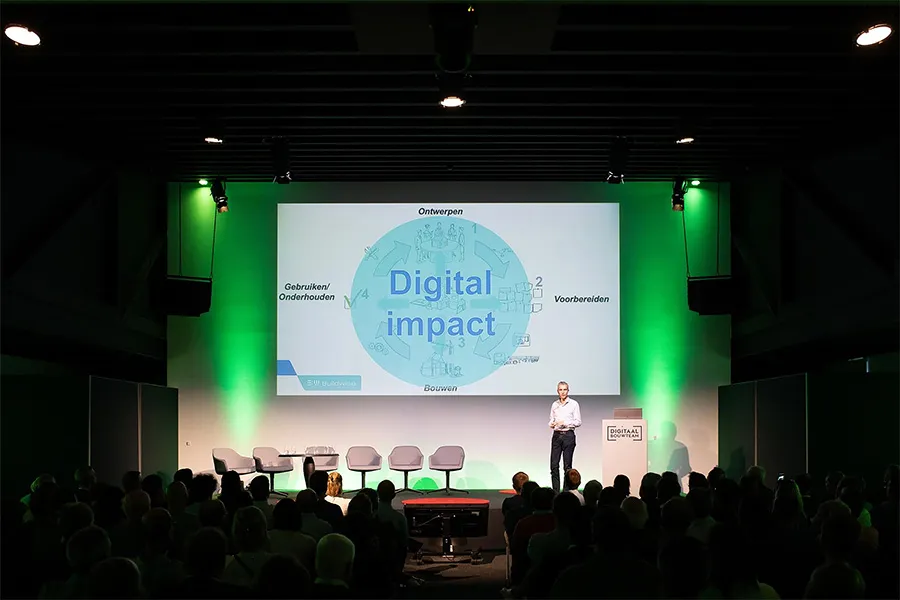
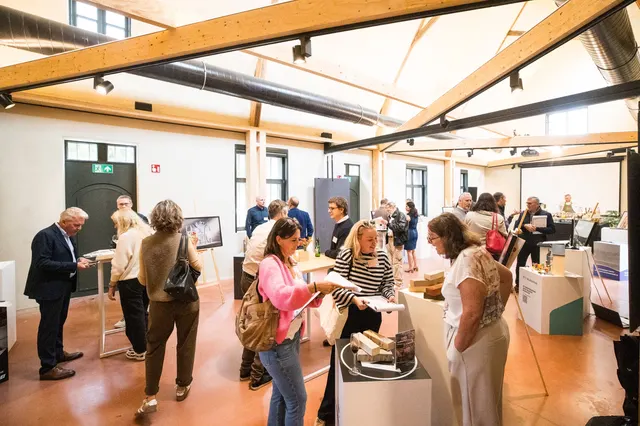
The digital construction revolution is well under way, thanks to the rapid rise of BIM. The fact that its promising theory is being put into practice a little more every day became clear at the inspiration event organised by Het Digitaal Bouwteam, which took place in Ghent at the beginning of October last year. Niki Cauberg, head of digital construction at Buildwise, explored current and future BIM capabilities and explained what lies ahead in the coming years. “Ultimately, we want to get to Design for Manufacturing and Assembly.”
A few years ago, a handful of sceptics still argued that BIM was little more than a passing trend, but there is no denying it now: thanks to the capabilities already available, BIM adds value at every stage of the construction process. What is more, an increasing number of innovative software applications are coming onto the market, creating many further opportunities over the next five years. “Alongside the uses that are already fairly well established, such as deriving 2D and 3D design drawings, carrying out clash detection, animating site meetings and making decisions on that basis, we will, for example, be able to see directly how specific design and construction choices affect the EPB and LCA scores. In other words, real-time dashboards instead of reporting after the event, as is still the case today,” says Niki Cauberg.

A more efficient design phase
There is still considerable scope for improvement in the design phase while we wait for such promising innovations, says Niki Cauberg. “The first thing we need to get better at is defining from the outset what the BIM model will be used for. It goes without saying that you need different parameters for clash checking than for LCA analysis via Totem. BIM should also be easier and more intuitive to use for parties with less technological expertise. Take VR remodelling, for example: a client could walk around the 3D model wearing a virtual reality headset and make changes in real time. This would make it possible to compare different scenarios quickly and clearly, and bring forward many decisions in the construction process, such as the choice of floor and wall finishes. We also hope that building permit applications will soon be able to be submitted using a BIM model. This could significantly shorten processing times, from months to just a few days, and even make interim benchmarking possible. This is not yet standard practice in Belgium, but it is already happening in Estonia, and from 2025 it will even be mandatory to submit building permit applications using BIM in Finland. So this is no science fiction!”
Making specialist work accessible
During the construction phase, the aim is to carry the digital preparation through to the site. Augmented reality can play an important role here, says Niki Cauberg. “Software for site monitoring based on 360° camera images has also been launched over the past two years. This makes it possible to produce a detailed progress report intuitively, in other words, without requiring any technical expertise. If there is a BIM model, it can also easily be checked against the actual situation, whether provisional or not, including the automatic detection of anomalies, construction errors and so on. This makes it possible to assess progress on site much more accurately. It is also important to involve all construction partners in the digital construction process, not just BIM specialists, by making data readily available and allowing changes to be made easily using user-friendly technology. For example, the shell could be measured to support the production of joinery, with the results fed straight into the BIM model. If we want to make optimum use of the central BIM model, we will have to pay more attention to standardisation. BIM is increasingly a database rather than a 3D representation, so interoperability is essential. The tools currently available still speak too many different languages.”
Towards Design For Manufacturing and Assembly
Finally, Niki Cauberg believes that the construction sector needs to industrialise much more and learn from so-called good practices in other sectors, such as real-time tracking by parcel delivery services or in the automotive industry. “In future, very few construction processes will be untouched by digitalisation,” he stresses. “Many construction professionals still have a strong project focus and work largely on an ad hoc basis. The emphasis will increasingly shift towards predefined processes. BIM is a crucial tool in achieving this. That does not mean everyone needs to understand and master everything down to the last detail, but the coordinating parties in particular, namely large contractors, engineering consultancies and architecture firms, will need to take the lead if they want to remain relevant. Ultimately, we want to get to Design For Manufacturing and Assembly. In other words, the aim is not merely to design something attractive, but above all to optimise the manufacturing and installation process. With this in mind, building junctions could be assembled in such a way that, while fully aligned with the architecture and structural design, they can be installed and dismantled more quickly, significantly increasing efficiency. One important condition for making Design For Manufacturing and Assembly work is for designers and software developers to be on the same page. This involves a great deal and is therefore not straightforward, but things are gradually moving in the right direction. I expect we will have made progress in this area in about five years.”
Question about this story? Ask your question
Keep following this
Get an email when a new story is published. No account needed.
- SubjectEvents