











‘Why I deliberately chose heating oil as my heating solution’

Choosing a heating fuel is far from straightforward.
To make sure he was making the right choice, the owner of this new home in Lustin (Namur) commissioned an independent consultancy to carry out an energy audit. The result? Heating oil emerged as the most cost-effective heating solution.
Words and images Informazout
“We didn’t know which energy source to choose,” admits Antoine Installé. “Technology has evolved considerably in recent years, and you hear so many different things. How can you be sure you’re making the right choice? Our architect hadn’t even mentioned heating oil as a possible energy source.” The new-builders therefore turned to an independent consultancy specialising in tailored advice for new-build and renovation projects, with the aim of drastically reducing energy consumption.
Energy audit by an independent consultancy
The consultancy carried out an energy audit covering the entire living area. It assessed the family’s heating requirements and analysed the different energy solutions based on their capital costs, as well as energy consumption over a 20-year period, taking into account the expected price trends for the different energy sources. The findings showed that heating oil was the most cost-effective heating solution in this case.
Natural gas was quickly ruled out because it was not available in this rural area. Geothermal energy with a heat pump, meanwhile, required a much larger investment than an oil-fired boiler. The sloping site was also poorly suited to this option. The couple did consider pairing a heat pump with photovoltaic panels. But electricity prices and the lack of subsidies for installing photovoltaic panels led them to spend their budget on other equipment. That left only propane. But heating oil came out ahead because of the building’s layout, safety, comfort, convenience and flexibility. “Our oil-fired boiler gives us the freedom to use liquid fuels of plant-based or synthetic origin in the future, with a very small environmental footprint,” says Antoine Installé.
An environmentally friendly heating solution
Installé: “Although heating oil is a fossil fuel, it is a low-sulphur product and European legislation is making it cleaner all the time. What’s more, our oil-fired boiler gives us the freedom to use liquid fuels of plant-based or synthetic origin in the future, with a very small environmental footprint. Ultimately, the fuel will be low-carbon or even carbon-neutral. We can also connect a heat pump or even solar panels later to heat domestic hot water. Such a hybrid solution would be even more (cost-)efficient..”

Oil-fired boiler output
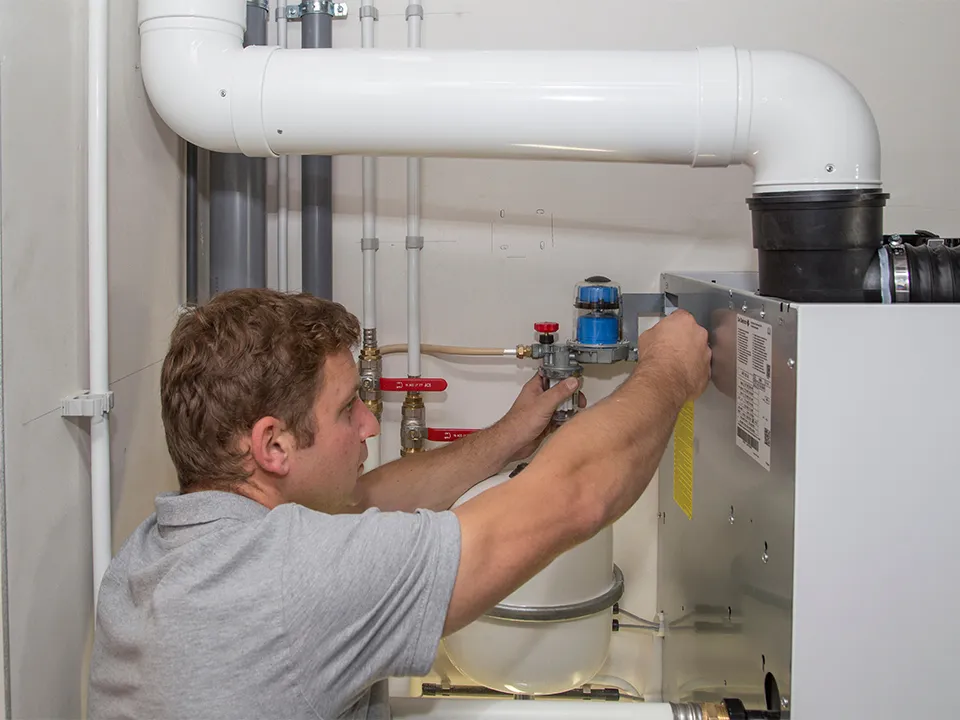
The energy audit also determined the output of the oil-fired boiler based on estimated consumption. However, this large family opted for a slightly higher output so that their 6 children can have a hot shower in the morning. They chose a 30 kW condensing boiler with a modulating burner, which adjusts the output to demand and the outdoor temperature. It serves three circuits: underfloor heating on the ground floor, a radiator circuit on the first floor and a circuit for hot water supplied by a 160-litre cylinder. Note that the radiator circuit on the first floor is intended only for the bathrooms; the bedrooms do not need heating thanks to the building’s good insulation.
“We installed a large-diameter duct leading outdoors, so that other equipment can be connected later, such as solar panels or a heat pump,” says installer Freddy Sacré. The family uses around 1,000 litres of heating oil a year. “The heating oil is stored in a 2,500-litre tank, which allows me to order 2,000 litres at a time, because the price of heating oil is always lower from that quantity upwards. The tank’s main advantage is that you can order when the price of heating oil is most attractive, which also makes it an economical choice,” concludes Antoine Installé.
Een zakelijke vraag aan Informazout? Get in touch
Companies in this story

Keep following this
Get an email when a new story is published. No account needed.
- SubjectNews
- CompanyInformazout







