











When it comes to pipe insulation…
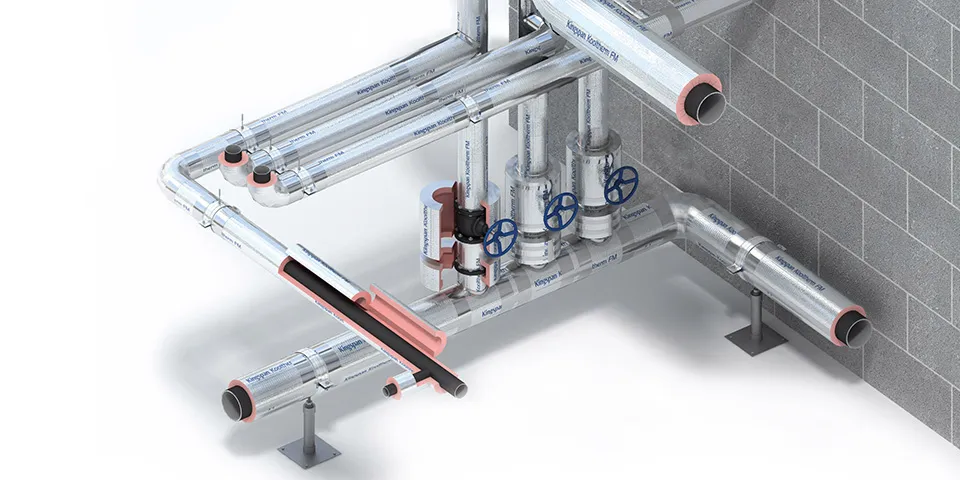
Installers have relied on traditional materials for pipe insulation for years. Can these materials measure up to an innovative material such as Kooltherm®? “This comparison requires a thorough approach. After all, it is in the interests of both investors and users to keep the short- and long-term costs of pipe insulation as budget-friendly as possible,” says Wouter Steeman, Marketing Manager Technical Insulation at Kingspan Technical Insulation. “We have summarised the results and conclusions of several comparative field studies in a Whitepaper, which demonstrates the benefits of Kooltherm® pipe insulation using a range of calculations.”
Leading manufacturer of pipe insulation products and systems compares widely used applications in a state-of-the-art reference project
Those investing in the construction of a building and its associated building services are increasingly facing rising energy costs for heating and cooling. “In the coming years, decisions about energy and insulation will therefore move further up the agenda,” Steeman expects. “This applies to engineers, consultants, contractors and installers, as well as building designers and owners, for whom these decisions also have major implications. Just think of commercial buildings that are used 24/7. If heating pipes are inadequately insulated, too much heat may escape at the lowest level and rise, leaving the lower floors too cold and the upper floors too warm. With Kooltherm® pipe insulation, both hot and cold pipes can be insulated using the same material. Kooltherm pipe insulation has a thermal conductivity of 0.025 W/m.K. ‘It is in the interests of both investors and users to keep the short- and long-term costs of pipe insulation as budget-friendly as possible.’
To prevent this, engineers, consultants and other stakeholders must make well-informed choices. In our Whitepaper, we examine an important building element that can not only help meet current and future standards, but also keep the energy and insulation budget under control: insulating pipework systems.”
Practical comparison
The Whitepaper describes a state-of-the-art project in France: the construction of several buildings for the ‘Condorcet’ university campus in Aubervilliers, Paris. This was a deliberate choice, according to Steeman. “Kooltherm® was specified throughout the project, enabling us to compare our pipe insulation in three (!) applications: a central heating system, a cold-water pipework system and a change-over (ATES) system. The project was also delivered in accordance with EN 12828. This standard sets out the design criteria for heating systems, particularly heat generation, distribution and emission systems. It distinguishes between several insulation performance classes, which define the maximum permitted heat losses (0 = uninsulated, 6 = very well insulated). In Flanders, this insulation standard is set out in Typebestek 105.” For this project, insulation class 2 or higher was specified for hot pipes; class 3 or higher was required for cold-water pipes and the change-over system.
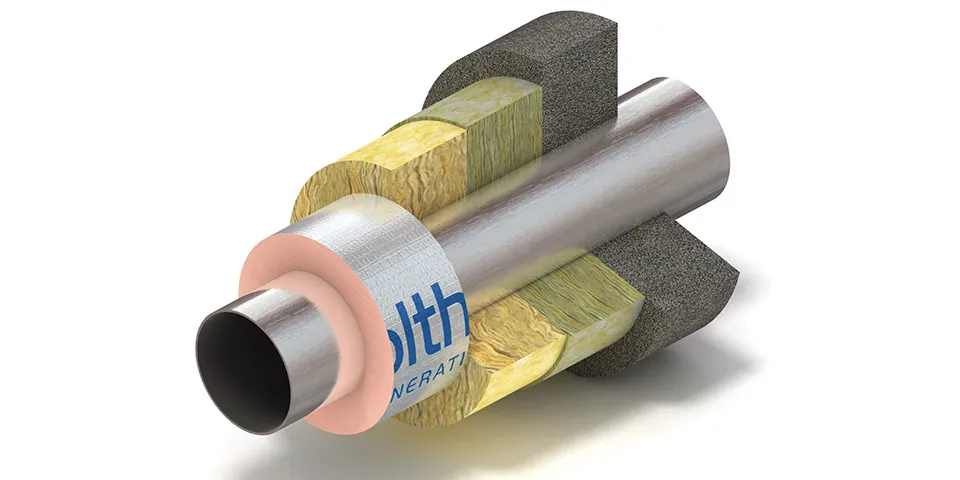
Kooltherm pipe insulation has a thermal conductivity of 0.025 W/m.K.
The findings
In Aubervilliers, Kingspan Technical Insulation compared Kooltherm® pipe insulation with mineral wool, PIR and flexible elastomeric foam. “We focused on installation costs, energy costs, insulation performance and payback periods. Our studies showed that, for insulating the entire pipework network to EN 12828 class 2 (central heating) and class 3 (cold water and the change-over system), installation costs with Kooltherm® pipe insulation are significantly lower than with a combination of mineral wool and PIR. Operating costs are also much lower with Kooltherm®. Even if Kooltherm® pipe insulation is specified one class higher than required, total installation costs remain slightly lower than with traditional alternatives at the specified classes. Choosing Kooltherm® classes 3 and 4 also reduces heat losses further, resulting in lower annual operating costs. As energy prices rise, the savings will continue to grow.”
With Kooltherm® pipe insulation, both hot and cold pipes can be insulated using the same material. A modest additional investment can further raise the insulation class to class 4 and 5, says In ’t Veld. “Calculations show that the payback period for this increased investment is less than a year. Raising the performance classes to class 5 and 6 would mean the investment is fully paid back in 3.8 years. The savings in energy over the following years would then be pure savings.”
Expert support
“Many clients and installers look only at material costs, when what they should really focus on is the payback period,” says In ’t Veld. “Installers also often reach for materials they have traditionally worked with. But development never stands still, either in technology or in ease of installation. The best insulation results from a combination of several factors. To get the best out of it, you need not only to understand these factors, but also to apply them in the right way. As an organisation, we are keen to play a part in this. We regularly give presentations to specifying bodies, actively sharing the importance of proper pipe insulation and the benefits and installation of Kooltherm®. We also support installers and insulation contractors with product calculations and installation, helping to ensure reliability and quality at all times.”
Interested in the Whitepaper? Visit www.kingspan-whitepaper.com or arrange a Lunch&Learn presentation with Jan Paeleman via [email protected].
Question about this story? Ask your question
Keep following this
Get an email when a new story is published. No account needed.
- SubjectNews







