











Transporting green hydrogen through the natural gas network: the near future?

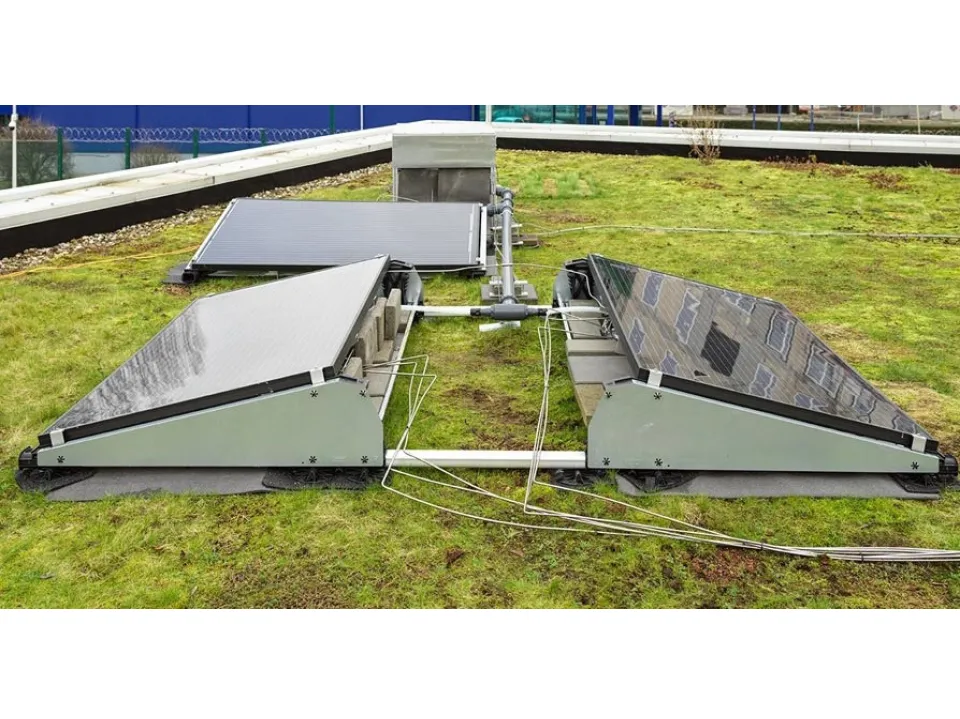
Three groundbreaking hydrogen panels are now installed on the green roof of the Fluxys laboratory in Anderlecht.
Researchers from KU Leuven and Fluxys want to analyse whether the green hydrogen produced can be injected directly into the natural gas network. To what extent can the existing gas network be converted to carry hydrogen? And what role can green hydrogen play in the energy transition? We put these questions to the researchers themselves.
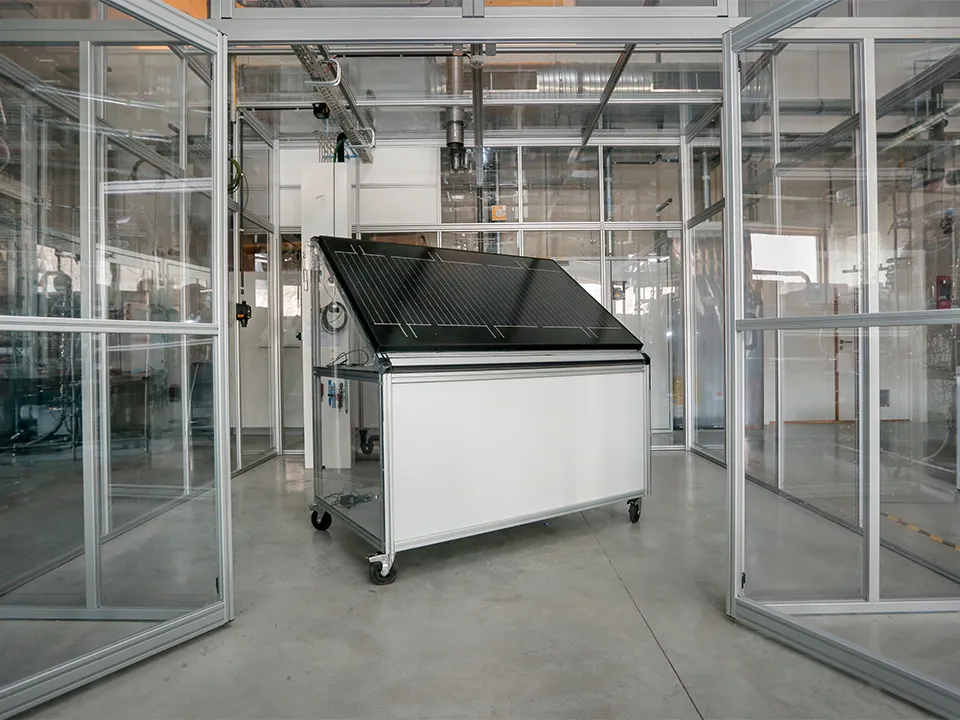
A solar panel that produces hydrogen from moisture in the air. Two years ago, researchers from KU Leuven unveiled this world first. The idea was simple: to build an energy system that works anywhere. “Sunlight and water are available everywhere, even in the desert,” Professor Johan Martens and his research team from the Centre for Surface Chemistry and Catalysis told us at the time. “Our panel captures water from the air and converts it as efficiently as possible into hydrogen and oxygen, which are collected separately.” The scale was groundbreaking too: a single panel can produce up to 250 litres of hydrogen a day. Today, green hydrogen is generally produced by electrolysis in very large facilities, which are not always powered by renewable energy. KU Leuven’s technology, by contrast, can be used at any scale and is 100% renewable.
Two years on, the same researchers are working on numerous pilot projects under the Solhyd name to investigate potential applications for their hydrogen panel. Using the test rig on the green roof of the Fluxys lab, they want to analyse whether the gas produced by the panel can be injected into the natural gas network. “It all depends on the quality of the gas and whether it is compatible with the natural gas network,” says researcher Jan Rongé. “The test rig also gives us the opportunity to see how our panel performs throughout the year: how do orientation, time of day, sunlight intensity and so on affect the composition of the hydrogen gas? Once we have the answers to these questions, we can roll out more pilot projects.”
Green hydrogen for industry
Fluxys’s laboratory is a well-known Belgian centre of expertise in gas volume measurement and gas chromatography, the analysis of gas composition. “We are happy to share our expertise with KU Leuven, and it is also interesting for us to carry out these analyses on hydrogen rather than natural gas,” says Remy Laurent, spokesperson for Fluxys. “We are convinced that hydrogen, and green hydrogen in particular, will play an important role in the energy transition. We aim to convert part of our gas network to transport hydrogen. Specifically, by 2025 we expect to be ready to supply some of our major industrial customers directly with hydrogen via our high-pressure network. Industry is currently responsible for 40% of CO2 emissions in our country. These companies currently use hydrogen produced from natural gas, known as ‘grey’ hydrogen. We can help them significantly reduce their emissions by supplying them with green hydrogen.”
Fluxys wants to reuse as much of the existing infrastructure as possible. “It goes without saying that this is much more cost-effective than building new infrastructure,” says Remy Laurent. “To transport hydrogen safely through our existing pipelines, pressure variations and their impact on the pipelines are the main considerations. We are currently investigating this.”
What about buildings?
Whether hydrogen can also play a role in supplying energy to our buildings remains to be seen. Jan Rongé says: “We produce hydrogen from sunlight. This can be done anywhere, but it does require a substantial area. If we can inject our hydrogen directly into the network, we will be much less restricted by location.
On the other hand, heat pumps already provide an excellent technology for heating buildings sustainably. But switching all our buildings to electricity is a huge challenge, especially when a gas network is already in place and very large quantities of green hydrogen will be available in the future. A fraction of that hydrogen could be used to supply some of our buildings with energy, but many questions still need answering: which buildings can use hydrogen efficiently? What would be the impact on the distribution network? These are issues we will need to investigate further in the coming years.”
Hydrogen and the energy transition
According to Jan Rongé, hydrogen will undoubtedly play an important role in the energy transition. “We will always need gases, especially in sectors such as industry and aviation, but if we want to protect the climate, green hydrogen is the logical choice.”
Remy Laurent is equally convinced: “By 2050, Europe wants to become the first climate-neutral continent, with an energy mix made up of 50% electricity and the remaining 50% from energy sources such as biomethane, biofuels and green hydrogen. When there is a surplus of renewable energy, hydrogen is an ideal molecule because it allows electricity to be stored. We can imagine that, in a few years’ time, we will store green hydrogen in existing gas infrastructure during the summer, then use it to generate electricity in winter when supplies are short, or to supply large industrial customers with a carbon-neutral molecule.”
Hydrogen’s potential is beyond doubt, but there are still hurdles to overcome before the roofs of our buildings are covered with KU Leuven’s hydrogen panels. “We are still looking at how to scale up our production capacity so that affordable panels can be manufactured by a spin-off company. Once that happens, I see a bright future for our panels in locations where we can produce large quantities of green hydrogen for direct injection into the natural gas network. For example, I can envisage an agrivoltaic system with several hectares of panels installed above farmland. We are also working on pilot projects in Africa, where there is more sun and moisture and a strong need for decentralised green energy generation. The possibilities are endless,” concludes Jan Rongé.
Question about this story? Ask your question
Keep following this
Get an email when a new story is published. No account needed.
- SubjectNews







