











The renovation wave and the push for hydrogen: how the heating industry can meet climate targets

Is the heating sector ‘Green Deal ready’? That was one of the key questions at the recent online edition of the ISH trade fair.
The organisers brought together leading figures from the German heating sector and politicians to discuss the current situation and possible solutions. Two themes ran through the presentations and panel discussions: a renovation wave is a prerequisite, and hydrogen has enormous potential.
The ambitions are high: by 2050, Europe must become the first climate-neutral continent. As the largest energy consumer in Germany (55 per cent of total consumption) and in Europe, the heating market has an important role to play in achieving these climate targets. “It is a major challenge, but one thing gives us confidence in the future: the technological solutions are available,” said Andreas Lücke, managing director of the Federation of the German Heating Industry (BDH). “But there is still a great deal of work to do. CO2 emissions from buildings need to be drastically reduced. We can lower heating demand by improving building insulation, but we also need innovative technologies.” Andreas Feicht, State Secretary at the German Federal Ministry for Economic Affairs and Energy (BMWi), noted that Germany’s CO2 emissions had fallen, but that this was more despite the building sector than thanks to it. “The decline was mainly driven by the mobility sector, and the coronavirus crisis had a lot to do with that,” he said.

1.2 million new investments a year
Uwe Glock, chairman of the BDH, reviewed the key figures for Germany. “Between 2010 and 2018, very little happened, because there were no subsidy schemes or incentives,” he said. “In 2019, new-build construction drove significant growth. In 2020, we saw a 13 per cent increase in the number of newly installed heating systems, bringing the total to 842,000. Biomass (+138 per cent) and heat pumps (+40 per cent) were the main growth areas. But that still leaves us a long way from the ultimate target of 1.2 million new investments a year. To reach that target by 2030, we cannot afford to sit back. We need to get to work today.”
Andreas Feicht expects decisions to be taken at European level, and asked whether the CO2 tax introduced in Germany should be rolled out across Europe. “That decision has brought about a real paradigm shift. The price of carbon is now rising to 65 euros. However, the next legislative term must decide what the long-term price will be in the second half of this decade. Will it be even higher?”
One thing is certain, according to Feicht: “Everyone, including energy users and households, must prepare for a world with a high price tag on CO2. That is why investment needs to be incentivised now, even while the CO2 price is still relatively low. That means investing in, and providing subsidies for, energy-efficient renovations.” In Germany, this policy has already led to an increase in the number of deep renovations, but further incentives are still needed. “That is why we are very keen to see the renovation wave the European Commission plans to roll out.”

Renovation as an economic recovery driver
Renovate, renovate, renovate: that is the message for Klaus Jesse, vice-chairman of the European Heating Industry (EHI), too. “65 per cent of European heating systems are more than 25 years old. If we raise the renovation rate from 4 to 5 or 6 per cent, we can already save 40 per cent of CO2 emissions. Germany has already seen a huge boost, and we need to extend that across Europe,” Jesse said. He called the gas condensing boiler ‘the workhorse’ of this effort. “Simply upgrading 16 million inefficient gas appliances to condensing technology could cut CO2 emissions by 37 tonnes.”
Intensive renovation is good for the climate, but also for the economy. “It could provide the basis for economic recovery after the coronavirus crisis,” said Feicht. “The existing building stock is a sleeping giant that we need to wake up in these times of crisis. A renovation wave is a powerful engine that can get the economy moving again,” added Timon Gremmels, a German member of parliament for the SPD. Simone Peter, president of the Bundesverband Erneuerbare Energie (BEE), said: “The pandemic will cause enormous job losses in the coming years. The construction sector could absorb up to a third of the jobs lost in other sectors.”
Full electrification is not the answer
When it comes to heating with renewable energy, heat pumps are never far from the discussion. Today, heat pumps account for 15 per cent of the German market, and growth is continuing in 2021. However, heat pumps cannot be considered separately from the renovation wave mentioned above, because a heat pump makes little sense in a home that has not been adapted. At ISH, many experts therefore saw promise in another technology that has been knocking ever louder in recent years: hydrogen. “Today, we consume 2,500 TWh in Germany, of which 580 TWh is electricity. That figure is rising, but it will never reach 100 per cent. Some sectors will never be able to electrify, so we will still need molecules. Hydrogen will play a crucial role in that,” said Andreas Feicht. There are still, however, some sticking points: “Before we can use hydrogen on a large scale, the technology needs to reach a certain level of maturity, and above all, large quantities must be available at a reasonable cost. For now, that remains the obstacle.”
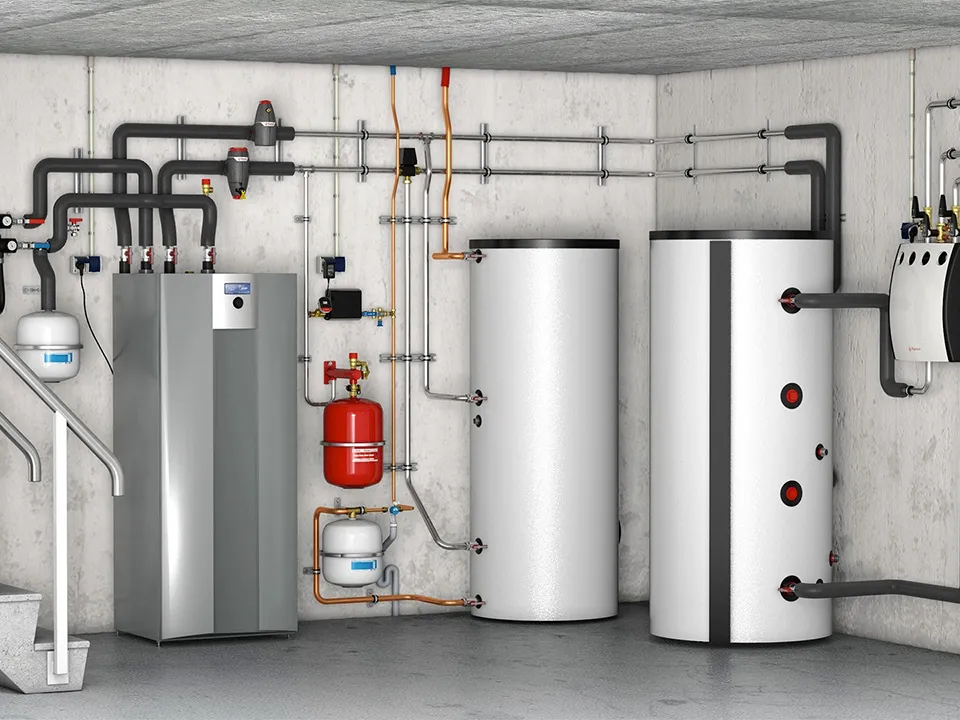
Several industry representatives also argued strongly for a technology-neutral framework. “We do not want the European Commission to promote one technology over others,” said Glock. “We want to be able to use every climate-friendly solution available.” He, too, was optimistic about hydrogen’s potential. “We expect to bring the conversion from gas to hydrogen to market by 2025. From 2030, we will be able to consider the heating market a key consumer of hydrogen,” he said optimistically. Timm Kehler of Zukunft Erdgas agreed. “Germany already has 500,000 kilometres of gas pipelines. The gas grid is ‘hydrogen ready’ and therefore also ‘Green Deal ready’, particularly as several conversion steps have already been taken in recent years, enabling the pipelines to transport not only natural gas but also hydrogen in future. The only requirement is for hydrogen to become as affordable as natural gas is today.”
Product presentations
Many companies also saw ISH as an excellent opportunity to showcase new products and innovations. Here are a few highlights.
Delabie
One of the key themes behind Delabie’s product solutions was ‘hygiene’.
A selection of Delabie’s handwashing and disinfection solutions was presented: the TEMPOMATIC MIX 4 basin mixer, the new BLACK BINOPTIC range in its various versions, and the electronic wall-mounted soap dispenser. The touch-free operation of the electronic taps and accessories guarantees 100 per cent hygiene.
Another focus for Delabie products is achieving significant water and energy savings without compromising performance or user comfort. The aforementioned BINOPTIC range of basin mixers, for example, saves 90 per cent of water. Self-closing taps, such as the TEMPOMIX 3, use no energy at all.
Virtual visitors could also discover a wide range of new product solutions combining functionality with innovative design. Each range has its own new additions: the FINO urinal and MINI BAILA basin in bacteriostatic stainless steel grade 1.4301, the new Be-Line® design range of accessibility products, comprising grab rails and folding shower seats, and the 2641BEL sequential single-lever basin mixer for healthcare facilities.
Viessmann
“Co-create climate for life” was Viessmann’s motto at this ISH. The HVAC specialist launched a host of new products developed in collaboration with specialist partners. Viessmann presented its new generation of heat pumps: compact, efficient and ideally suited to modernisation projects. With the new Vitocal 250-A, 250-AH and 252-A, designed as monobloc units and suitable for use without underfloor heating, Viessmann is responding to demand for heat pumps that are easy to install in renovation projects. Existing radiators can even be used with these heat pumps.
Viessmann has also taken note of the rapid progress being made with hydrogen. The company already has a broad portfolio of efficient systems that are also H2-ready. The gas condensing boilers in the Vitodens 300 and 200 series are now certified to run on natural gas containing up to 20 per cent hydrogen, and can even convert a 30 per cent hydrogen blend into heat easily and efficiently.
Viessmann also wants to do its bit in the fight against coronavirus, with innovative air-cleaning and ventilation systems. The Vitovent 200-P, for example, is specifically designed for use in schools, seminar rooms and nurseries.
WILO
At this year’s virtual ISH, WILO focused on cold-water applications, which are becoming increasingly important, not least as a result of ongoing urbanisation around the world and the global water shortage. As a technology specialist whose core competence is moving water, WILO also aims to establish itself as an innovation leader and industry pioneer in this sector. The company also showcased several product innovations, including Wilo DrainLift SANI (a dual sewage lifting unit), Wilo-Isar BOOST5 (which maintains constant water pressure at draw-off points) and the Wilo-Separators GEO, MONO and MODU. Separator is a new range of grease separators that helps prevent grease from causing blockages in the sewer system.
Just in time for the start of the fair, WILO set a new benchmark for customer experience with the live launch of “Wilo World”, its new virtual point of contact. This is a world rendered photorealistically down to the smallest detail. Starting from the technology specialist’s new digital headquarters, Wilopark in Dortmund, visitors can embark on a journey through the digital world, exploring real-world references and seeing pumps, systems and solutions in operation. Customers can choose which areas to visit, gaining an in-depth virtual insight into applications and solutions.
Question about this story? Ask your question
Companies in this story
Keep following this
Get an email when a new story is published. No account needed.
- SubjectNews
- CompanyDelabie
- CompanyViessmann







