











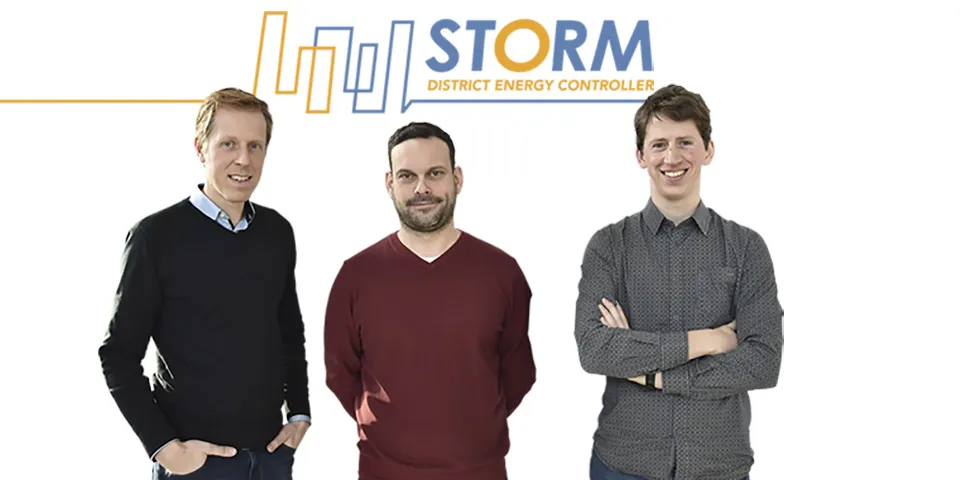
The Pen | Dirk Vanhoudt, Tijs Van Oevelen and Koen Allaerts, Researchers, Thermal Energy Systems
‘The road to sustainable district heating networks’
In just over ten years, we must not only save 32.5% of energy, but also ensure that 32% of the energy we consume comes from renewable sources. Given that in 2016 we had barely achieved a third of this target, we still have a long way to go.
Solar panels, solar water heaters, pellet stoves and heat pumps are becoming increasingly widespread, but they are not a complete solution. We need to make greater use of sustainable heat, such as waste heat from industry, energy from waste incineration and geothermal energy. To achieve this on a large scale, we will need to roll out district heating networks, following the Scandinavian example. Copenhagen is already 98% heated by district heating networks, and the Danes pay half as much for their heat as they would if they heated their homes individually. Did you know that every village in Sweden with more than 10,000 inhabitants has a district heating network? Why should that not be possible in Flanders?
District heating networks could become an important tool in our energy transition. But a network is only as sustainable as the source supplying its heat. And that is where problems can arise. As with the electricity grid, demand does not always match the supply of sustainable heat. That is why VITO, together with software company NODA, has developed a smart, self-learning controller to better match heat demand to supply: the STORM controller. It shifts buildings’ heat demand to times when sustainable energy is available. Buildings take a long time to warm up and cool down slowly. We can therefore heat them a little earlier or later without the occupants noticing. If we do this across enough buildings, we can make a significant impact. The STORM controller is implemented in three phases. First comes installation: the controller is integrated into the energy management system of buildings connected to the district heating network. Data is then collected for several weeks or months to predict the building’s behaviour, during the monitoring or test phase. The reliability of heat demand forecasts improves as more data becomes available. Once testing is complete, the controller can operate autonomously and optimise the buildings’ heat demand.
An important pilot project is under way in Rottne, Sweden, where the local energy utility operates a district heating network 10 km long. Heat is generated by two biomass boilers fuelled by waste wood, supplemented by a peak-load oil boiler running on rapeseed oil. Of the approximately 200 buildings connected to the network, the 10 largest heat users are controlled by the STORM controller, accounting for 35% of total consumption. Following a testing and trial period, the STORM controller has been operating autonomously there since early 2018. The initial results show that the STORM controller has a significant impact on the heat consumption profile, both at the level of individual buildings and at the heat plant. The amount of oil saved will be quantified after this winter. At the end of last year, the STORM controller was also installed on Ennatuurlijk’s district heating network in Eindhoven. The network supplies heat from a biomass plant to more than 1700 residential customers and 29 business customers. Here, too, the aim is to source as much heat as possible from the biomass plant.
Hopefully, in 2030 we will be able to look back with pride on the many sustainable district heating networks that have been established. At VITO, we are working hard to get the technology ready for this.
Question about this story? Ask your question
Keep following this
Get an email when a new story is published. No account needed.
- ThemeFossil-free heating and cooling
- SubjectNews







