











The Pen | Claude Debaecker, Vice-President of Atic
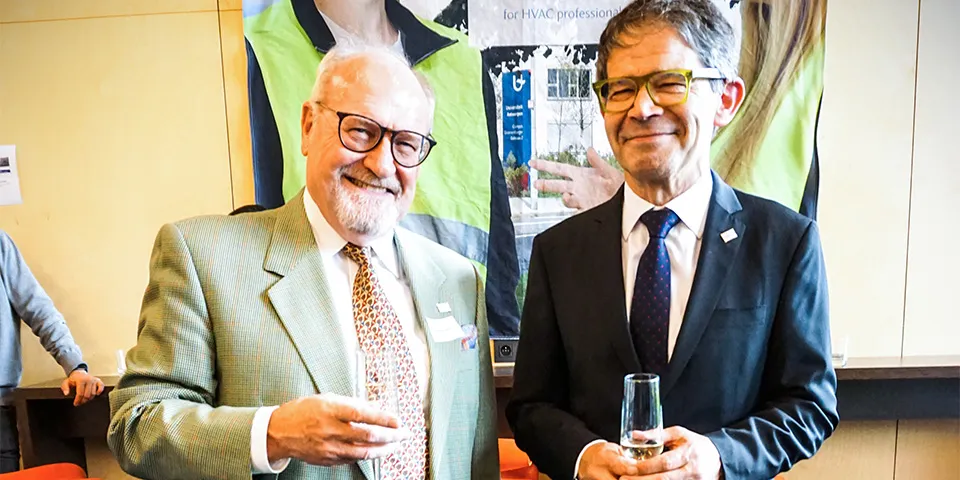
Seeking answers to today’s and tomorrow’s challenges
The construction sector is a complex world that is also constantly changing. It affects the environment in many ways, including through energy use and air and water quality, and also plays an important role in people’s wellbeing in their surroundings, both at work and at home. That is why it is essential for a modern building to be the result of a collaborative, coordinated approach involving owners, designers, contractors and, ideally, future occupants, all in compliance with the applicable legislation.
With Atic (Royal Association for Heating, Ventilation and Air Conditioning Technology), we organised a study day on 19 December 2019, dedicated entirely to innovations in the HVAC sector.
We can see that construction professionals are becoming increasingly aware of the challenges posed by global warming. At Atic, this is indeed high on the list of priorities when assessing whether a design is ‘good’ or ‘less good’. Both philosophical and technical considerations are important here: how do we respond to the issues outlined?
As several speakers noted during the study day, the economy, the driving force behind modern society, is increasingly facing a shortage of available raw materials. These are still found on our beautiful, unique planet, but are becoming increasingly scarce. It goes without saying that the construction industry and related technologies are affected by this issue. To minimise energy consumption, building envelopes are becoming more efficient, with materials chosen for their ease of recycling at the end of their life cycle. The same applies to technical equipment and systems: an increasing number of technical installations are fitted with heat recovery systems. Rainwater harvesting for sanitary use has also become almost standard practice.
The trend in the HVAC sector is to maintain comfortable ambient conditions by using precisely as much energy as necessary: not too much, since waste is unacceptable, and not too little, since a minimum level of comfort is essential. Many factors need to be taken into account, including whether the occupied space is in use, the number of occupants, and the air and water flows circulating through the facilities. Heat pumps can also be a useful option. The entire system is controlled by networked control equipment, ensuring rigorous energy management and monitoring. Machine manufacturers are focusing on energy-efficiency criteria supported by powerful software, bringing the concept of ‘predictive maintenance’ into the picture.
Current and future regulations are becoming increasingly stringent in terms of environmental issues and energy performance criteria. This is a positive development, and we must respond to it with vigilance. Everyone in the sector will need to adapt. Installers, too, must find answers to emerging issues such as the accelerating pace of digitalisation and the need for all of us to play our part in addressing growing concerns about the climate.
Question about this story? Ask your question
Keep following this
Get an email when a new story is published. No account needed.
- SubjectNews







