











The Pen | Chris Hendrickx, Lecturer in Electromechanics at Hogeschool PXL
Heat pumps are increasingly used to heat and cool both homes and large buildings efficiently. But what should you consider when installing and using a heat pump? Here are five tips…
Pump it! Five tips for using heat pumps efficiently
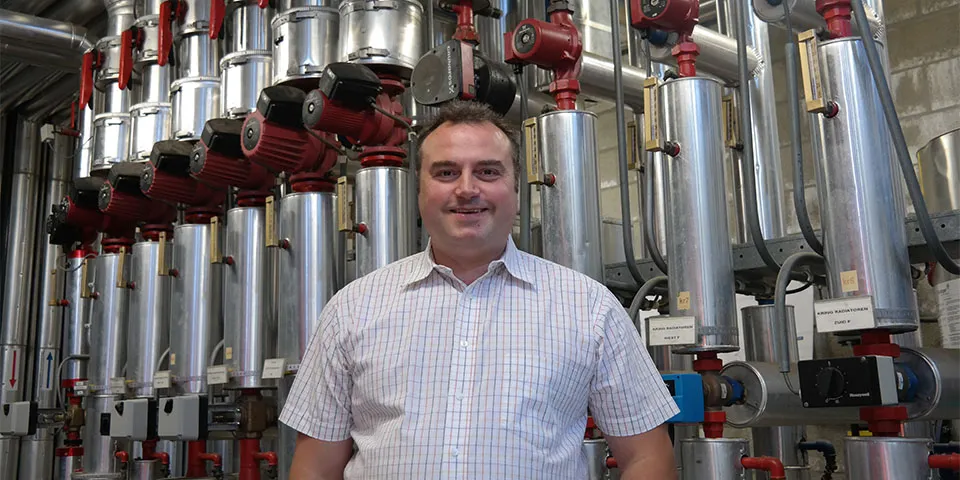
From 2016 to 2019, the electromechanics programme at PXL carried out the research project ‘Optimisation of energy flows’, which examined how to achieve maximum energy comfort with minimum energy consumption. In the demonstration installation developed for the project, a heat pump was connected to two large buffer tanks, one hot and one cold.
What should you bear in mind when you want to use a heat pump in your home or in a building? Here are five basic tips that emerged during the research project.
1. Keep it running!
Heat pumps need long operating times: you should press ‘stop’ and ‘start’ as little as possible, as this significantly shortens their lifespan. So just let it run! The heat produced is stored in the buffer tank.
2. Ensure good stratification in your buffer tank(s).
Aim for good stratification, with a carefully planned arrangement of different temperatures at the top and bottom of your buffer tank(s). A hypothetical example: say you have a 1,000-litre hot buffer tank. Which would you prefer: a uniform temperature of 40°C throughout the tank, or 60°C at the top and 20°C at the bottom? The answer is the latter, because this stratification allows you to better meet the different energy needs in your home, such as heating, cooling or hot water for showers. Energy is added from the top, while it is drawn off from the bottom.
3. Choose the highest insulation class.
When choosing a buffer tank, opt for one with the highest insulation class: A or, better still, A+, which delivers the lowest consumption (kWh/24h).
4. Prevent energy loss caused by unwanted flow.
Unwanted water flow leads to energy loss, which is best avoided. When water rises because its density is lower, this is known as the thermosiphon effect. You want to prevent this, so it is advisable to use loops, add anti-thermosiphon valves and/or fit a gravity brake. When the water no longer flows unintentionally, the heat and energy stay where they belong: in the buffer tank.
5. A constant high-temperature source, with heat delivered at a low temperature.
You achieve maximum energy output with minimum electrical energy consumption when the source for your heat pump is constant and at as high a temperature as possible (typically 20°C), and heat is delivered at as low a temperature as possible.
In our demonstration installation, the manufacturer’s maximum permitted inlet temperature (source temperature) is 20°C. The aim is therefore to stay as close as possible to 20°C at all times. Heating, or heat delivery, then takes place at a low to very low temperature (30-35°C). Higher temperatures (55-60°C) are needed for domestic hot water in the bathroom and kitchen if you want to prevent Legionella bacteria, but this results in a much lower efficiency. The solution is a buffer tank based on the concept of a combi/hygienic cylinder, a kind of ‘bain-marie’ flow-through system operating at 40-45°C. Another alternative is a fresh water station connected to a conventional buffer tank.
In short, if you want to work with heat pumps and buffer tanks, think first, install afterwards. Pump it!
Question about this story? Ask your question
Keep following this
Get an email when a new story is published. No account needed.
- ThemeFossil-free heating and cooling
- SubjectNews







