











The huge potential of carbon-neutral fuels
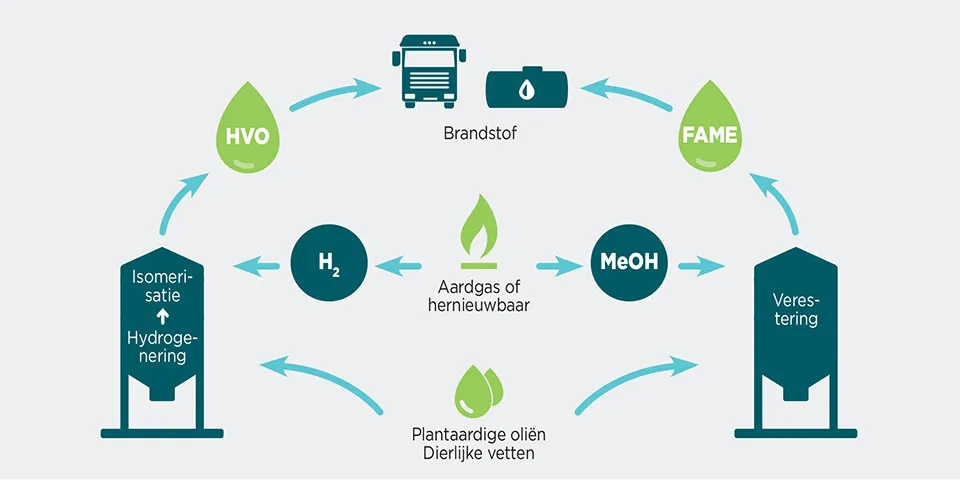
Europe aims to be fully carbon-neutral by 2050. That is why scientists are continually looking for solutions to achieve this goal. The heating oil sector is focusing on carbon-neutral fuels. These fuels are climate-neutral and renewable, and offer the same benefits as heating oil: they are easy to transport and store, and are always available.
There are four different types of carbon-neutral fuels: FAME, Biomass-to-Liquid and HVO, which are all biofuels, and finally e-fuels.
FAME (Fatty Acid Methyl Ester): a renewable fuel made from recycled animal and vegetable oils is blended with heating oil to make it more sustainable. The transport sector already uses this fuel.
BtL (Biomass-to-Liquid): a liquid, carbon-neutral fuel made from biomass and plant waste, such as wood pulp, vegetable oil or algae.
HVO (Hydrogenated vegetable oil): made by treating vegetable oils and waste cooking oil with hydrogen. Today, more HVO is produced from waste and residual fat fractions from the food, fish and slaughterhouse industries, as well as from vegetable oil fractions that are not of sufficient quality for use as food.
E-fuels: synthetic fuels made using solar or wind power.
This green electricity is used to produce renewable fuels, while CO2 is also captured from the air. In this way, part of the greenhouse gas problem becomes part of the solution.

‘In Finland, Neste has stored HVO for more than 10 years, and its quality is still exceptionally good.’ (Image: NESTE).
Potential
There is significant potential for heating, as carbon-neutral fuels can be used in existing heating boilers and do not require major changes to our energy supply system. Will you be able to heat your home with carbon-neutral fuels in the very near future? That is unlikely. For now, production costs remain high because carbon-neutral fuels are not yet being produced in very large volumes.
Carbon-neutral fuels are drop-in fuels, so they can be blended with heating oil. Their share of the mix can gradually increase in the short term as their cost falls thanks to greater availability. This will make it possible to replace heating oil completely over the longer term.
Successful trials
Several test households in Belgium and other European countries are already heating without any problems using a blend of carbon-neutral fuel and heating oil.
Heating with FAME has been established practice in Scandinavian countries for several years. In Belgium, FAME is currently used as a bio-component in transport diesel, but its use for heating is yet to come. Field trials with varying blend ratios across Europe, and in Belgium since December last year, demonstrate that it can be used without any problems. Homes are being heated in complete comfort with a blend of 20% FAME and 80% heating oil.
Numerous pilot projects are also under way in private homes in Germany, Austria, Switzerland and Belgium, using central heating boilers that run either on 100% HVO or on a blend of HVO and heating oil.
“Tests in Germany and Finland showed that the product can be blended with conventional heating oil in any proportion. HVO can even be used safely in its pure form,” says Pieter Zonneveld, Vice President Sales for Europe and Asia at sustainable diesel specialist Neste. “In Finland, Neste has stored HVO for more than 10 years, and its quality is still exceptionally good. HVO’s calorific value of 44.1 MJ/kg is almost identical to that of heating oil.”

Synthetic fuel (Image: INERATEC).
Up to 90% less CO2
A home with an upgraded heating system running on 30% HVO, combined with insulation, emits 80% less CO2 than before. With 50% HVO, CO2 emissions from the same home fall by almost 90%. A key additional benefit of HVO and other carbon-neutral fuels is that modern heating systems require virtually no modifications to run on HVO. So there is no need to install a new boiler or fuel tank to heat your home more sustainably.
Although Biomass-to-Liquid fuels and e-fuels are currently more expensive than conventional heating oil, they too could provide an interesting solution, particularly once prices begin to fall as production scales up. Biomass-to-Liquid fuels are expected to become established in the short term, in stages: first blended with fossil fuels, then in their pure form. This will rapidly reduce greenhouse gas emissions. Over a somewhat longer timeframe, e-fuels also show promise, although this type of renewable fuel requires sufficient sunshine or wind. E-fuels are therefore likely to be produced in parts of the world with abundant sunshine or wind.
Question about this story? Ask your question
Keep following this
Get an email when a new story is published. No account needed.
- SubjectNews







