











The added value of the EPC (+)

Spring is just around the corner. The ideal season to sell your home or start looking for a new one. Whereas buyers were once mainly interested in a large garden or a double garage, prospective homeowners are increasingly asking about a property’s energy performance too.
On that front, 2019 brings good news. The new Energy Performance Certificate (long announced as the EPC+) is now available. The plus sign has disappeared from the name, but the added value of the new EPC is undeniable. Anyone putting their home up for rent or sale must provide an Energy Performance Certificate. An EPC issued less than ten years ago remains valid. Even so, it is worth considering having one drawn up using the new methodology. The most noticeable new feature is the energy label, which shows your home’s energy performance, much like the energy label on electrical appliances. Instead of a number, every home will now receive a colour-coded label, ranging from red (F, a highly energy-consuming home) through orange

Contractors and installers can be sure that there will be plenty of work for them in the years ahead.
(E-D), yellow (C-B) to green (A, an exceptionally energy-efficient home). A+ is also possible. In that case, your home produces energy. The new EPC also shows how your home’s energy performance compares with the average for homes of the same type.
But that is not all. The document sets out, point by point, how (prospective) homeowners can make their property more energy-efficient and which measures (roof, windows and doors, walls, floors, space heating, systems, etc.) can improve its energy performance. It also includes an estimate of the potential costs and useful advice on the best order in which to carry out the work.
Alongside the Woningpas, which serves as the digital passport for your home, the new EPC also gives you an energy guide to your property. The document sets out a pathway for improving your home’s energy efficiency and achieving a better label. As a Flemish policymaker, I am convinced that people with a clear picture of the timing, costs and improvements involved are more likely to take action.
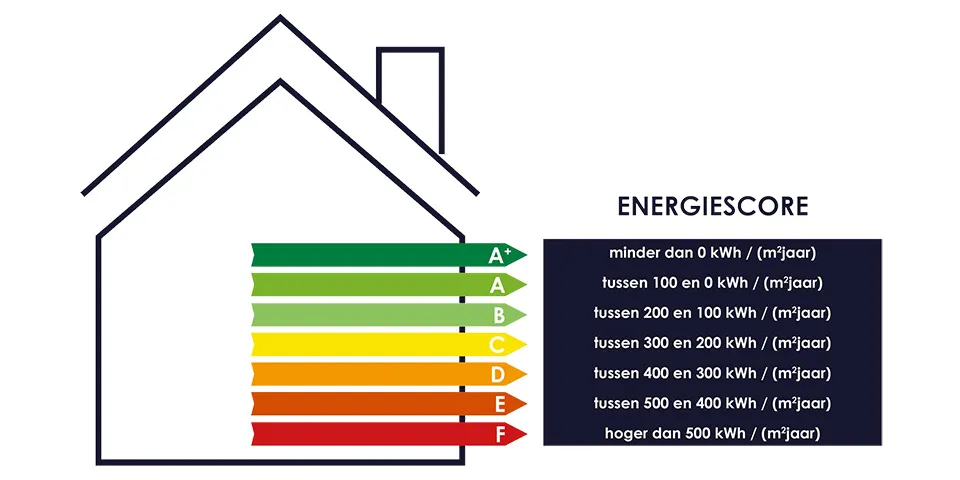
The new EPC+: instead of a number, every home will now receive a colour-coded label.
As well as providing citizens with additional useful tools, the Flemish Government has further measures in the pipeline to encourage homeowners to renovate. Under the Flemish Energy Plan 2021-2030, homes purchased from 2021 onwards must meet at least 3 of the following 6 requirements within five years: roof, wall and floor insulation; high-performance glazing; a condensing boiler no more than 15 years old; and/or a renewable-energy water heater (heat-pump or solar water heater).
This also means that contractors and installers can be sure of plenty of work in the years ahead. They would also be wise to keep up to date with legislation and technological developments. Will district heating networks be installed in residential areas? Is a heat-pump water heater, for which a new grant has recently been introduced, a viable option, or would a solar water heater be the better choice? The Government is not standing still, technology is evolving, and citizens are becoming increasingly well-informed… Are you keeping up too?
Question about this story? Ask your question
Keep following this
Get an email when a new story is published. No account needed.
- SubjectNews







