Installatie & Bouw Vlaanderen is part of Louwers Mediagroep: 45+ trade platforms in the Netherlands, Flanders and Wallonia. Trade magazines, websites, newsletters, video and podcasts, since 1987.
The current Covid-19 (Corona) crisis is presenting many companies, institutions and transport operators with an unprecedented challenge. The latter in particular play a decisive role in curbing the spread of the virus. Screening travellers for an elevated body temperature (fever) is one of the measures being used for this purpose. Naturally, this must be done without contact. Two types of measuring device are available, and various factors need to be taken into account.
Thermal imaging cameras and infrared thermometers are commonly used in the medical sector, for example during Ebola outbreaks in ‘far-off countries’. The current Covid-19 crisis means that patients and medical staff in our own country now also need to be checked quickly, easily and frequently for symptoms of illness. Checks are also being carried out on travellers at railway stations and airports.
Infrared technology and pitfalls
Both thermal imaging cameras and infrared thermometers use infrared technology to determine the temperature of an object or person. It is important to remember that this is purely a measurement of surface temperature. For reliable readings, the emissivity (energy radiation factor) of the object being measured and the accuracy of the measuring device are both crucial. Some devices allow the user to set the emissivity of a material precisely, but many do not. For human skin, this factor is ± 0.98. For materials, the emissivity factor can vary widely, from 0.1 to 0.98. A material’s reflectivity (e.g. aluminium compared with concrete) is a major factor here. When buying, check what emissivity settings are available.
Accuracy is also essential. An infrared thermometer with an accuracy of ±2°C may give a reading of 36 to 40°C when the actual temperature is 38°C. This is hardly reliable for detecting fever, when a difference of 1°C can make all the difference. Always check the technical data sheets for IR thermometers and thermal imaging cameras carefully for their accuracy.
Finally, ambient conditions must also be taken into account. If someone has just come in from a sunny environment, it is logical that their skin’s surface temperature will be somewhat higher than normal, even though they are not actually ill. Take all these factors into account and you are well on your way to obtaining reliable, accurate readings. However, there are also some product-specific features that need to be considered.
Thermal imaging cameras
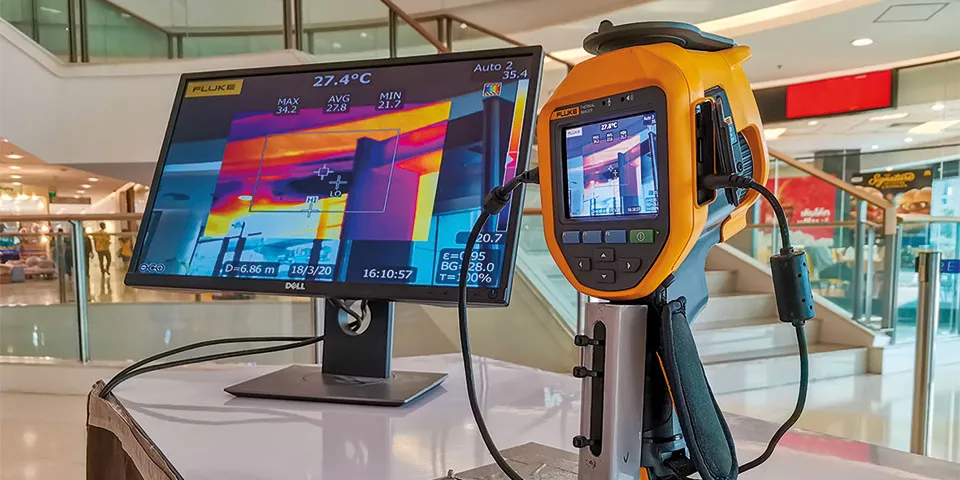
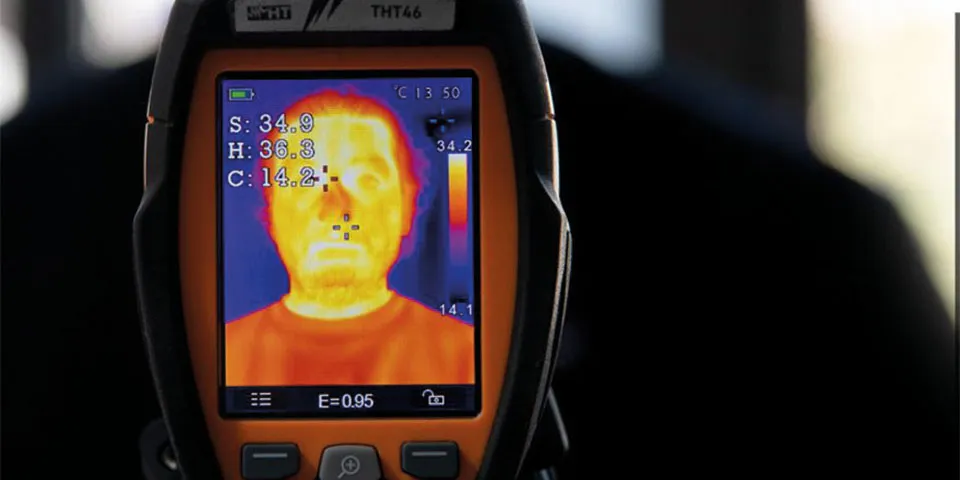
A thermal imaging camera provides a complete picture of a person’s temperature. This can vary from pixel to pixel in the image, giving a realistic representation of, for example, the person’s entire face. Advanced cameras can display the temperature of each pixel. As with digital cameras, the higher the image resolution, the more accurate the result. It is best to ask people to remove their glasses and any other face coverings so they do not affect the result. If the camera has manual focus and/or special lenses, it can also be used to carry out a good inspection from a greater distance. A device with automatic or fixed focus is less suitable for this. Ideally, a person’s body temperature is measured at the inner corner of the eye, which requires very precise positioning of the temperature measurement. This is possible with an automatic hotspot detection function.
Infrared thermometers
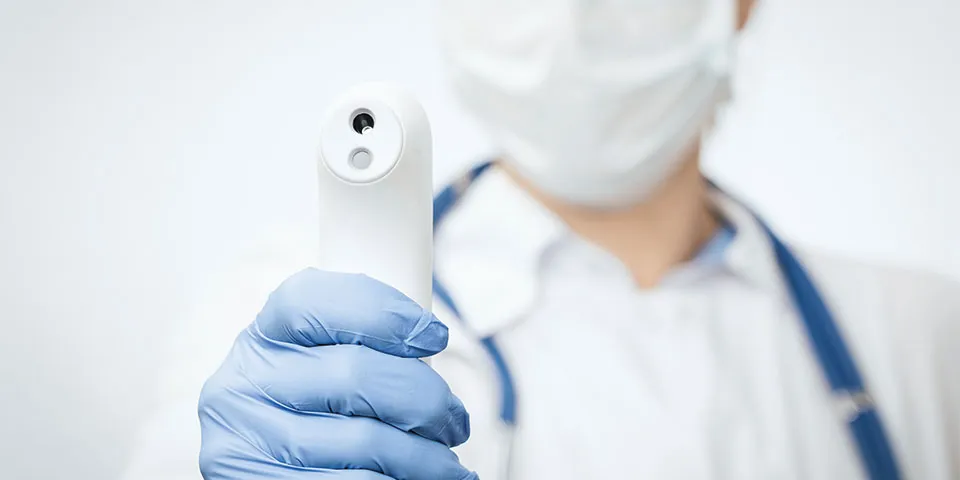
In addition to the pitfalls mentioned above, the distance-to-spot ratio (D:S) of an infrared thermometer is also very important. An infrared thermometer often uses a laser beam to indicate the centre of its measurement area. In reality, however, it does not measure the temperature at that point, but displays the average temperature of the area around it. The size of this area depends on the device’s distance-to-spot ratio and the distance to the object being measured. A distance-to-spot ratio of 12:1, for example, means that the diameter of the measurement area is one twelfth of the distance to the object. At a distance of 1 metre, the device will therefore display the average temperature of a circle 8.33 cm in diameter (100 cm : 12) around the centre of the measurement area. At a distance of 2 metres, the diameter is 16.66 cm, and so on. So if you want to measure the (average) temperature of a face, bear this in mind and stand close enough to ensure that the temperature of objects in the background is not included in the calculation.
It is also advisable, where possible, to switch off the IR thermometer’s laser beam so that it cannot shine into anyone’s eyes. This also applies, of course, to thermal imaging cameras equipped with a laser beam as an aiming aid. With infrared thermometers, switching off the laser does make it much more difficult to determine the exact location of the measurement area, let alone the inner corner of an eye.
Useful extra functions
Depending on the device, several useful extra functions may also be available. These include displaying and recording the highest temperature measured (per pixel), or automatically issuing a warning when the measured temperature exceeds, for example, 37,5 °C. More expensive thermal imaging cameras can often also stream thermographic images live to a screen, and the results can be analysed and edited using professional software.
Privacy legislation
Whether using a camera to screen people breaches privacy legislation is still a matter of debate. In this context, the public interest is likely to take precedence, as long as the measures taken are necessary and proportionate.
What happens after the crisis?
If you no longer need your thermal imaging camera or IR thermometer for health screening, you can use it for numerous other applications, such as detecting problems in electrical cabinets, central heating systems, underfloor heating, insulation and so on.
Find the right company in the sectorSearch by product, field, region or project in the company directory and across all articles from Installatie & Bouw Vlaanderen.
We use cookies to keep the site working properly. With your consent, we also use cookies for statistics and third-party banners. Read more in our privacy and cookie statement.