











Solar thermal collectors: the ideal heat source for your swimming pool
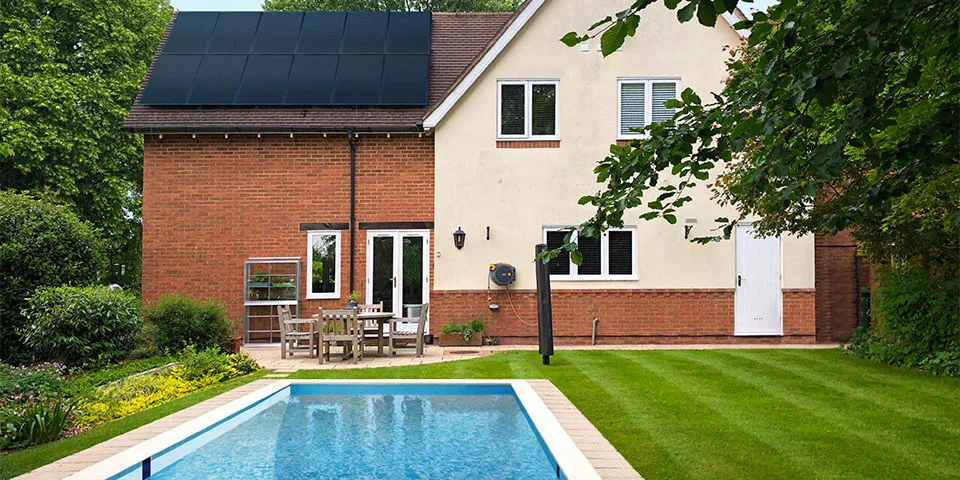
The coronavirus crisis has had a positive impact on at least one sector: private swimming pools. Outdoor pools are now more popular than ever. Unfortunately, however, our country rarely enjoys sun-drenched days and tropical temperatures. If you want to extend the swimming season by a few months, you need to heat the pool. The ideal solution? Solar thermal collectors. From May to September, solar collectors can provide more than half of the energy needed to heat the pool. And on warm days, the solar installation can heat the pool water entirely. Environmentally friendly and completely free!
More and more Belgians are having a swimming pool installed in their garden, or planning to do so. Figures from the Groepering van Algemene Aannemers van Zwembadbouwers show that in the first 3.5 months of this year, orders were up 2%, following a very strong 2019, when they rose by 27%. Possible reasons? Belgians are unsure whether they will be able to go on holiday this year and have been preparing for a staycation in their own garden for several weeks. There is also a clear trend, even outside the coronavirus crisis, towards enjoying the garden with friends and family and keeping fit.
Affordable and silent
If you want to enjoy your outdoor pool in spring and autumn as well as on sunny summer days, it is best to heat the water. You can do this in the traditional way, or opt for a modern, environmentally friendly alternative such as a heat pump or solar thermal collectors.
Heat pumps can deliver a consistently high efficiency, even on cloudy days. Compared with heat pumps, solar collectors have the advantage of being relatively inexpensive, as you only pay for the initial purchase, not for energy, while also delivering high efficiency on sunny days. A solar thermal system is also virtually silent. This is important, of course, when you are sunbathing by the pool or enjoying an aperitif on the terrace with family and friends.
Solar collectors help reduce greenhouse gas emissions and global warming. They require very little maintenance, are quick and easy to install, and are still eligible for government support.
More than just free domestic hot water
Solar thermal collectors are sometimes confused with photovoltaic (PV) panels. Some types of solar collector do indeed look like them, but the two are quite different. Photovoltaic panels, or PV panels, generate electricity. Solar thermal collectors, on the other hand, produce heat. That is why they are also known as solar thermal panels. Heating a swimming pool obviously requires heat.
The most popular use of solar thermal collectors is to provide domestic hot water. Since this accounts for 15 to 20% of our energy bills, a solar water heating system delivers its greatest savings here. With 4 to 6 m² of collectors, a household of four can meet 90% of its hot water needs in summer, when the sun's rays strike the surface of the solar panels at right angles. In December, the figure is still 25%, thanks to the winter sunshine.
Solar water heating systems can also save 15 to 20% on energy when used for space heating. In very well-insulated homes, the savings can be even greater.
A final application can be found in the garden, where solar thermal collectors can heat an outdoor swimming pool. This makes sense, as pool water does not need to reach high temperatures. 28 degrees is usually enough. What is more, pools are used most when the sun is at its strongest. On hot summer days, solar collectors can provide enough energy to bring the pool to a comfortable temperature. From May to September, they can supply more than half of the energy required.
A worthwhile investment
A solar thermal pool heating system can reduce your energy consumption in three ways.
1 The solar collectors heat the pool only
The sun's energy is captured in a frost-resistant fluid in the collectors, pumped through insulated pipes to a heat exchanger, and then transferred directly to the pool water.
2 The solar collectors heat the pool and your domestic hot water
By connecting a domestic hot water cylinder to the solar thermal pool heating system, the residual heat from the solar installation can be used to reduce the energy needed to heat domestic water.
3 The solar collectors heat the pool and the domestic hot water cylinder, and provide support for space heating.
By connecting a combi buffer tank to the solar installation, residual heat can be used to reduce both domestic hot water consumption and some of the energy used for space heating. This is the ultimate form of solar thermal energy, delivering maximum savings, particularly with a low-temperature heating system such as underfloor heating or oversized radiators. When the solar collectors cannot provide enough energy, the combi buffer tank steps in to heat the central heating or domestic hot water.
For more information about solar water heating, or to find a distributor or installer, visit www.InfoZonneBoiler.be, the online information platform of the Belgian solar water heating association Belsolar.
Question about this story? Ask your question
Keep following this
Get an email when a new story is published. No account needed.
- SubjectNews







