











“Renovated building showcases energy-efficient ventilation system”
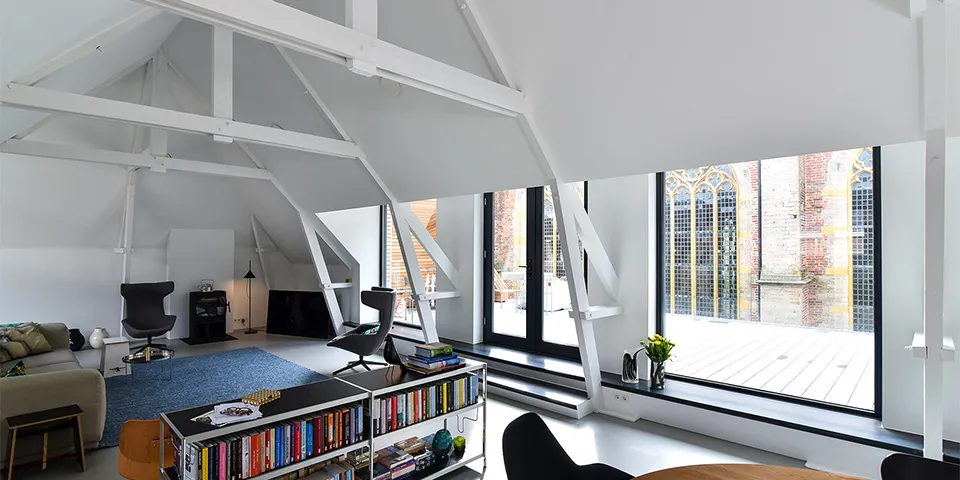
In the heart of Deventer in the Netherlands, we find the former Salland bank branch. The bank on Hofstraat had been left neglected for several years. Two years ago, interior architect Carlos van Dijk set his sights on this historic building. He and his wife Thea fell in love with it at first sight and turned it into a real gem. The ground floor was transformed into a vast home furnishings shop. Upstairs, the bare attic was converted into a luxury apartment, with a focus on a healthy indoor climate.
A bank building dating from 1914 was transformed in mid-2018 into a home furnishings shop spanning more than 800 m² and a comfortable, energy-neutral apartment. After standing empty for five years, the couple bought the building in the centre of Deventer. The project, known as Carlos in Huis, is where they moved in 2018.
As soon as we open the majestic front door, it is clear that this is a distinctive building with a soul. We are currently in the shop, where every room has its own atmosphere and style. The terrazzo floors, classic panelling and marble counter … contrast sharply with the contemporary collection of furniture, lighting and accessories. We meet the owners, Carlos van Dijk and Thea Witteveen, who are happy to tell us more about their apartment on the top floor of this listed building.
Protected heritage
‘This building has never been used as a home,’ van Dijk begins. ‘In other words, the way was completely clear for us. We bought this former bank branch and spent the first year renovating the shop. The following year, we converted the attic. The result is a comfortable, energy-neutral apartment finished to a high standard.’
‘The opportunity to turn this wonderful location into a warm home was superb,’ the owner continues. ‘The building was designated a “Rijksmonument”, which meant we were subject to certain restrictions. For example, we opted for double glazing throughout, except in a few windows where high-quality heritage glass had to be used. We worked closely with Monumentenzorg at every stage and restored the building to its original condition as far as possible.’
Future-proof apartment
Upstairs, we are struck by the apartment’s homely feel. ‘We had a strong preference for warm, natural materials such as red cedar, ayous wood and linoleum,’ says van Dijk. ‘We are also conscious of our energy use. Our apartment is ready for the future. The building has no gas supply, but is connected to district heating. We have also opted for solar panels and extensive insulation, combined with a reliable ventilation system.’
Choosing a system D
Richard Geraerts, Sales Manager at Duco, adds: ‘Choosing the right ventilation system for historic buildings can be challenging, especially when aesthetic considerations also need to be taken into account. Here, a system D solution was chosen, namely DucoBox Energy with two-zone control. This balanced ventilation unit with two zones distinguishes between the living and sleeping areas to deliver good energy performance. Sensors track the occupants’ movements around the home, allowing the system to determine automatically when ventilation is needed. This saves a great deal on energy costs and also helps reduce overall CO2 emissions.’
‘Another benefit is the acoustic comfort for the occupants,’ says Geraerts. They need not worry about noise. Thanks in part to the integrated two-zone control, the favourable positioning of the fans and the use of sound-absorbing materials, supply air noise is among the lowest on the market (55 dB at 325 m³/h).’
Looks matter too
‘As an interior architect, I may consider aesthetics the most important factor,’ van Dijk admits. ‘For example, we looked for supply and extract valves that would be almost invisible in the room, and found that DucoVent Design valves were a perfect fit,’ Witteveen continues. ‘These valves have a discreet design and are suitable for ceiling and wall mounting. As our apartment is beneath the roof ridge, they were the ideal solution.’
In practice
Edwin Spijker, Regional Manager for Installation, Netherlands, at Duco, adds: ‘Modern apartments such as Carlos and Thea’s are increasingly being designed with a focus on airtight insulation. Saving on energy bills can be effective when a home is insulated airtight. However, fresh air has to come from somewhere, and it is best not to rely on uncontrolled airflows, as these cause heat losses.’
‘That is not the case with balanced ventilation,’ Spijker continues. ‘The unit mechanically supplies fresh air to the home and mechanically extracts stale air using integrated fans. Existing heat is recovered as efficiently as possible: heat is recovered from the extracted air and transferred to the supply air. Implementing this ventilation system ensures a healthy indoor climate and occupant comfort.’
Have a business enquiry for DUCO? Get in touch
Wie aan Carlos in Huis werkte

Keep following this
Get an email when a new story is published. No account needed.
- ProjectCarlos in Huis
- ThemeHealthy air and summer comfort
- SubjectNews
- CompanyDUCO







