











Removing limescale and corrosion deposits from central heating systems
The WTCB (Belgian Building Research Institute) is currently working on new recommendations aimed at limiting deposits and corrosion in closed water systems in buildings.
As most heat generators, such as boilers and heat pumps, are still installed in the renovation market, it is also important to measure and assess water quality in existing systems. Existing installations are often found to contain contamination, both in suspended form (sludge in suspension) and as hard deposits. Hard water is a major cause of limescale in central heating systems. This contamination causes various problems. NBN 14336 describes several methods for chemically cleaning and flushing installations. Naturally, safe products must always be used, meaning products with Belgaqua Category 3 certification.
What are limescale and corrosion in central heating systems?
Limescale and corrosion are two of the main causes of faults or poor performance in central heating systems. Limescale forms when the water used is too hard, causing calcium deposits to build up on the walls of pipes and equipment. Corrosion is a process in which metal components in the heating system are damaged by chemical reactions with the water. Both problems can lead to lower efficiency, increased energy consumption, leaks and seals that no longer function properly.
Removing limescale from heat exchangers
Limescale deposits, sometimes mixed with black magnetite, often form in the boiler’s heat exchanger. Above 60 °C, limescale precipitates permanently and builds up as a hard layer. This layer impedes heat transfer and reduces the efficiency of the heat exchanger and the system. In extreme cases, this can cause the heat exchanger to overheat. The most common remedy is to descale the heat exchanger using a non-aggressive acid containing a corrosion inhibitor. Acids such as hydrochloric acid (HCl) and acetic acid must be avoided altogether, as they will damage certain boiler components.
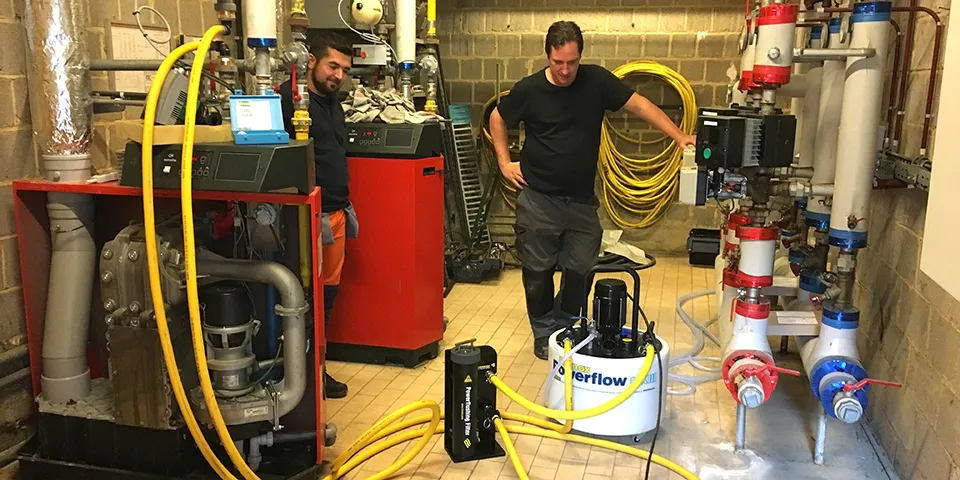
Descaling is quickest when work can be carried out at a high temperature, up to 80° C, using a reversible flushing pump. This allows the entire heat exchanger to be cleaned under controlled conditions in both flow directions.
2. Removing light contamination from a domestic central heating system
When replacing a boiler, a hydrocyclone magnetic filter is often used, as described in NBN 14868. The filter is installed on the return pipe of the existing heating system, and a pH-neutral chemical cleaner is added to the system. The cleaner circulates through the existing system for several days, while the filter captures as much of the contamination as possible and removes it from the heating water.
When replacing the boiler, it is often sufficient to drain the system, clean the filter and thoroughly flush the entire system with fresh water before protecting the upgraded system with a suitable corrosion inhibitor.
When cleaning the central heating system, it is essential to disconnect and reconnect electrical connections carefully to prevent faults.
A powerful, reversible flushing pump is often used to clean a central heating system.
3. Removing heavy contamination and resolving flow and circulation problems
In systems with heavy deposits in pipes and heat emitters, including radiators and underfloor heating, it may be advisable to clean the system using a flushing pump (see NBN 14868). The system is cleaned as thoroughly as possible using a combination of a powerful, high-flow flushing pump, pH-neutral cleaners and a magnetic filter. Ignoring flow problems can lead to costly repairs in the long term. High temperatures make it easy to check whether flow through the heat emitter system has been restored. This can be checked manually or with thermal imaging cameras.
Preventing problems and maintaining central heating systems
Regular maintenance of the central heating system is necessary to prevent limescale and corrosion. This includes checking the temperature, pressure, water level and electrical connections. It is also important to clean the pipes regularly to prevent blockages. A water softener can be installed to reduce water hardness before the water flows into the boiler or hot water cylinder. This can extend not only the life of the cylinder, but also that of other appliances, such as the dishwasher and taps. It improves the flow of hot and cold water through radiators.
It is also advisable to flush vinegar through the pipes once every 6 months. This can extend the life of the boiler and prevent unnecessary costs. A blocked condensate drain can be cleared by cleaning the boiler’s trap. Soda or vinegar can be used to clear a blocked drain. Special condensate drain cleaner can also be used to clear a blockage.
To have a hot water cylinder descaled, it is advisable to call in a professional. The professional is responsible for maintaining the cylinder correctly without causing further damage. If the limescale build-up is severe, the professional can also replace cylinder components correctly using the appropriate spare parts. It is important to contact a qualified installer.
The cost of servicing a hot water cylinder is difficult to determine in advance. Most professionals charge by the hour, so the price depends on the type of contamination and the time needed to carry out the service. On average, you can expect the work to take 2-3 hours.
An increasingly important consideration
In conclusion, removing contamination and deposits from central heating systems is becoming an increasingly important consideration when work is carried out on an installation. Manufacturers of system components are increasingly emphasising this. The expectation is that the heating water will be free from contamination. Heat emitter systems, which have been designed and balanced for a specific flow rate, will also operate at maximum efficiency when free from sludge and hard deposits.
Proper maintenance carried out by specialists is essential to ensure the efficiency and service life of the central heating system.
It is therefore necessary to take the appropriate measures to clean the central heating system and remove limescale and corrosion deposits. The techniques, equipment, products and professional support are available to service engineers and installation companies.
Question about this story? Ask your question
Keep following this
Get an email when a new story is published. No account needed.
- SubjectNews







