











Regensburg chooses Siemens technology for sustainable local public transport
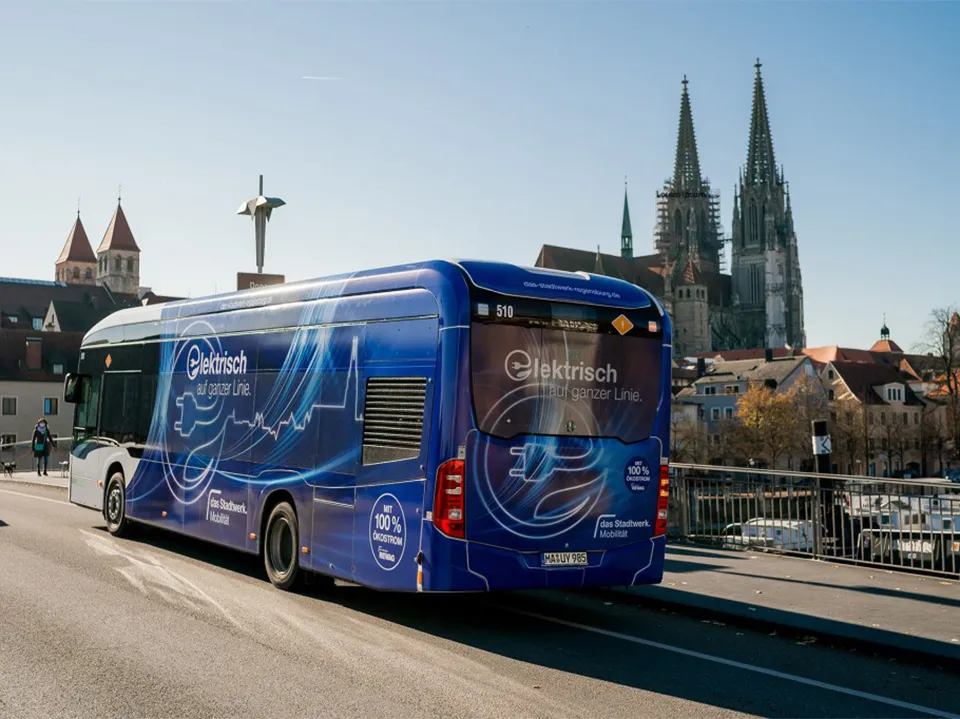
Siemens Smart Infrastructure has been commissioned by ‘das Stadtwerk Regensburg.Mobilität’, the transport authority for the German city of Regensburg, to equip the bus depot on Markomannenstraße for electric mobility.
- Bus depot to be equipped with charging technology and power distribution infrastructure
- 23 charging stations will supply e-buses with 150 kW each
- Busbar technology enables easy installation of a power distribution system in an existing building
As well as the charging infrastructure, Siemens will also supply the power distribution technology. The project is due to start in 2021. Electric buses have been operating in Regensburg city centre since 2017.
“We want to take the electrification of local public transport to the next level to make mobility in Regensburg more environmentally friendly and climate-neutral,” says Manfred Koller, Managing Director of das Stadtwerk Regensburg. “It is important to us that we can integrate the new charging infrastructure into the existing bus depot easily and cost-effectively. We also want to be able to add charging points in the future. We chose Siemens because its charging infrastructure is easy to expand and its busbar system provides an alternative to complex cabling for power distribution.”
The Sicharge UC 200 charging stations will serve 22 new electric buses across 23 parking spaces, each with a charging capacity of 150 kW. Charging will take place overnight or while the vehicles are stationary, using charging cables and connectors. 16 of the 23 parking spaces have a dedicated cable reel that retracts automatically when charging is complete, keeping the access lanes clear. The vehicles are powered by locally generated green electricity from REWAG, the energy supplier in Regensburg.
“This project once again shows how important it is to be able to integrate new charging infrastructure into existing structures. Many cities are investing in sustainable bus transport, but the necessary modifications have to be feasible. Converting existing bus depots for electric buses must therefore be straightforward and cost-effective,” says Birgit Dargel, Head of Future Grids at Siemens Smart Infrastructure.
To connect the depot to the public grid and distribute electricity throughout the building, Siemens will also install transformers and a Sivacon S8 low-voltage switchboard.
The individual charging points in the depot will then be supplied via a Sivacon 8PS busbar. What makes this form of power distribution unique is its special connectors, which allow the busbar system to adapt seamlessly to the specific features of the existing building. Compared with cables, this is a much more flexible solution. Installation is also easier and faster. Extensions can be added via tap-off units as required. When planning the distribution system, a digital twin of the busbar system is created using digital planning tools. This makes it possible to simulate a future modular extension of the system and incorporate it into the planning process today. The result is forward-looking, financially sound planning and efficient implementation.
Question about this story? Ask your question
Keep following this
Get an email when a new story is published. No account needed.
- SubjectNews







