











Noise requirements for heat pumps: how to prevent nuisance
Text Frixis en Wouter PolspoelImage Frixis en AI
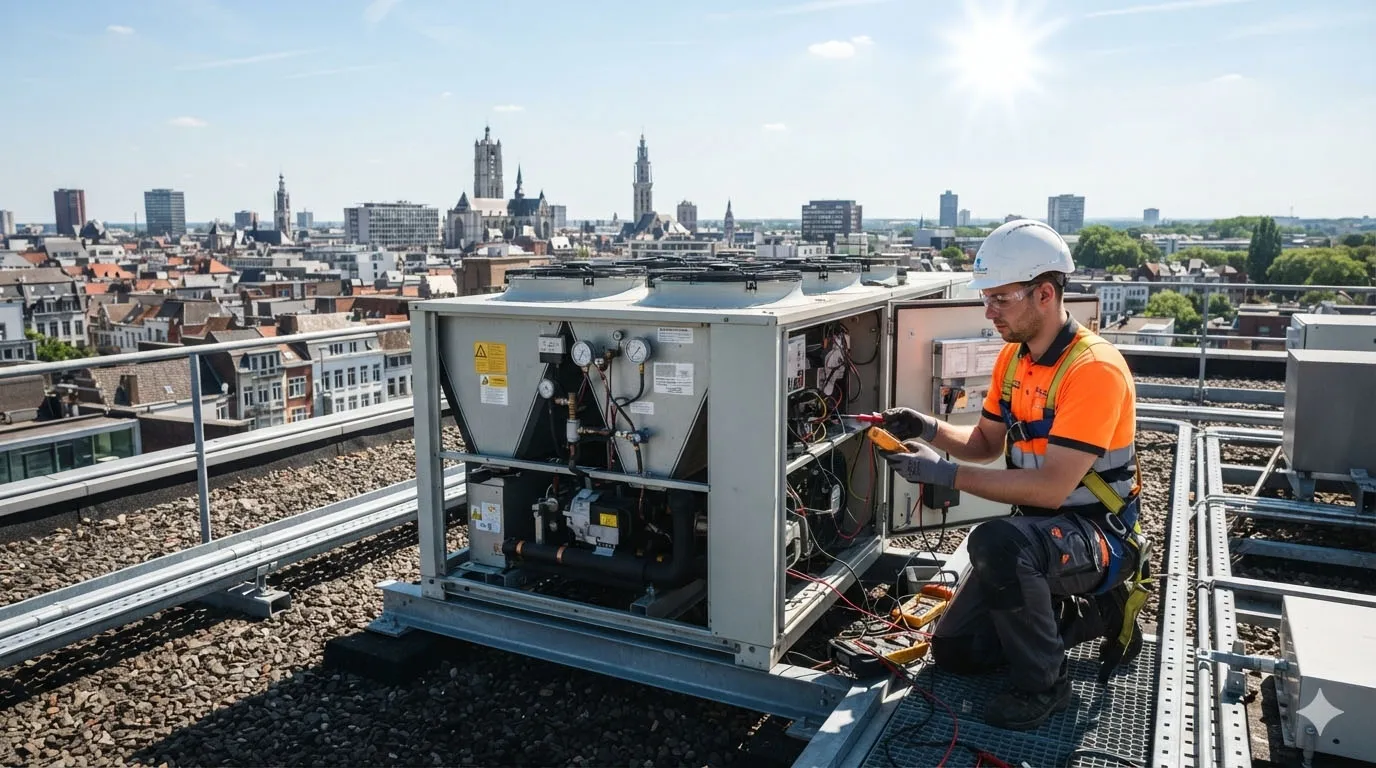
The noise from a heat pump’s outdoor unit can sometimes be a source of disputes between neighbours. That is why its positioning and orientation need careful consideration from the design stage onwards. To provide guidance for designers, installers and permit authorities, and avoid fragmented rules from one municipality to another, the Flemish Government drew up the guidance document ‘Environmental aspects of heat pumps and air conditioning systems’. Frixis, the professional association for the refrigeration and air treatment sector in Belgium, contributed to the document and explains its key recommendations in this article.
There are no specific noise requirements in Flanders for many residential outdoor units, but local rules may apply. It is therefore important always to check the requirements with the municipal environmental department first.
Where no specific statutory requirements apply, the recommendation is to aim for a sound pressure level of no more than 45 dB(A) during the day, between 7 and 22 hours, and 40 dB(A) at night, between 22 and 7 hours. These values are assessed outdoors, at a height of 1.5 metres, at the property boundary, the boundary between gardens, or the edge of a neighbour’s terrace. Openable windows in neighbouring houses or flats must also be taken into account.
A clearly audible humming or buzzing tone is perceived as more disturbing than a steady sound. Therefore, 5 dB is added to the measured sound pressure level for the assessment. If several outdoor units are installed on the same property, they are assessed together: the combined sound pressure level must meet the guideline value.
Choose the right unit
Choosing the right unit starts with correct sizing. An undersized heat pump runs at high output more often and therefore produces more noise. An oversized unit, on the other hand, switches on and off more frequently, and the variation in noise levels makes this more noticeable. A heat loss calculation is therefore essential. Use the stated sound power level as a reference when selecting the unit. This can be found in the technical documentation or on the energy label. If the manufacturer gives different values for different operating conditions, use the maximum sound power level. A quiet night mode is strongly recommended, particularly as the night-time limit is 5 dB stricter than the daytime limit.
Positioning matters
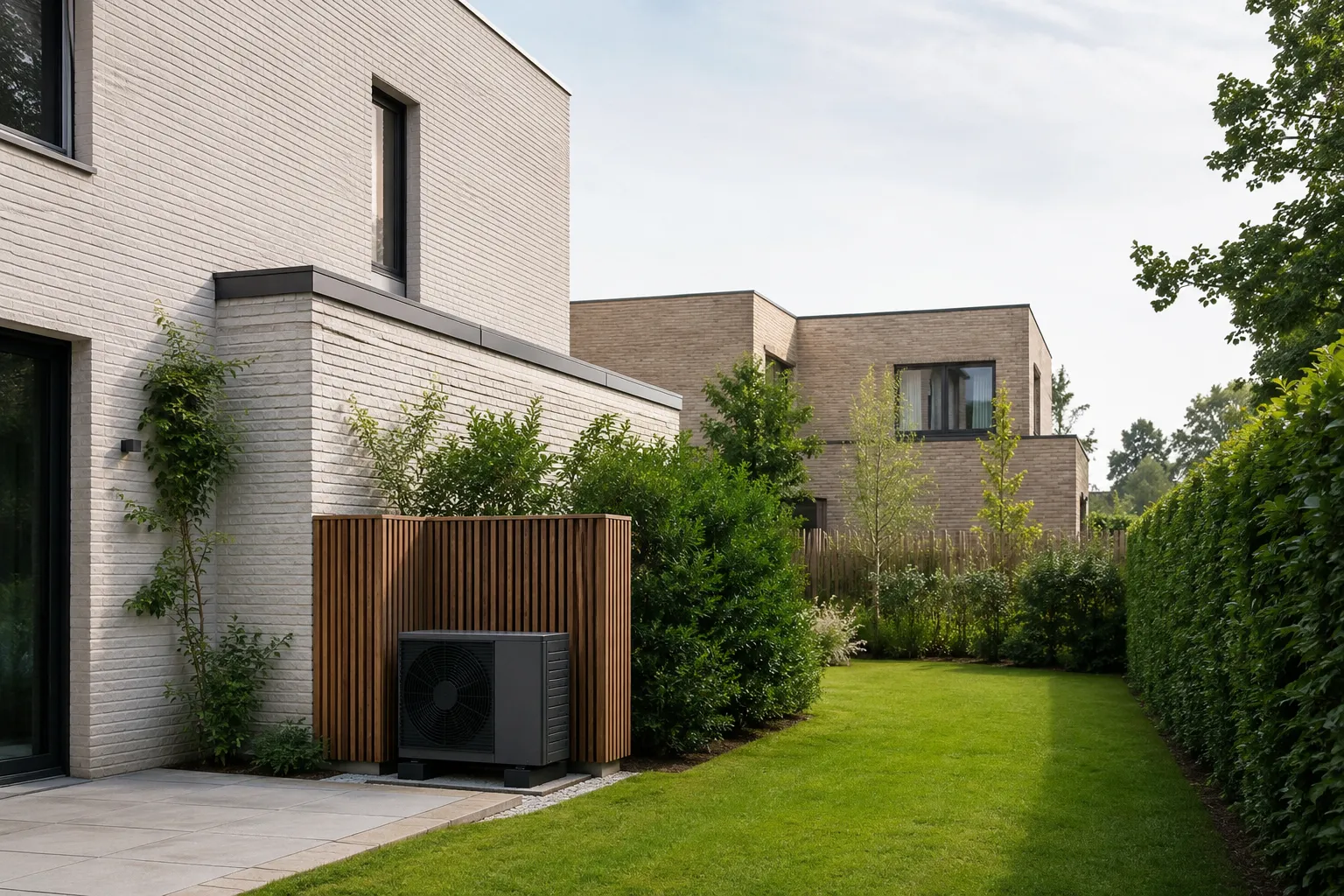
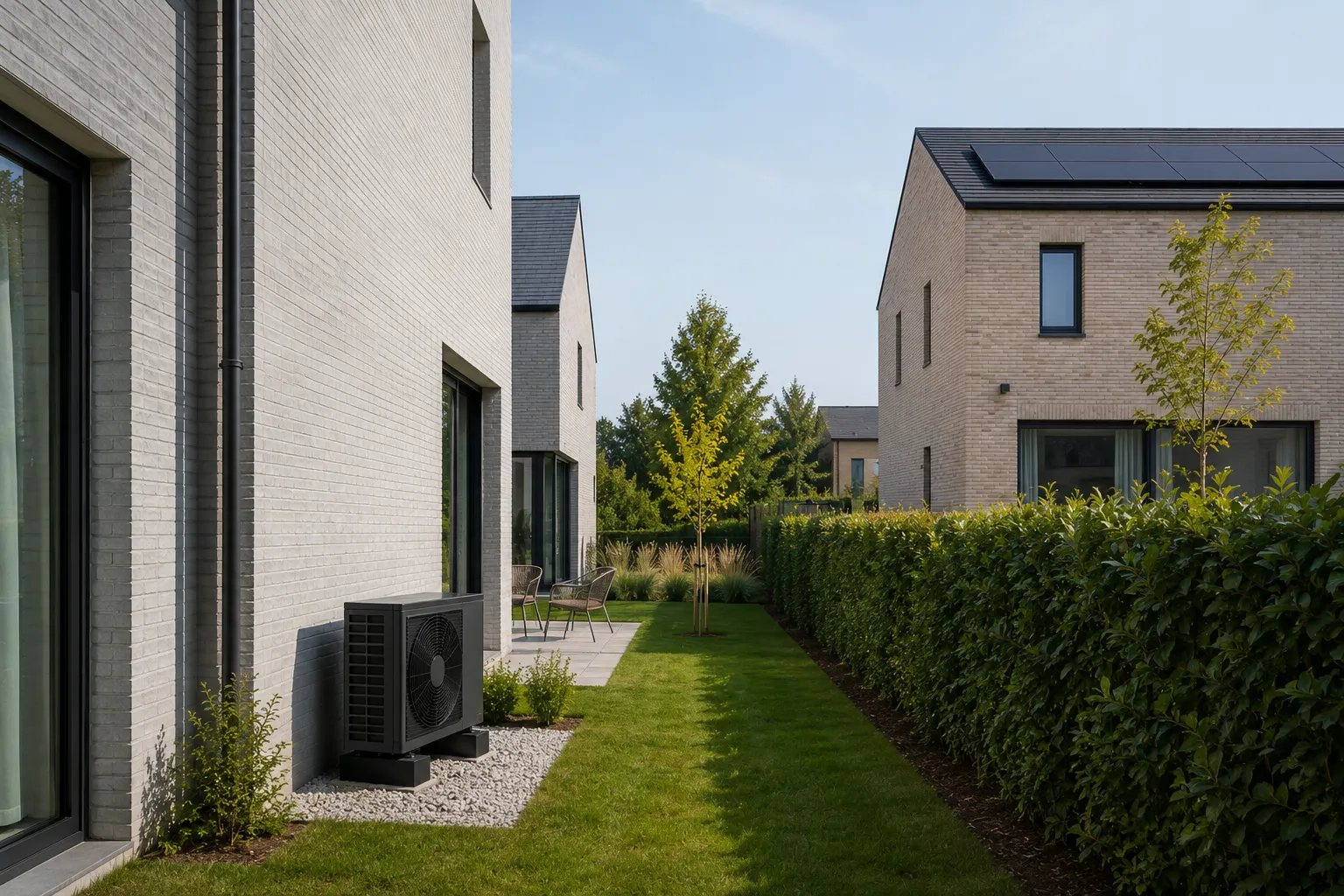
Correct positioning and orientation of the outdoor unit significantly reduce the risk of noise nuisance. Place the outdoor unit as far as possible from property boundaries, terraces and openable windows. Always comply with the manufacturer’s installation instructions, including the maximum pipe lengths, while also assessing the acoustic impact on the surrounding area.
Where possible, do not point the air outlet towards neighbouring terraces, openable windows, ventilation grilles or other noise-sensitive areas. Also consider the surroundings: hard surfaces such as walls, floors and roofs reflect sound, while well-planned screening or sufficient distance can reduce noise levels.
The ‘Code of good practice. Noise from outdoor units of residential air-to-air (air conditioning) and air-to-water heat pumps’, a separate publication by the Department of Environment of the Flemish Government, contains various practical examples and installation scenarios showing how to achieve the recommended noise levels.
Structure-borne noise also needs attention, in addition to airborne noise: vibrations can be transmitted through plinths, walls, pipes or lightweight structures. Ideally, install the outdoor unit on the ground or on a heavy, stable plinth with correctly selected vibration isolators, use flexible connections and acoustic brackets, and avoid rigid contact at wall and ceiling penetrations.
What if nuisance does occur?
If nuisance does occur after installation, first check the system and its controls: dirty heat exchangers, damaged fans, incorrect settings or inadequate vibration isolation can increase noise levels. Where necessary, a quiet mode, adjusted controls, a buffer tank or acoustic screening can be used. A solid, sufficiently heavy screen with no openings can also noticeably reduce noise levels. If this does not help, relocating the outdoor unit strategically may resolve complaints.
Informing owners and neighbours in good time helps ensure smooth communication. Since the perception of sound is subjective and can vary from person to person, open dialogue helps align expectations. In apartment buildings, consultation with the owners’ association is also valuable, so that both current and future installations can be integrated in an acoustically responsible way.
The guidance document ‘Environmental aspects of heat pumps and air conditioning systems’ can be downloaded from vlaanderen.be, the official website of the Flemish Government.
Question about this story? Ask your question
Keep following this
Get an email when a new story is published. No account needed.
- ThemeFossil-free heating and cooling
- SubjectNews







