











LINK2030! study highlights changes and opportunities in the energy transition
The latest edition of Install Day, held on Friday 19 November, featured a strong programme of talks. The focus was LINK2030!, a future study looking at the future of the installation sector in light of the energy transition.
‘The energy transition can never succeed without the commitment of our ecosystem’
LINK2030
The challenges posed by climate change mean that we need to use energy differently and more intelligently. The energy transition is therefore essential, and will bring significant changes and opportunities for the installation sector. As collaboration between manufacturers, distributors, installers and maintenance companies will inevitably evolve during this transition, the Federation of Electricity and Electronics (F.E.E.) and Techlink have joined forces to produce a future study: LINK2030.
Green Deal
LINK2030 is based on the European Green Deal, the policy framework for achieving the 2030 climate targets and a climate-neutral Europe by 2050. Belgian federal and regional legislation to improve energy efficiency and renewable electricity production, and reduce greenhouse gas emissions, stems from this framework. Achieving these targets requires a new generation of energy systems. This is creating a social and technological environment with a major impact on the multifunctional building services sector.
Ecosystem
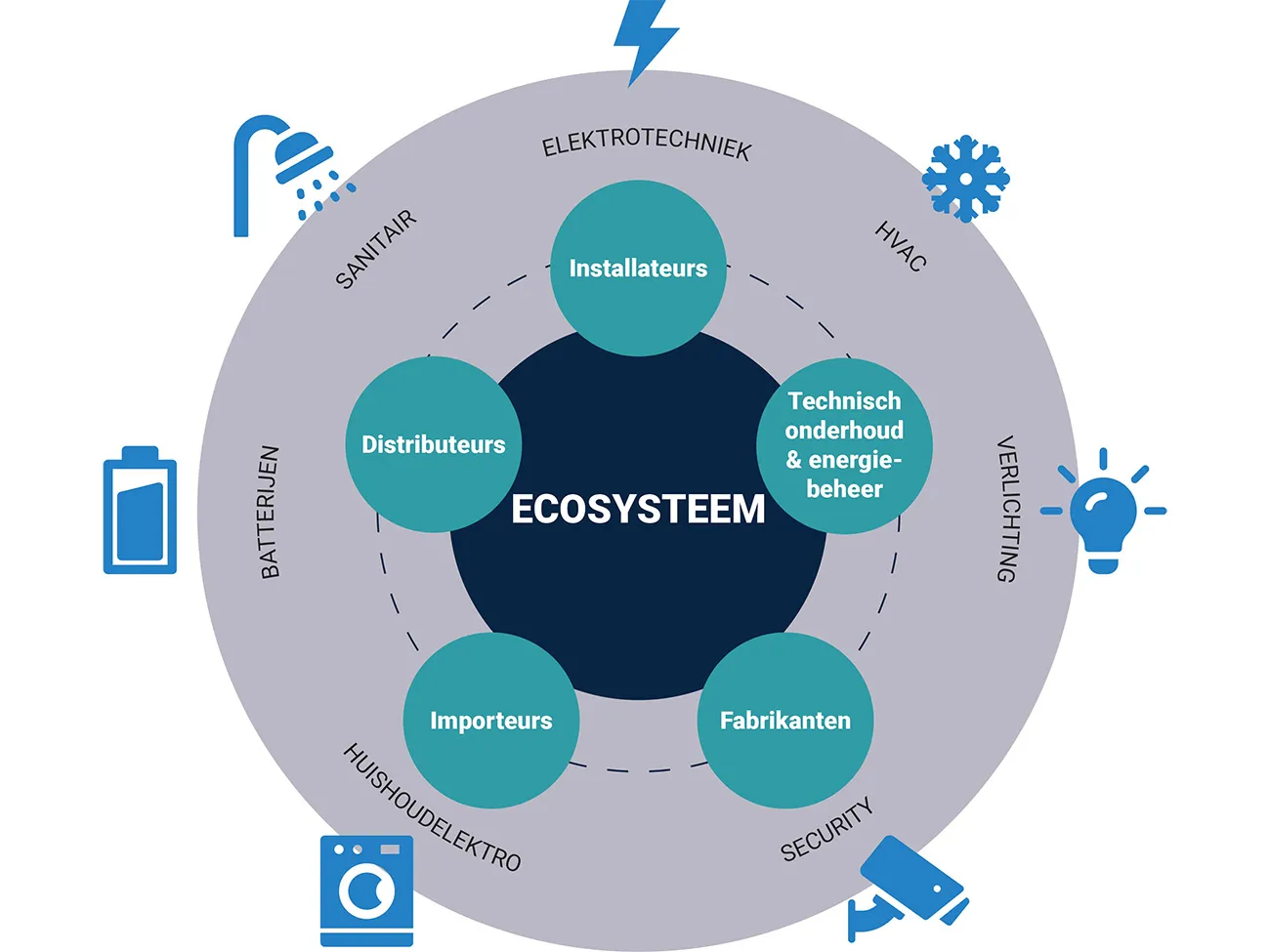
The “Multifunctional installations” ecosystem comprises manufacturers, distributors, installers, and companies working in technical maintenance and energy management across electrical engineering, HVAC, plumbing, security, lighting, batteries and domestic electrical appliances.
The federations F.E.E. and Techlink have joined forces to develop this future study because technological trends alone will not shape the multifunctional ecosystem in which installers work. These trends include more renewable energy, less waste and resource wastage, high-tech applications, data flow management and smart applications, all of which will make future installations climate-neutral and circular, decentralised and smart, and technologically advanced. The relationships between manufacturers, distributors, installers and companies working in technical maintenance and energy management will also change.
Social trends
Social trends, such as the changing customer profile (consumers are now prosumers too), the shift towards new business models (e.g. ‘as-a-Service (aaS)’) and the ‘war for talent’, mean that the installation sector will need to invest in new technical knowledge and digital skills. It will also need to consider new business models and partnerships.
Tip: Invest in training and development! As an employer with an eye to the future, it is important to invest in technical, digital and soft (communication) skills. Take account of what professionals today want, including responsibility, opportunities for development and a good work-life balance. The ‘war for talent’ is set to continue, and focusing on human capital is becoming increasingly important if we are to meet today’s and tomorrow’s challenges.
Online webinar
LINK2030 was presented as an exclusive preview to F.E.E. and Techlink members during an online webinar on 18 June 2021.
Moderator Hanne Decoutere spoke to Eric Piers, Managing Director of F.E.E., and Kris Van Dingenen, Director General at Techlink, about how they will tackle the energy transition together.
LINK2030 is intended as a guide and source of inspiration for policymakers at European, federal and regional level, as well as for education, science and all partners in sectors such as construction, industry, water and energy. Both federations are making policy recommendations while also seeking to capitalise on market opportunities and improve the services they provide to their members. They are also calling on policymakers and the wider sector to work together to accelerate the energy transition.
“The energy transition can never succeed without the commitment of our ecosystem. Together, we ensure that new forms of energy are efficiently converted into affordable comfort through our multifunctional installations. Our unique strength is our ability to play an all-encompassing role,” says Van Dingenen.

Call for greater collaboration
At Install Day, Techlink also called on the government to work more closely with the sector to achieve Belgium’s climate targets. In conjunction with the trade fair, Techlink surveyed more than 1000 Belgians to identify the barriers and motivations influencing their decision to install energy-saving systems. The findings showed that for 1 in 2 Belgians, the cost of energy-saving installations or measures puts them off using them.
“We need to find ways to help consumers. Our installers are ready to install energy-saving systems and measures, but consumers need to be able to afford them. The government and the sector need to think outside the box to encourage and help people carry out the necessary energy renovations. This has to go much further than subsidies alone,” explains Van Dingenen.
1 in 2 Belgians said that environmental and climate concerns motivate them to install energy-saving systems or measures in their homes. Yet 43% of Belgians say they pay little or no attention to their home’s energy consumption. As many as 82% say they have limited or very little knowledge of energy-saving installations and measures, and for 2 in 5, a lack of knowledge is a barrier to installing them.
“A very large proportion of the Belgian population knows too little about energy-saving installations and measures. The link between energy consumption, the climate and energy bills needs to be made clearer. The sector and government need to work together to raise awareness of the opportunities energy-saving installations offer, both for the environment and climate and for people’s wallets,” concludes Van Dingenen.
Finally
The focus of the fourth edition of Install Day was the energy transition and sustainability in the sector. Presentations by speakers including Dirk Van Evercooren (ODE), Hans Verboven (Sustacon/UAntwerpen), Véronique Vens (Veka) and Jan Caerels (Techlink) highlighted the impact of the energy transition on the multifunctional installation sector and offered practical tips for seizing the opportunities it brings.
The presentations can be downloaded from the Install Day website:
www.installday.be/seminaries
More information? www.link2030.be
Question about this story? Ask your question
Keep following this
Get an email when a new story is published. No account needed.
- ThemeThe installer of tomorrow
- SubjectNews







