











Improve your EPC? Insulation pays off the most!
Greater comfort, lower energy bills, reduced CO2 emissions, a substantial increase in your home’s value and, from next year, additional grants too…
There are plenty of reasons to aim for a good score on your Energy Performance Certificate (EPC). But how can you improve the energy performance of a home with, for example, an E label, as quickly and efficiently as possible, to achieve a D, C, B or A label? By giving absolute priority to roof, wall and floor insulation, according to figures commissioned by Recticel Insulation for its 2020 Insulation Barometer.
An Energy Performance Certificate (EPC) is compulsory for homes and flats offered for sale or rent. Since 2008, it has informed owners and prospective buyers or tenants about the energy performance of the property in question. Since the beginning of 2019, it has provided even clearer information, with a label added to the new EPC, ranging from F (a highly energy-consuming home) to A+ (a home that produces more energy than it consumes).
To meet European energy targets, all existing homes must achieve an A rating or better by 2050. We are still a long way from that ambition. At present, flats in Flanders achieve an average C label, while detached and semi-detached houses average an E label. Much more energy-efficient renovation is therefore needed to improve energy ratings.
A better EPC? Here’s how!
But what is the best way to approach an energy-efficient renovation, or a BENOvatie (a renovation in line with the energy ambitions of the 2050 Renovation Pact), if you want to improve the label as quickly and efficiently as possible?
“The answer is clear,” says Pieter Bailleuil, Technical Manager Belux at Recticel Insulation, a leading player in thermal and acoustic insulation. “Give absolute priority to roof, wall and floor insulation. Starting with insulation to keep heat demand as low as possible, and only then considering the most sustainable way to meet that demand, is not only entirely in keeping with the Trias Energetica principle. Insulation measures also deliver much greater energy savings than investing in energy-efficient systems for heating, domestic hot water, ventilation or electricity generation.”
A real-life example proves the point
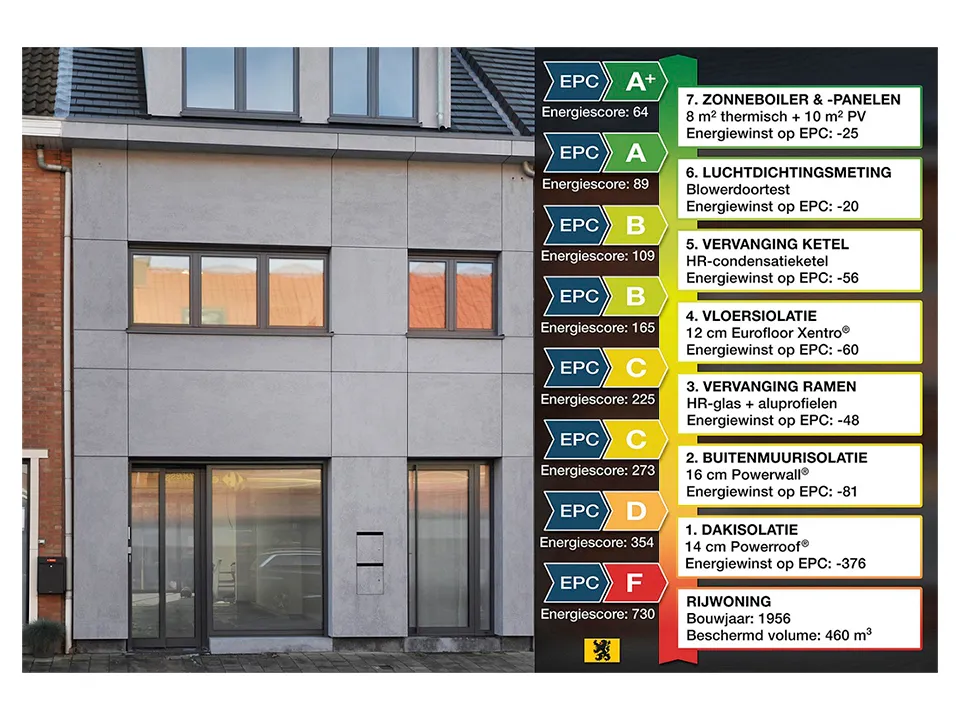
The figures commissioned by Recticel Insulation for its 2020 Insulation Barometer also clearly show that roof, wall and floor insulation are the most effective measures for improving your EPC.
For example, renovating a terraced house with an initial energy score of 730 kWh/m²/year shows that roof insulation delivers energy savings of 376 kWh/m²/year, external wall insulation 81 kWh/m²/year and floor insulation 60 kWh/m²/year. Good airtightness added a further 20 kWh/m²/year in energy savings on the EPC. In other words, the three insulation measures together saved no less than 537 kWh/m²/year, while installing an energy-efficient boiler saves just 56 kWh/m²/year, fitting 8 m² of solar thermal collectors a mere 15 kWh/m²/year, and installing 10 m² of PV panels only 10 kWh/m²/year.
In terms of EPC labels, roof insulation improved this home’s rating from F to D. Wall insulation raised it from D to C. Floor insulation and window replacement brought the home up to a B label. A new boiler, a solar water heater and PV panels were then just the icing on the cake, taking it to A+.
Rewarded with additional grants in 2021
The Flemish Government has long offered a range of grants, available through grid operator Fluvius, to encourage people in Flanders to renovate more and improve their homes’ energy efficiency. From next year, grants for roof, wall and floor insulation will become even more attractive. The grant for external wall insulation will double from 15 to 30 euros per m². Grants for roof insulation and external wall insulation will also increase by an additional 8 euros per m² when asbestos roof slates, asbestos-containing roof underlay or asbestos-containing façade cladding are removed at the same time.
To provide an additional incentive to focus on improving EPC ratings when renovating, two further financial incentives will be introduced next year, on top of the existing grants: a label grant and an interest-free loan of up to 60,000 euros. The label grant is worth 2,500 to 5,000 euros and is available to anyone who owns a home with an E or F label and renovates it to achieve a C, B or A label within 5 years. If you buy, receive or inherit a home with an E or F label and commit to improving its rating to C, B or A within 5 years, you will be entitled to an interest-free renovation loan or an Energielening+ of up to 60,000 euros, in addition to the individual renovation grants and the label grant.
Find out more
For more information, visit www.isolatiebarometer.be. You will also find a comprehensive white paper there.
Question about this story? Ask your question
Keep following this
Get an email when a new story is published. No account needed.
- SubjectNews







