











(How) does smart security really work?
Text Trees AccouImage Equans & Elia
Software that captures, predicts and advises
Equans, known worldwide for its multi-technical installations and maintenance services, is taking new steps in smart building security. What exactly is a smart building, and how can smart systems be deployed effectively and efficiently? The team responsible for fire safety, security and audiovisual (FSA) brings us up to date on its latest developments and its collaboration with grid operator Elia.
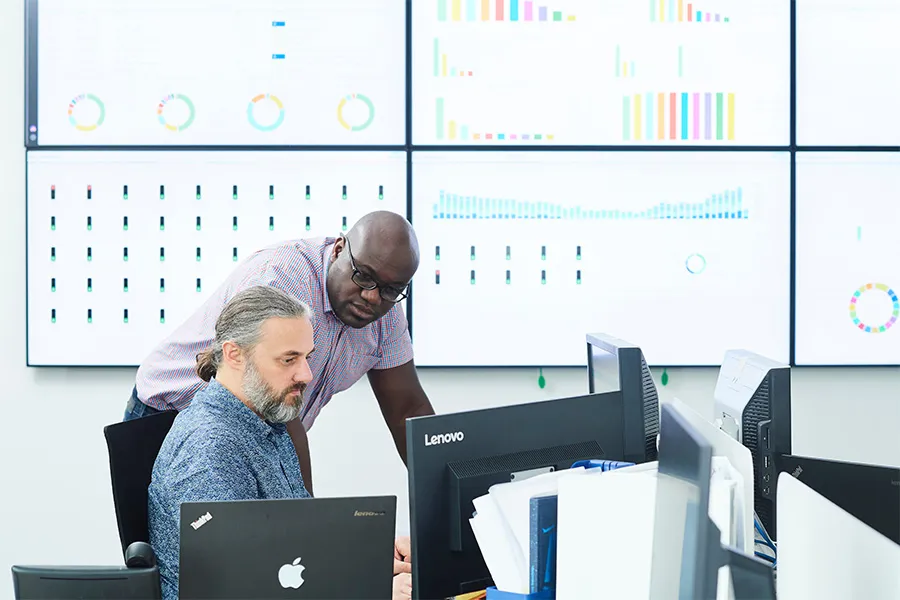
The FSA team deploys installations and smart systems for fire detection, security and audiovisual applications. Wouter Buelens, FSA’s commercial lead, explains: “We increasingly work on smart buildings, which are monitored using connected data from various subsystems, such as CCTV, fire detectors, access control, intrusion detection and building management systems. We turn that data into useful information that provides insights that cannot be obtained from any one system alone. We are moving from integrated security technologies, such as a camera automatically turning towards the location of a fire alarm to verify it, towards a system that intelligently combines all available data to improve availability, quality and performance.”
Ronny Stormezand, business development manager at FSA, adds: “Existing security systems collect a great deal of data, but no single system solves the most pressing problem: companies need to do more with fewer people. That is where our software makes the difference.”
Insights from data
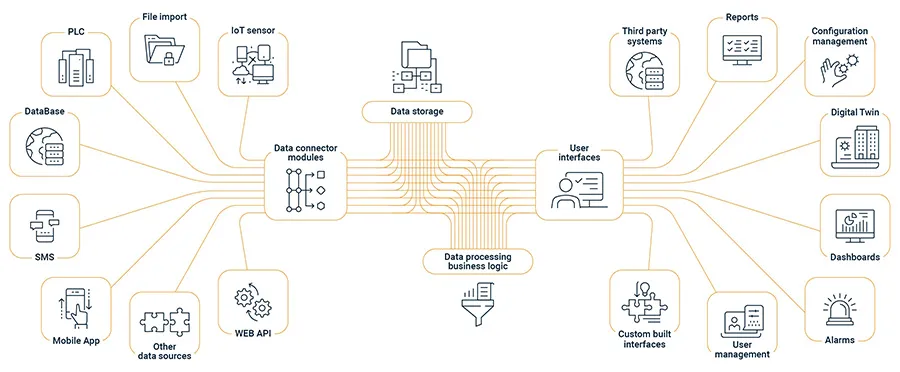
The new software, called Quantes, sits on top of building and security systems. It currently does three things: connects relevant data from buildings and security systems in real time; models, correlates and stores data from these systems; and derives value from the stored data by presenting it in interactive dashboards, including real-time notifications, anomaly detection and the identification of often surprising correlations.
Quantes can therefore make large volumes of data from diverse sources clear and understandable to stakeholders, without requiring major investment. This enables decision-makers to make faster, better-informed decisions and monitor their impact in real time, making adjustments as needed.
For example, Quantes can help minimise false alarms by analysing data from multiple incoming sources. An analysis dashboard helps operators stay alert by systematically focusing on genuine alarms. Another application is a set of specially developed dashboards that enable operators to manage their own workload more effectively, helping them prioritise incidents more accurately and deal with the most urgent ones first, with greater confidence. As the dashboard is updated in real time, all stakeholders can follow developments and step in where necessary. This helps teams spot trends and patterns sooner, enabling them to address inefficiencies and safety risks.
“If you already have all the relevant data at your disposal, there is a good chance you can also automate the statutory compliance and reporting. That allows us to maximise the return on companies’ investment in security,” says Wouter Buelens.
What is the next step? Ronny Stormezand explains: “Our aim is to create further value from the processed data for our customers by providing structural technical advice more quickly, optimising maintenance activities and enabling them to predict potential damage and inefficiencies for themselves. In short, we help customers get a better return on their investment in buildings and security systems in terms of availability, quality and performance.”
Tested, adjusted and tested again
Before rolling out a new technology, Equans always runs a preliminary programme with a so-called preferred client. In this case, it worked closely with grid operator Elia. Amar Amraoui, FSA project manager at Elia, explains why: “We know the grid operator, its buildings and systems, and we also know the challenges it faces. What is more, we are trusted to approach this as something other than a conventional project. In this case, the people at Elia were willing to take part in a series of iterative workshops and adopt a highly agile approach to development. This meant we could build the tool and change direction or approach along the way.”
Ronny Stormezand agrees: “The trust placed in our department allows us to work together as partners. It has made it possible to sit down together in an agile way and define the requirements very precisely, with clear objectives. Taking a project forward in this way and gaining a thorough understanding of each stakeholder’s challenges is highly productive. What keeps them awake at night? How can they improve their specific results?”
Wouter Buelens confirms that this requires a degree of openness on the client’s part. “You can only help them if you know what the problems are. We are therefore very grateful to be able to work with Elia in this capacity. Client and supplier need to strengthen each other as partners and move forward together. This allows us to provide not only technical guarantees but also assurances for the future.”
Een zakelijke vraag aan EQUANS? Get in touch
Companies in this story
Keep following this
Get an email when a new story is published. No account needed.
- SubjectNews
- CompanyEQUANS







