











Future-proof RFB technology offers economic, environmental and safety benefits

C-energy, part of Cordeel Group, has signed a licensing and R&D agreement with the Dalian Institute of Chemical Physics (DICP) of the Chinese Academy of Sciences (CAS) to commercialise, produce and optimise Vanadium Redox Flow Batteries (VRFB). C-energy aims to offer a complementary battery technology for longer-term energy storage that is economically viable, environmentally friendly and safe.
C-energy develops new sustainable technologies and applications designed to address the energy transition and all the challenges it brings. These cover every aspect of energy management, storage, optimisation and trading. To further expand and optimise its Energy-as-a-Service offering, it has signed an agreement with DICP.
”DICP is an authority in Redox Flow battery research and development, with extensive experience in working with companies and transferring technology,” says Dany Bosteels, Out-Of-The-Box Manager at Cordeel Group, who initiated contact with DICP.
António Guterres, Secretary-General of the United Nations, recently called for ‘Global cooperation on battery storage’ at the launch of the World Meteorological Organization’s ‘State of the Global Climate 2021 Report’. Guterres highlighted the crucial role battery storage can play in tackling the global climate crisis. He called for renewable technologies, such as battery energy storage systems, to be treated as essential and freely available global public goods by removing barriers to knowledge-sharing and technology transfer, including intellectual property restrictions.
“Battery storage of electricity will become crucial to further optimising our customers’ energy consumption. Through its subsidiary C-battery, C-energy already offers lithium-ion batteries, and will soon be able to complement this offering with Redox Flow batteries,” says Niko Bonnyns, Project Director at C-energy. “The agreement with DICP covers both the use of existing core technology and a research collaboration to develop it further, enabling us to meet the needs of our project and customer portfolio as effectively as possible.”
Renewable sources and industrial applications
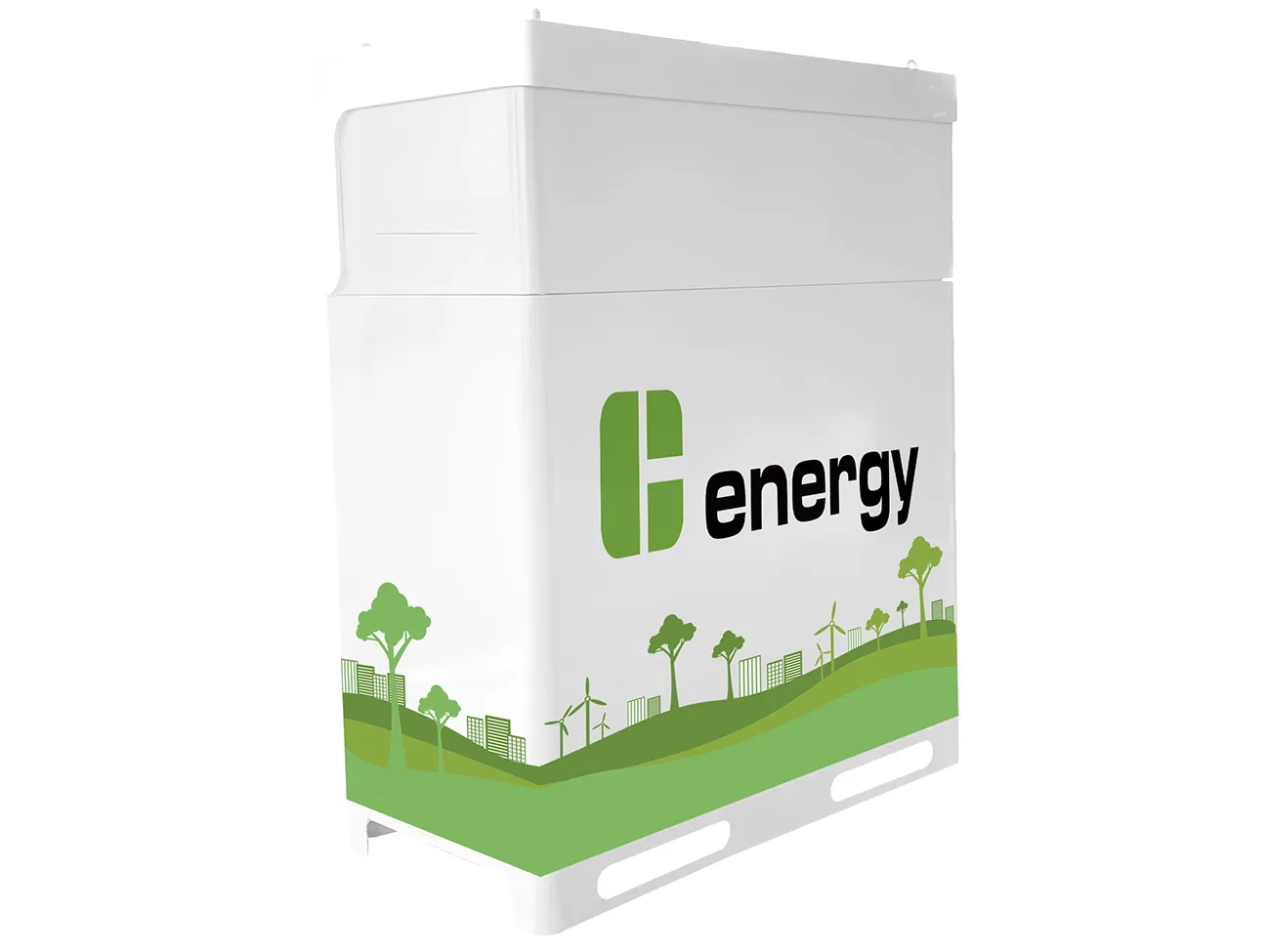
A Redox Flow battery consists of a stack, which determines the battery’s power (W), and an electrolyte reservoir, which determines its capacity (Wh). In this project, vanadium is the active component in the electrolyte.
As power and capacity are decoupled, this type of battery is particularly well suited to storing and supplying energy from renewable sources such as wind farms and solar parks. It also offers considerable benefits in industrial applications.
A solar installation, for example, typically generates a large amount of solar energy over 4 full-load hours per day, often during periods of lowest energy consumption, and charges the battery. The battery is then discharged during peak demand periods. The same applies to wind farms: energy is stored when the wind is strong and released when it is weaker.
Balancing the grid
This optimal distribution of storage and supply plays a crucial role in making energy management more sustainable by helping to stabilise the grid. RFB technology offers design flexibility in how power and capacity are configured, making users less dependent on imbalances between renewable electricity generation and electricity consumption. As we seek to increase renewable energy generation, and this generation does not always coincide with consumption, investing in storage is important. This type of storage is also exceptionally future-proof: if more capacity is needed, it can be scaled up by making more electrolyte fluid available.
Economic, environmental and safety benefits
RFB technology is fully complementary to lithium-ion batteries, but offers several important advantages. The cost per cycle is significantly lower than for lithium-ion batteries, and RFBs offer a longer lifespan of up to 25 years. They also offer considerable environmental benefits. Redox Flow batteries are easier to recycle, and their long-term supply of raw materials is secure, as the base material is more abundant in the Earth’s crust than lithium. Redox Flow batteries also have the safety advantage of no fire risk. One challenge, however, is that an RFB installation requires more space, depending on the application.
With this partnership, C-energy and Cordeel Group are once again demonstrating their commitment to their mission: ‘Building a passionate CO2-free future’. This project, including the planned in-house assembly of the batteries and continued, substantial investment in R&D over the long term, underlines their ambition to contribute actively to the energy transition as a European player. The group also aims to use logistics centres as energy hubs in the future, and to offer an end-to-end approach to building a sustainable cradle-to-cradle future.
Minister for Energy Tinne Van der Straeten: “Electricity storage is a key element of Belgium’s energy strategy. With our ambition to quadruple our offshore wind capacity in the North Sea by 2040, we will need flexible capacity, such as batteries, to balance the grid and compensate for fluctuations in wind and solar power.
Renewable energy benefits everyone: our wallets and the planet. But it is also an opportunity to create jobs and a major asset for Belgium’s influence abroad through innovation and expertise.”
Question about this story? Ask your question
Companies in this story

Keep following this
Get an email when a new story is published. No account needed.
- SubjectNews
- CompanyNiko







