











Flemish homebuilders plan ahead: almost everyone is already building to BEN standards!

From next year, all new buildings in Flanders must be BEN (nearly zero-energy) and therefore have an E-level of no more than 30. Since 2012, BEN has been the Flemish implementation of the European Energy Performance of Buildings Directive, issued in 2010. But are we meeting the requirements of that directive, judging by the EPB performance of Flanders’ new-build stock? The short answer is yes. Flemish people have been building to a higher standard than the Flemish EPB requirements for years. What is more, the latest EPB figures report, discussed by Minister Zual Demir on the opening day of Batibouw2020, shows that the construction sector has been ahead of the European target for several years, and that almost everyone in Flanders is already building to BEN standards.
Minister Zual Demir announces findings of latest EPB figures report:
EPB regulations setting out the energy requirements for new homes and permitted renovations have been in force in Flanders since 2006. These statutory requirements, expressed as an E-level, have been tightened gradually over the years. For example, in 2016 the E-level of new homes could be no higher than E50. Since 2018, the requirement has been a maximum of E40, and this year it is E35. The BEN standard, with an E-level of 30, only becomes mandatory from 2021.

But what does the latest EPB figures report, ‘2006-2020’, show? The average E-level of completed homes in Flanders has been better each year than the requirement for that year. What is more, almost all new-build homes in Flanders and many apartments already perform better than E30, one of the key requirements for a home to qualify as BEN.
6 requirements for BEN
BEN is the Flemish implementation of the European Energy Performance of Buildings Directive, or EPBD. It defines a “nearly zero-energy building” as a “building that has a very high energy performance. The nearly zero or very low amount of energy required should be covered to a very significant extent by energy from renewable sources, including energy produced on-site or nearby from renewable sources.”
In Flanders, a new home or apartment is classed as BEN if it meets 6 requirements:
- the E-level is E30 or lower,
- the S-level is S31 or lower,
- each building component meets a specific maximum U-value requirement,
- the overheating indicator is below 6,500 Kh,
- the home has ventilation provisions as set out in Annex IX of the Energy Decree of 19 November 2010,
- most of the energy comes from a renewable energy system that meets specified qualitative and quantitative requirements.
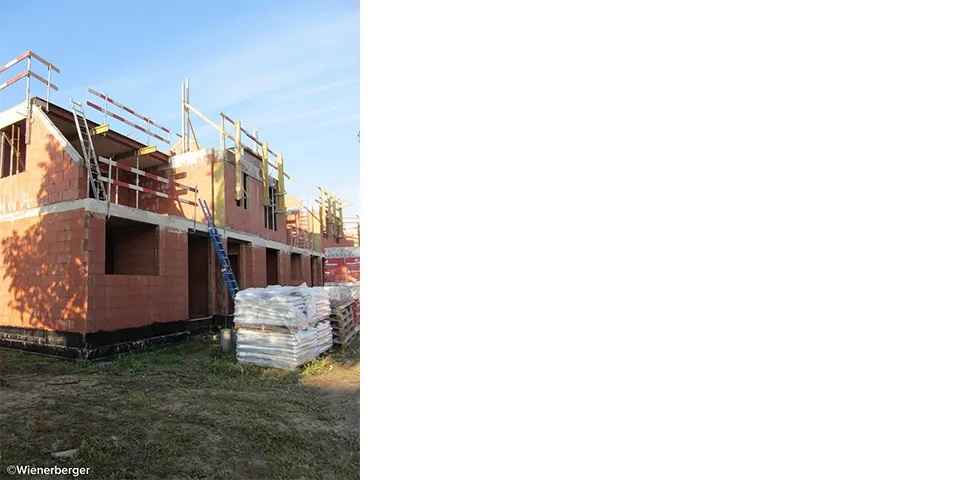
Everyone building to BEN standards!
To explain clearly what building to BEN standards means in practice, and to show that many building solutions are already available to make BEN construction achievable and affordable, several market leaders in Flanders’ renovation sector joined forces in 2014 to launch the website www.IedereenBEN.be.
At www.iedereenBEN.be, coach BEN guides prospective homebuilders through the 5 steps they need to take to make a home BEN. . These cover everything from ‘roof and floor’ to ‘external walls’, ‘glass, windows and doors’, ‘ventilation’ and ‘heating and renewable energy’, as well as ‘airtightness’. Each step provides a clear overview of the statutory requirements, possible solutions, distributors, financing tips and more.
With almost 50,000 visitors from Flanders a year, more visitors than there are planning applications in Flanders, www.IedereenBEN.be has become the most visited website about building to BEN standards.
Better than BEN since 2016
New single-family homes for which planning applications were submitted in 2016 now achieve an average E-level of E28. That is a full 22 E-level points better than the statutory requirement for applications submitted in 2016, namely E50, and 2 E-level points better than BEN (E30). Since 2006, a total of 16,930 BEN homes have been built, an increase of almost 50% compared with last year (11,500).
And progress is rapid. For building permits applied for in 2018, for which the first final EPB declarations are now being submitted, homes already achieve an average E-level of E19, while the requirement is still E40. There is also a clear trend towards lower E-levels in apartment construction. The average E-level remains higher than for single-family homes, but is also falling, reaching an average of E34 for applications submitted in 2017.
Flemish Brabant (average E-level E15), Antwerp (E14) and Limburg (E19) are top of the EveryoneBEN class. Average E-levels are slightly higher in East Flanders (E26) and West Flanders (E26).
Historically, apartments have performed less impressively than single-family homes, but here too there has been a sharp fall in E-levels, towards an average of E36. Almost 1 in 4 apartments is BEN (23% of applications submitted in 2016).
www.IedereenBen.be was developed in collaboration with AXA Bank, Deceuninck, ISOVER, Recticel Insulation, Renson, Soudal, Viessmann and Wienerberger. As pioneers, they are joining the Flemish Energy Agency in promoting the benefits and principles of nearly zero-energy building to prospective homebuilders.
Question about this story? Ask your question
Companies in this story


Keep following this
Get an email when a new story is published. No account needed.
- SubjectNews
- CompanySoudal
- CompanyViessmann







