











Finding new employees a problem for 8 in 10 construction and building services companies

Finding suitable employees is a very serious problem for 51% of construction and building services companies, and a serious problem for 29%, according to research by construction federation Embuild. Around 14,000 vacancies are currently open in the sector, and this has been a structural problem for years. Construction companies are mainly looking for traditional profiles: construction workers and site managers. “What is problematic is that 1/5th of companies are limiting the number of tenders they submit because of this shortage,” says Niko Demeester, CEO of Embuild. “It is therefore high time to restore the reputation of construction education and focus labour market policy even more on activation, training and retraining.”
There are currently 14,000 vacancies in Belgium’s construction and building services sector. The figures below clearly show that construction faces a structural problem. The sector has long struggled to find staff.
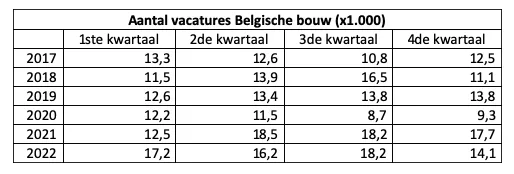
Finding staff is a very serious problem for 51% of construction and building services companies, while 29% consider it a serious problem. Just 4% of companies have no difficulty with it, according to an Embuild survey of 200 companies in the sector. Some 37% of companies are looking for construction workers, 19% for site managers, 11% for senior construction technical profiles (estimators, draughtspeople, planners, logistics managers, etc.), 7% for construction workers on energy renovation projects and 5% for profiles involving the use of new technologies in construction (BIM engineers, 3D specialists, drone pilots, etc.). The sector is in the midst of a transition and becoming increasingly technology-driven, which is also reflected in the profiles it needs.
Construction and building services companies are initially trying to make up for the staff shortage by subcontracting work to Belgian companies (24%) or foreign companies (20%). More worrying is that 21% are limiting the number of tenders they submit because they will not be able to complete the work due to a staff shortage, while 17% are starting projects later. “If they had more workers available, this would not happen. In other words, labour market shortages mean that construction work is carried out later or not at all,” says Niko Demeester, managing director of Embuild.
The construction federation therefore wants to increase the number of people entering the sector. The number of pupils in the second and third stages of full-time construction education fell by 12% between the 2016-2017 and 2021-2022 school years. “That is why we need to highlight the advantages of construction much more: the work is varied and increasingly technology-driven, cleaner and less physically demanding. In addition, construction workers are the best paid after those in the chemical industry, and enjoy many social benefits,” says Embuild’s chief executive.
The construction federation is currently running a ten-year image campaign with all the sector’s social partners to modernise perceptions of construction. Under the name ‘De Bouw Kijkt Verder’, the sector is specifically targeting young people. This summer, for example, we will be present at a number of festivals (Couleur Café, Suikerrock, Les Ardentes, etc.). Embuild Vlaanderen, Embuild.Brussels and Embuild Wallonie are also each running recruitment campaigns. To address the staff shortage, the construction sector is also making greater use of automation and digitalisation, boosting productivity and enabling more construction work to be completed with the available workforce.
Embuild says the government also has an important role to play. Everyone who is able to work should be strongly encouraged to do so. Some steps are already being taken, but Embuild believes there is room for improvement. It cannot be right that many sectors, including construction, face a serious staff shortage while a pool of available talent remains largely untapped. Activation, training and retraining should be at the heart of labour market policy. Construction companies are already making considerable efforts in this area, and it is important for public authorities to encourage inactive people to work.
Question about this story? Ask your question
Companies in this story

Keep following this
Get an email when a new story is published. No account needed.
- SubjectNews
- CompanyNiko







